
Demand for play cafés keeps rising because modern families want “one trip, two outcomes”: parents get a comfortable café experience while children play in a controlled indoor environment. But the location decision is where many projects either protect ROI—or silently lock in operational friction that shows up every weekend.
A good site is not just “busy.” It matches your target family demographic, allows fast drop-off and parking, and supports clear sightlines, safe circulation, and code-ready exits. In other words, location affects revenue, staffing load, safety management, and how quickly you can open.
This guide provides a practical play café location checklist—covering catchment area, footfall, parking and access, competitor density, rent-to-revenue targets, and landlord requirements. It also shows how to validate assumptions before you sign the lease, and how to connect location data to your layout and equipment plan.
A strong play café location combines a family-heavy catchment (10–15 minutes travel), reliable weekend footfall, easy parking/drop-off, and lease terms that keep total occupancy cost typically within ~10–15% of projected gross revenue. Confirm visibility, competitor overlap, egress/code constraints, and landlord requirements before finalising your layout and equipment plan.
What catchment area and demographics actually work for a play café?
The most common mistake is judging a site by “busy streets” or cheap rent without checking whether the traffic is made of your customers. A play café needs family decision-makers, repeat visits, and predictable peak patterns—so the wrong catchment can look promising on a weekday tour and still underperform on weekends.
A workable catchment is usually a family-dense area within 10–15 minutes travel time, with enough households that have young children to support repeat visits and party demand—while staying accessible for prams, car seats, and quick stops.
A manufacturer-and-operator lens starts with who will use the space, how often, and how they arrive. For many play cafés, your core audience is typically parents/caregivers with children roughly 1–8 years old, with heavier weekday reliance on toddlers and heavier weekend reliance on mixed-age families. Instead of guessing, map a primary catchment (often a 3–5 km radius in urban areas or a 10–15 minute drive-time ring in suburban areas) and a secondary catchment (often up to 20–25 minutes drive for parties and special visits). Then pressure-test the site against practical constraints: peak-hour parking, stroller access, and whether nearby anchors (grocery, kids’ services, gyms, community centres) naturally generate “family errands” traffic.
From a build perspective, demographics also shape zoning. A younger catchment pushes you toward more toddler and soft play, calmer circulation, and more parent seating with clear supervision lines. A slightly older catchment can justify higher-energy structures, more vertical elements (subject to ceiling height), and stronger party-room demand. If you want a broader view of how customer profile links to play zoning and business model, use the Play Café guide and solution page as a reference point for planning assumptions.
To make the decision measurable, set three “go/no-go” demographic checks you can validate quickly:
- Family density: a visible concentration of family housing, schools, clinics, and kid-oriented services within your primary catchment.
- Income fit: pricing tolerance for café spend + play admission + parties (often reflected by surrounding retail mix).
- Routine alignment: weekday vs weekend patterns (e.g., school drop-off routes and weekend shopping corridors).
How do you estimate footfall and visibility without guessing?
Many operators rely on what a broker says about “good traffic,” but play cafés are sensitive to time-of-day and weekend demand. If your footfall is commuter-heavy or tourist-heavy, it may not convert to family visits or parties—and you may overbuild staffing for the wrong peaks.
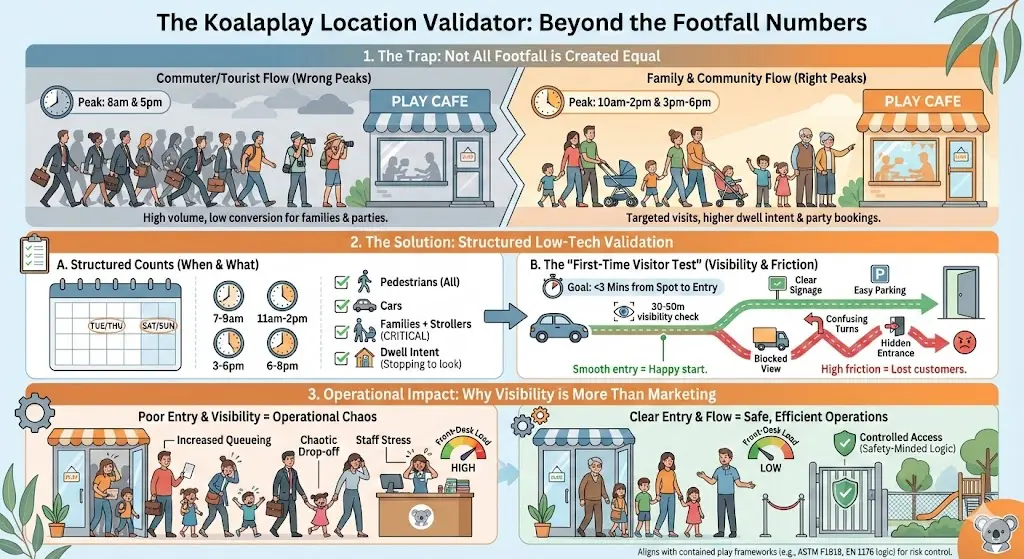
Estimate footfall by counting at the exact times families would come (weekends + after-school), and validate visibility using a “first-time visitor test”: can a parent spot the entrance, park, and enter within 2–3 minutes without confusion?
A practical, low-tech validation method works surprisingly well and costs little compared to a lease mistake. Do a structured observation plan:
- Count windows: 2 weekdays (e.g., Tue/Thu) + 2 weekend days (Sat/Sun).
- Time blocks: 7–9am, 11am–2pm, 3–6pm, and 6–8pm.
- Metrics to record: pedestrians passing, cars passing, families with children, stroller/pram sightings, and “dwell intent” (people stopping to look in windows or signage).
- Entry friction notes: how many turns from main road, whether signage is blocked, and whether the storefront is visible from 30–50 m away.
Visibility is not only marketing—it impacts operations. A confusing entry creates queueing, increases front-desk load, and makes drop-off chaotic. This matters even more when you’re planning safe circulation and controlled access to the play zone (especially if you design around standards-minded logic for contained play and risk control). For indoor soft play environments, many projects reference frameworks such as EN 1176 and ASTM F1918 for safety-minded design and contained play considerations (market-dependent).
Use a simple scorecard to compare locations consistently:
| Factor | What to check on-site | Target signal (typical) | Risk if weak |
|---|---|---|---|
| Weekend family footfall | Count families with kids per hour | Consistent uplift vs weekdays | Parties + weekends underperform |
| Storefront visibility | Can you see entrance/sign from 30–50 m? | Clear line-of-sight | Higher CAC + confused arrivals |
| “Errand adjacency” | Neighbours: grocery, clinic, kids classes | 2–4 family anchors nearby | Lower repeat visitation |
| Queue space | Lobby/entry can hold 6–12 people | Space to avoid blocking doors | Safety + experience issues |
| Competitor overlap | Similar venues within 10–15 min | Differentiated positioning | Price pressure + churn |
What parking and access plan reduces drop-off friction?
A play café can have strong demand and still lose sales if arrival feels difficult. Parents optimise for convenience: quick parking, easy stroller access, and minimal conflict at the entrance. If parking is tight or confusing, you’ll see shorter visits, more complaints, and lower party conversion.
Plan parking around peak family arrival patterns (weekends + after-school), then design for a clear drop-off path, barrier-free access, and an entry flow that prevents congestion at doors and reception.
Treat parking and access as an operational system, not just a site feature. Your peak is usually concentrated—often weekend late morning through early afternoon and weekday after-school windows—so “average” parking conditions are not enough. If you are in a retail centre, request landlord data on peak occupancy times, shared-parking rules, and any enforcement policies. If you are street-front, test real availability by timing how long it takes to find a space during your target peak windows.
A widely used professional resource for estimating parking demand by land use is ITE’s Parking Generation, but many play cafés will still need local observation because your mix (café seating + play admission + parties) can behave differently from standard categories. A practical approach is to model two scenarios:
1) Walk-in peak: short stays, high turnover (e.g., 60–120 minutes).
2) Party peak: longer stays, clustered arrivals (e.g., 90–180 minutes).
Then make sure the site can handle both without creating unsafe crowding at the entrance. This is also where landlord restrictions matter: some leases limit signage, outdoor queuing, or changes to entrances—so confirm early.
Use the checklist below to connect access conditions to design and staffing:
| Access item | What “good” looks like | Typical mitigation if weak |
|---|---|---|
| Pram/stroller route | Step-free path from parking to entry | Add ramp/handrails (if permitted), relocate entry |
| Drop-off zone | Short-stop area without blocking traffic | Timed party arrivals + signage + staff guidance |
| Door + lobby capacity | Space for 6–12 people without blocking egress | Rework entry layout, add queuing rails |
| Car seat handling | Space to unload safely | Prefer wider bays / nearby bays |
| Public transport walk | Safe crossing + short distance | Add wayfinding, partner with nearby parking |
If your project also depends on mall footfall and shared parking logic, it helps to study comparable models like Top 10 Profitable Mall Indoor Playground Models (2026) and adapt the access assumptions to your own format.
How should you test rent, landlord terms, and competitor density before signing?
Operators often focus on base rent and ignore the rest of the occupancy cost chain: CAM/service charges, property tax, insurance requirements, fit-out rules, and opening constraints. Those “hidden” lease conditions can delay launch, increase build cost, and limit what you can operate.
Use a rent-to-revenue model (including CAM and charges), verify competitor density within a realistic drive-time ring, and confirm landlord requirements that affect build scope, approvals, signage, hours, and safety/egress responsibilities.
A disciplined location decision treats lease terms like part of your equipment bill—because they change the real cost of opening. Start with a simple financial guardrail: many operators aim to keep total occupancy cost (base rent + CAM/service charges + mandatory fees) in the range of ~10–15% of projected gross revenue, adjusting for market realities and concept strength. Then run sensitivity: what happens if revenue lands 20% below plan for the first 3–6 months? A location that looks fine on paper can become stressful if occupancy costs are inflexible.
Competitor density should be assessed by substitution risk, not just counting venues. A trampoline park 20 minutes away may not be your direct competitor; a small play café with party rooms 8 minutes away often is. Map competitors within a 10–15 minute ring and note:
- age focus (toddler-heavy vs mixed-age)
- party capacity and booking strength
- price positioning and membership offers
- café quality (some win on food, not play)
Landlord requirements are where build timelines can slip. Ask for written confirmation on:
- permitted use (play café / indoor play / family entertainment)
- maximum occupancy and any assembly-related constraints
- egress path requirements and door hardware rules (your local code authority decides, but you need to know what the landlord expects)
- sprinkler/fire alarm status and responsibilities
- restrictions on penetrations, hanging loads, and floor anchoring
Codes and standards are not “paperwork afterthoughts”—they affect layout, exits, and how you control access. Many jurisdictions reference building/fire codes for means of egress, and assembly-type occupancies can trigger specific requirements. If your play structure design references EN 1176 and/or ASTM F1918 logic, documentation support can help your local review process—but Final compliance depends on local regulations and the authority having jurisdiction.
Use this lease-and-risk checklist to stay systematic:
| Topic | Questions to ask | Why it matters to play cafés |
|---|---|---|
| Total occupancy cost | Rent + CAM + fees = % of projected revenue? | Protects ROI and cashflow |
| Fit-out approvals | Who approves drawings, and how long (typ. 2–6 weeks)? | Delays postpone opening revenue |
| Fire/life safety scope | Sprinklers, alarms, exits—who pays and who manages? | Impacts design + inspection readiness |
| Use clause | Is “indoor play + café” explicitly permitted? | Avoids disputes after investment |
| Signage rights | What size/placement is allowed? | Visibility drives first-time visits |
| Hours + noise | Any limits on parties, music, peak times? | Direct impact on revenue model |
When you want a broader view of how costs, timeline, and operational model connect, it’s worth reading 200 sqm Play Cafe Investment Cost Guide alongside The Complete Guide to Play Cafes: Concept, Business Model, and Future Trends—then bring that logic back to your lease negotiation.
Conclusion
A play café site decision is a chain: catchment and demographics determine demand quality, footfall validation reduces guesswork, parking/access protects conversion and repeat visits, and lease terms control whether your ROI survives the first year. Build your checklist around what you can measure on-site—especially weekend family traffic, entry friction, and true occupancy cost—then confirm landlord constraints before design is finalised.
If you want a practical next step, share your floor plan (or agent brochure) plus ceiling height, column positions, and entrances/exits. We can suggest a basic zoning approach and the key site risks to resolve early—or you can request a budget checklist/BOM-style template to structure your planning.
FAQ About Site selection for Play Cafe
1) What is the best catchment radius for a play café?
Most play cafés perform best when the primary catchment is within 10–15 minutes travel time (often ~3–5 km in dense cities, larger in suburbs). A secondary catchment can extend to 20–25 minutes for birthday parties and special visits. Use drive-time mapping plus on-site checks (school routes, weekend shopping patterns) to confirm the area supports repeat family visits.
2) How can I estimate footfall for a play café before signing a lease?
Do structured counts instead of relying on “busy area” claims. Visit 2 weekdays + 2 weekend days, and count traffic in 7–9am, 11am–2pm, 3–6pm, 6–8pm blocks. Record families with kids, stroller sightings, dwell intent, and how many people pass without noticing the storefront. Compare weekend vs weekday lift—play cafés usually need strong weekend family demand.
3) How important is storefront visibility for a play café?
Visibility is a revenue and operations factor. If first-time visitors can’t spot the entrance quickly, you get more calls, confused arrivals, and queueing at the door—especially during party check-ins. A practical test: can a parent find the entrance, park, and enter within 2–3 minutes without asking for directions? If not, budget for stronger signage (if allowed) and clearer wayfinding.
4) What parking setup is considered “enough” for a play café?
There’s no universal number because visit length and party clustering change demand. A safer approach is to model two peaks: walk-in peak (60–120 minutes stays) and party peak (90–180 minutes stays with clustered arrivals). Test real availability during weekend peaks and confirm rules for shared parking, validation, or enforcement. If parking is limited, plan timed party arrivals and clear drop-off flow to reduce congestion.
5) Should I choose a mall location or a street-front location?
Both can work, but the risk profile differs. Malls often provide built-in family footfall and parking, but may add stricter landlord requirements, higher CAM fees, signage limits, and longer approval cycles. Street-front sites can offer stronger brand control and simpler navigation, but you must validate weekend family traffic and parking convenience more carefully.
6) How do I evaluate competitor density for a play café?
Count competitors within a 10–15 minute drive-time ring, then measure substitution risk, not just the number of venues. Compare: target age focus (toddler vs mixed-age), party capacity, pricing/memberships, café quality, and booking strength. A nearby venue with similar party rooms and pricing is usually more competitive than a larger attraction farther away.
7) What is a reasonable rent-to-revenue ratio for a play café?
A common planning guardrail is keeping total occupancy cost (base rent + CAM/service charges + mandatory fees) at roughly 10–15% of projected gross revenue, adjusted for your market and concept strength. Always run sensitivity: if revenue is 20% lower for the first 3–6 months, can you still operate comfortably? If not, the lease is likely too tight.
8) What landlord requirements matter most for play café build and operations?
Ask for written confirmation on: permitted use (“play café/indoor play”), fit-out approval process and timeline (often 2–6 weeks), responsibilities for sprinkler/fire alarm work, restrictions on anchoring/hanging loads, signage rights, operating hours, and party/noise rules. These items directly affect layout feasibility, build cost, opening speed, and long-term operations.
9) What site features create layout problems for indoor play cafés?
Common constraints include low ceiling height, columns in high-traffic zones, narrow entrances, limited egress options, and awkward restroom placement. Also check floor loading assumptions (especially for dense structures), delivery access for installation crates, and whether you can create controlled entry/exit points for safe supervision and guest flow.
10) When should I finalise the layout and equipment plan relative to the lease?
Don’t “design later” if the lease is close to signature. Before committing, confirm the site can support your core zones, circulation, and code-ready exits. Ideally, complete a preliminary zoning plan and confirm landlord constraints first; then proceed to engineering drawings after lease terms and scope responsibilities are clear. If you need a planning reference, link your checklist back to the Play Café guide and solution page to keep location decisions aligned with your concept and build path.
References
- ASTM International. (2021). ASTM F1918-21: Standard safety performance specification for soft contained play equipment. https://www.astm.org/f1918-21.html
- National Fire Protection Association. (2024). NFPA 101: Life Safety Code. https://www.nfpa.org/product/nfpa-101-life-safety-code/p0101code
- International Code Council. (2021). International Building Code: Chapter 10—Means of egress (overview). https://codes.iccsafe.org/content/IBC2021P2/chapter-10-means-of-egress
- Institution of Transportation Engineers. (n.d.). Parking Generation resources (overview). https://www.ite.org/technical-resources/topics/trip-and-parking-generation-v2/parking-generation-info1/
- Royal Society for the Prevention of Accidents. (n.d.). BS EN 1176 playground equipment standard (overview). https://www.rospa.com/play-safety/advice-and-information/en1176-playground-equipment-standard




 English
 Spanish
 German