
Play cafes have grown because modern family routines changed: parents want a place that feels like a real café, while children get safe, supervised play that isn’t weather-dependent. In many cities, the demand is strongest in toddler-to-early-elementary ages, where “playdate energy” and “parent downtime” need to happen in the same visit.
For operators, popularity isn’t just about cute décor. It shows up in measurable outcomes: repeat visits, membership adoption, controlled peak-hour flow, fewer safety incidents, and faster opening readiness because the layout and rules match how families actually behave.
This guide breaks down five popular play cafes in the USA, why they work, and what design ideas you can copy—especially if you’re planning a play cafe build, upgrading an existing café with a play area, or validating your concept before investing.
Which 5 popular play cafes ideas in the USA are good benchmarks?
Parents often assume any “café + play corner” will perform the same. In reality, the most popular venues behave more like controlled micro-attractions: they limit capacity, set clear rules, and design the play space around supervision, cleaning access, and age fit—so the experience stays consistent even on busy weekends.
A practical benchmark list is less about copying a brand name and more about copying the system behind the brand: time slots, zoning, circulation, and parent comfort.
Here are five USA benchmarks and what to learn from each.
| Venue (USA) | Why families return | Design idea to borrow | Operational signal |
|---|---|---|---|
| Twinkle Playspace (Brooklyn, NY) | Strong trust through rules (socks-only), clear age targeting | “Mini attraction” theming; photogenic sets | Reservations / time slots + passes |
| Peekaboo Playground (NJ/DE) | Parent-friendly environment + early childhood learning framing | Low-to-mid-height soft play with easy supervision | Multi-location repeatability |
| Just Kidding Play Cafe (Houston, TX) | Membership + classes create routine visits | Café-forward seating + controlled play flow | Membership and programming |
| The Littles Play Cafe (NY Capital Region) | Clean, modern “chill for parents” positioning | Minimalist, bright interior + open sightlines | Multi-site expansion template |
| Tiny Play Café (Columbia, MO) | Pretend-play “village” keeps kids engaged | Six role-play houses (grocery, vet, etc.) | Reserved sessions + cleaning resets |
From a supplier and design standpoint, these five examples are useful because they represent repeatable play-cafe mechanics. Notice that popularity is less about having the biggest structure and more about reducing friction in three places: (1) entry and capacity control, (2) parent comfort and supervision, and (3) predictable cleaning and maintenance.
A common pattern is age targeting. Venues that clearly focus on ages roughly 0–8/0–10 can design safer equipment heights, softer impact zones, and calmer circulation. That reduces conflicts between toddlers and older kids—one of the fastest ways to get negative reviews. When a venue says “for kids 6 and under,” it is not just marketing; it is a design constraint that shapes platform height, crawl tunnel dimensions, and the number of “fast movement” elements like slides.
A second pattern is repeat-visit economics. Many popular venues offer passes or memberships because the customer journey isn’t “one big day out,” it’s “weekly routine + birthday events.” If you’re building a play cafe, you should decide early whether you’re optimizing for walk-ins, bookings, memberships, or a blended model. That decision affects layout (check-in counter size, queue lanes), seating density, and how you separate café noise from active play.
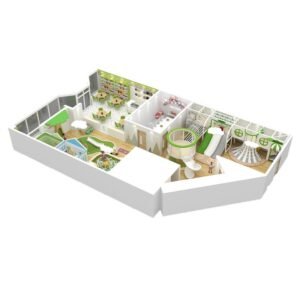
1) Twinkle Playspace (Brooklyn, NY)
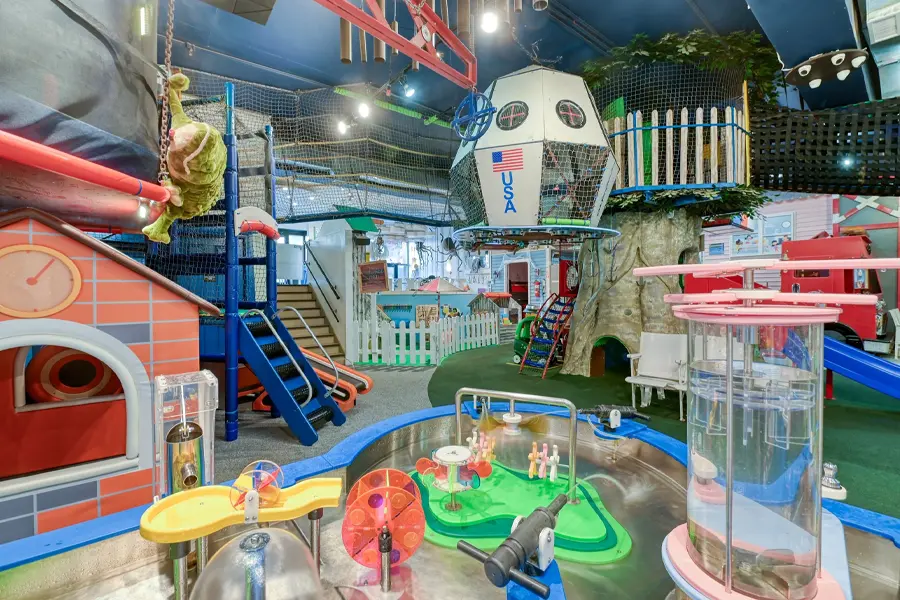
Design theme: “World-building + controlled entry = low-stress magic”
Why it’s popular (what parents are responding to)
Twinkle Playspace wins demand by being extremely clear about who it is for: young kids, 6 and under. That age cap, combined with advanced reservations and socks-only rules, reduces friction between toddlers and bigger kids—and improves the “this place feels clean” perception.
Another key popularity signal is longevity: being around for over 10 years builds trust in the parent community and makes the space feel like a “safe default option.” Add memberships and play passes, and the venue doesn’t rely purely on walk-ins.
Design ideas to copy
1) Build a mini attraction, not a corner playground
Twinkle’s “world-building” approach makes the space feel like a curated experience. Parents love it because it photographs well, and kids feel like they’re inside a tiny story.
2) Design your operations into your layout
The success here is not only aesthetic—it’s logistical. Controlled entry + session attendance keeps the play floor comfortable, which prevents the #1 play café problem: overcrowding stress.
What to copy in your layout
- A clear entry/check-in funnel before the play zone
- A visible “rules wall” (socks, age range, food policy)
- A play floor that supports session-based flow (easy reset points)
2) Peekaboo Playground (Medford, NJ / Bayville, NJ / Hockessin, DE)
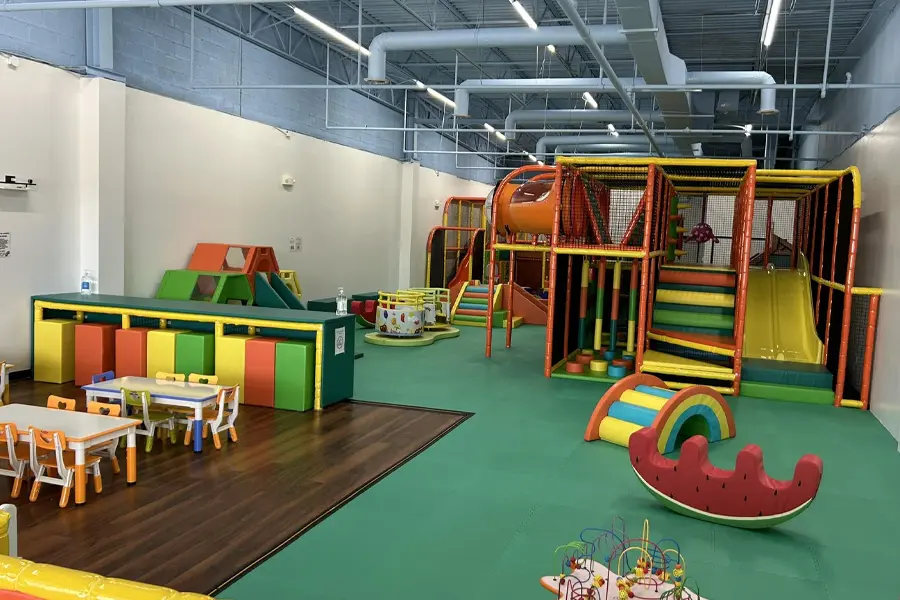
Design theme: “Early-childhood confidence building + sightline-first seating”
Why it’s popular
Peekaboo Playground is a strong example of “multi-location proof.” Multiple sites signal that the brand has found a repeatable formula—not just one good-looking venue.
Another reason parents trust it is founder credibility: a certified speech-language pathologist, positioning the venue around learning-through-play, which matches how parents justify spending.
Finally, Peekaboo doesn’t treat adults as an afterthought. It explicitly supports caregivers: work/relax + coffee while kids play.
Design ideas to copy
1) Keep play equipment low-to-mid height
Instead of big thrills, Peekaboo focuses on movement and confidence: swings, slides, tunnels, climbing structures designed for younger kids.
2) Reduce blind corners and design seating for supervision
This is one of the most important “copy this” layout principles in the whole list:
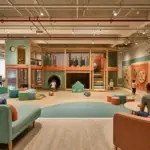
Parents feel safe and relaxed when they can see most play zones from their seat.
Layout formula worth copying
- Put the main play zone in the center
- Place seating around the perimeter
- Avoid tall partitions that break visibility
- Keep the most active features away from café traffic
3) Just Kidding Play Cafe (Houston, TX)
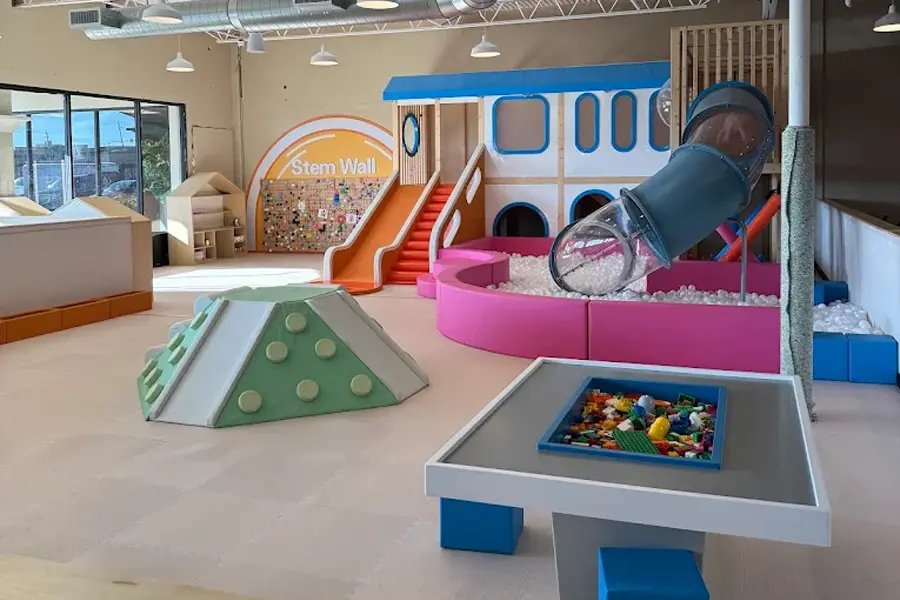
Design theme: “Café-forward experience + operational friction control”
Why it’s popular
Just Kidding Play Cafe wins parent confidence by being strict in the right way:
- No sick visitors
- No outside food
These rules sound simple, but they dramatically reduce conflict, mess, and hygiene complaints.
It also uses a clean, simple pricing ladder:
- Single pass
- Pass packs
- Monthly unlimited
This converts first-timers while building repeat customers.
The “community playground” framing is also smart. It creates shared responsibility and improves behaviour norms (which matters a lot in real-life operations).
Design ideas to copy
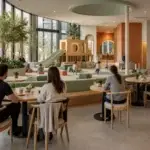
1) Build a real café atmosphere, not a snack counter
This is one of the biggest differences between “a play area inside a café” and a true play café business:
Adults judge the venue like a café, not a playground.
A café-forward look increases adult satisfaction, time spent, and higher spend per visit.
2) Separate café seating from the most active play path
This is an operational cue many new operators miss. If kids are constantly cutting through seating zones, adults can’t relax or work, and staff spend the day resolving small conflicts.
What to copy in your floorplan
- Create a buffer zone between play activity and seating
- Keep café seating in a low-traffic pocket
- Maintain open sightlines without forcing circulation through tables
4) The Littles Play Café (NY Capital Region: Latham / Delmar / Schenectady)

Design theme: “Calm, premium, scalable template”
Why it’s popular
This brand is another example of “repeatable expansion.” Multiple sites + consistent age targeting makes the experience predictable, which is what families love.
The caregiver value proposition is clear: “recharge while your child plays,” supported by a menu that’s not just coffee—bubble tea + small bites helps the venue appeal to a wider group.
Risk-control messaging is also consistent:
- Socks required
- Waiver
- Illness-free rule
These signals matter because parents mentally rank play cafés by safety and cleanliness.
Design ideas to copy
1) Use a calm modern interior language
Neutral colours, simple wall graphics, clean furniture: the space reads “premium and hygienic” on social media.
This style is popular because it looks good even when the venue is busy.
2) Build a scalable layout template
If you want multi-location potential, the model should be replicable:
- Standard zoning
- Standard rules
- Standard play mix ratios
This reduces redesign cost every time you open.
Scalable design principle
If your layout only works for one exact space, it’s not scalable.
A strong play café design should adapt to different footprints with minimal changes.
5) Tiny Play Café (Columbia, Missouri)
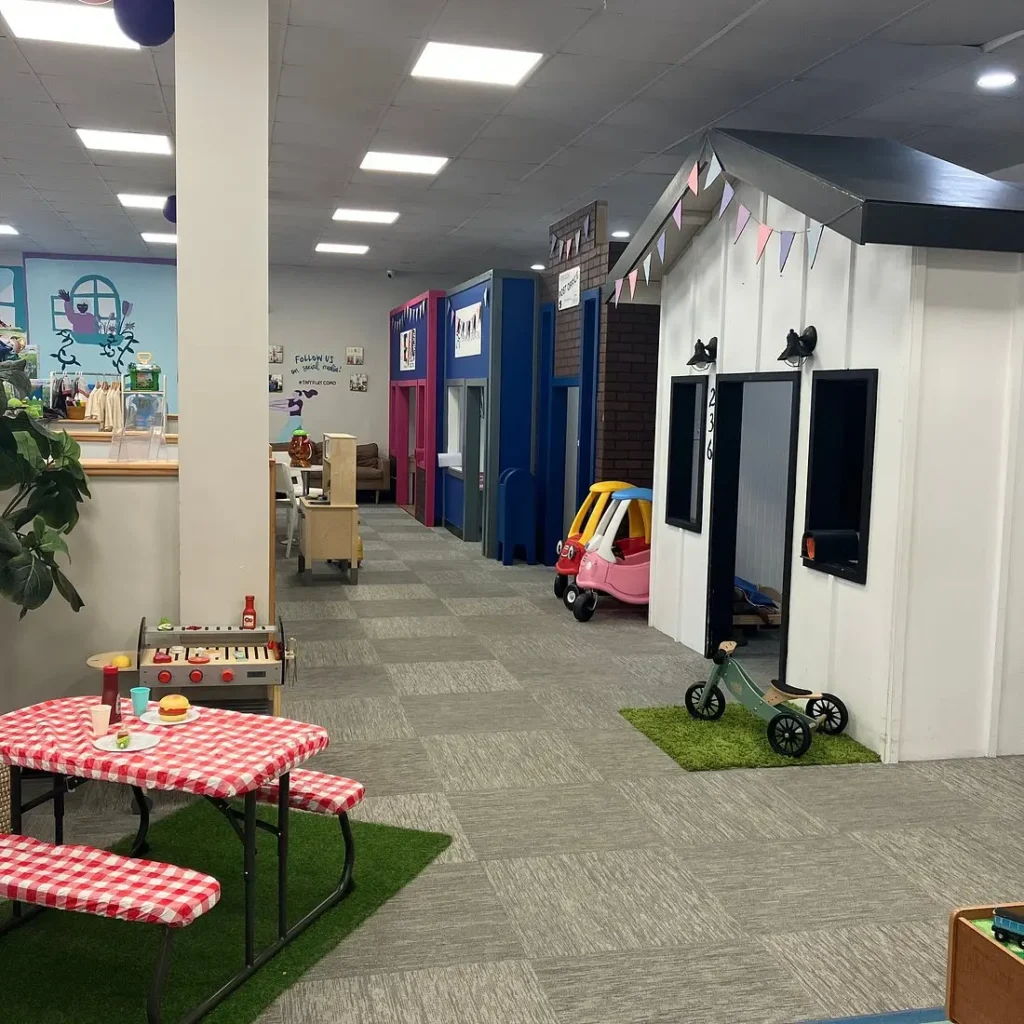
Design theme: “Role-play mini village + friction-free family amenities”
Why it’s popular
Tiny Play Café is highly specific and therefore very easy for parents to understand:
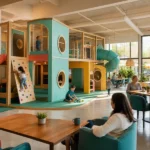
A playspace + full coffee shop for ages 0–9, featuring six child-sized role-play houses (grocery store, school, office, house, vet clinic, construction site).
It also runs capacity and cleaning like a system:
- 2-hour play sessions
- Disinfection between sessions
- Socks-only
- Clear check-in flow
That creates a predictable experience and protects reviews.
Family amenities reduce friction:
- Wheelchair accessibility
- Nursing/sensory break room
- Changing stations
These details directly increase the “we can stay longer” factor.
Design ideas to copy
1) Mini village role-play format = longer engagement
Role-play zones work because kids rotate through stations, instead of repeating one activity.
This reduces boredom and increases dwell time naturally.
2) Timed sessions + “soft reset” cues
Tiny Play Café uses dimming/announcements at the end of sessions to reset without feeling harsh.
That’s operationally smart: it trains parent behaviour, protects cleaning schedules, and reduces staff conflict.
Operational design cue
If you want session-based business, you must design:
- check-in flow
- session timing
- reset/cleaning access
directly into the layout.
The 5 Design Patterns That Show Up Again and Again
When you compare these 5 venues, the “popular play café formula” becomes very obvious:
1) Tight age targeting = fewer conflicts
Successful venues design for young kids first, then control access through rules.
2) Session and capacity control is a design choice, not a policy
Timed sessions work only when your space supports reset points, cleaning logic, and flow control.
3) Parent seating and sightlines are your retention engine
Parents return to the place that feels easy:
- comfortable seating
- clear visibility
- low stress
4) Calm, premium design sells cleanliness
Neutral, modern interiors photograph well and signal hygiene.
This is a marketing and trust advantage.
5) Role-play zones create “rotation value”
Mini village role-play is one of the strongest engagement drivers in family venues—especially for ages 2–7.
If you want to build the same “popular mechanics” into your own project, KoalaPlay’s end-to-end reference is here:
Play Café Design + Manufacturing Solution
How should you plan budget, safety, and delivery when copying these models?
Many new play cafe projects fail at the same point: the concept is attractive, but the build timeline slips and costs expand because the design isn’t frozen early, the site constraints aren’t measured properly, or the supplier scope is unclear (especially for overseas shipping and installation).
A benchmark venue can inspire you, but your execution needs a project chain that protects ROI.
Plan your play cafe like an integrated chain: site measurement → layout freeze → CAD/3D approval → manufacturing lead time → shipping/duties → installation method → inspection readiness → opening operations. Budget should include equipment, freight, local labour, permits, and a maintenance plan. Safety should be designed-in (risk points, materials, fire behaviour options).
It is a workflow with risk points. We recommend planning with realistic ranges and decision gates:
- Design + approval (typically 2–6 weeks): site measurements, zoning, circulation, 3D rendering approval. Delays often happen when ceiling height, columns, or exit paths are discovered late.
- Engineering package (typically 1–3 weeks): CAD drawings, part numbering, BOM logic, installation sequence. This reduces on-site labour uncertainty.
- Manufacturing + QC (typically 3–8+ weeks depending on complexity): material sourcing, finishing, pre-shipment checks.
- Shipping + customs (typically 2–8+ weeks depending on route/mode): packaging, documentation, freight, duties/taxes.
- Installation (typically 3–14 days depending on size and method): local crew with guided install vs professional install support.
A planning table helps you align expectations:
| Stage | Typical deliverables | Time range (often) | What to lock early |
|---|---|---|---|
| Site validation | Measurements, photos, constraint list | 3–10 days | Ceiling height, columns, exits, MEP |
| Layout + 3D approval | Zoning plan, circulation, theme direction | 2–6 weeks | Age zoning + parent sightlines |
| CAD + engineering | CAD set, part numbering, install logic | 1–3 weeks | Interfaces with walls/floors |
| Manufacturing + QC | Material control, packaging plan, inspection | 3–8+ weeks | Materials, finishes, key risks |
| Shipping + import | Packing list, labels, freight plan | 2–8+ weeks | Incoterms, delivery window |
| Installation + handover | Tightening checks, net tensioning, visual checks | 3–14 days | Crew plan + tools + access |
If you want a cost anchor for planning, use our 200 sqm play cafe investment cost guide as a baseline framework and adjust by your market, rent level, and local labour rates. For broader planning context on demand and concept direction, our play cafe trends overview can help you choose a model that matches your local customer behaviour.
Conclusion
Popular play cafes in the USA are popular because they are engineered for repeatability: age-targeted play, comfortable adult seating, simple rules that protect cleanliness, and capacity control that prevents weekend chaos. The strongest design ideas are not complicated—they are practical: clear sightlines, separated café flow, and themed micro-zones (especially pretend-play houses) that keep children rotating activities longer. If you’re planning a new venue, treat budget and timeline as one chain, and freeze the layout early to avoid rework.
If you’d like, share your floor plan and ceiling height, and we can give a basic zoning suggestion (toddler vs main play vs café seating). Or request a simple budget checklist / BOM template to structure your investment planning.
References
ASTM International. (2022). ASTM F1918—Standard Safety Performance Specification for Soft Contained Play Equipment. https://www.astm.org/f1918.html
CPSC. (2023). Public Playground Safety Handbook (Pub. No. 325). U.S. Consumer Product Safety Commission. https://www.cpsc.gov/s3fs-public/325.pdf
European Committee for Standardization. (2017). EN 1176 (Playground equipment and surfacing). https://standards.iteh.ai/catalog/standards/cen/8d4df2c1-0a1d-4f0f-9b1f-2db6fcbf3a1e/en-1176-1-2017
NFPA. (2024). NFPA 101: Life Safety Code. National Fire Protection Association. https://www.nfpa.org/codes-and-standards/all-codes-and-standards/list-of-codes-and-standards/detail?code=101
CDC. (2024). Handwashing: Clean Hands Save Lives. Centers for Disease Control and Prevention. https://www.cdc.gov/cleanhands/index.html

 English
 Spanish
 German