
Modern family venues—from indoor playgrounds to play cafés—exist because parents want a safe, controlled place where kids can move, explore, and socialise while adults can supervise comfortably. The challenge is that “safe and fun” changes quickly as children grow: a feature that builds confidence for a 2-year-old may bore a 7-year-old, while a school-age obstacle can overwhelm a toddler.
For operators and developers, age-appropriate playground equipment is not just a design preference. It directly affects injury risk, class/group management (schools and daycares), throughput at peak hours, cleaning workload, and how long children stay engaged. The wrong age mix usually leads to either constant supervision pressure or customer complaints that the play is “too easy” or “too scary.”
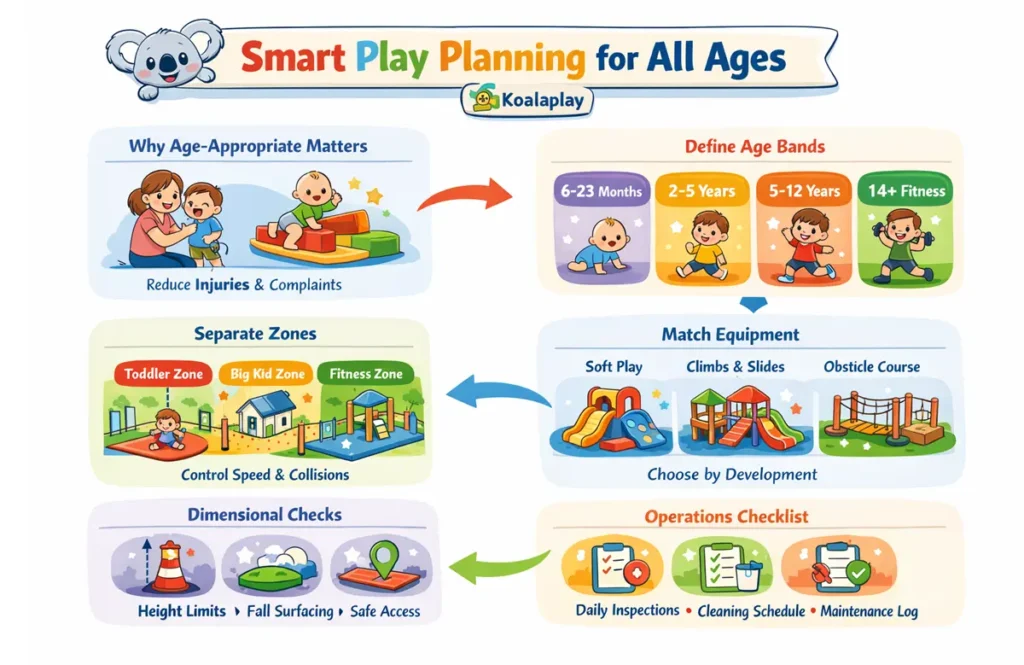
This guide shows how to define age bands, separate zones, select equipment by developmental stage, verify dimensional limits (height, fall risk, access), and set inspection routines that protect ROI and daily operations.
Choose age-appropriate playground equipment by defining clear age bands (commonly 6–23 months, 2–5 years, 5–12 years, and optional 14+ fitness), separating zones to control speed and collisions, and matching each zone’s height, access, and challenge level to children’s motor and social development. Confirm surfacing, accessibility, and maintenance requirements before purchase.
Why is selecting age-appropriate playground equipment important?
Many projects focus on how equipment looks in a concept render, but the real risk appears after opening: children struggle to use features that don’t match their size or skills, parents feel unsafe, and staff spend the day “managing problems” instead of running smooth sessions. The outcome is predictable—more incidents, shorter visits, and weaker repeat rates.
Age-appropriate equipment keeps play safe and enjoyable by aligning height, access, and challenge to children’s physical and cognitive development. It reduces frustration for younger kids, avoids boredom for older kids, improves supervision efficiency, and supports better social play—especially when different age groups share one venue.
From a manufacturer and buyer-evaluation perspective, age-appropriateness is best treated as risk control + engagement control:
- Minimise frustration: If a child can’t climb onto a platform, reach a handle, or sit safely, they stop playing or act unpredictably. That raises supervision load and reduces perceived value.
- Avoid boredom: If older kids “finish” the play structure in 2 minutes, they either leave early or use equipment in unintended ways (jumping, climbing outside nets, crowding one feature).
- Control collisions: Younger children have slower reaction times and less spatial awareness. Mixing toddlers with fast-moving preschoolers or school-age kids increases collision risk unless separation and circulation are designed carefully.
- Support social development: Toddlers often play side-by-side and explore sensory inputs. Preschool and school-age kids increasingly want cooperative and imaginative play. Equipment should offer both solo and group play opportunities, matched to the age zone.
- Protect operational efficiency: The right zoning reduces staff interventions and simplifies cleaning routines (high-touch props, ball areas, soft blocks), which matters for play cafés and family centres.
- Promote accessibility and inclusivity: Accessible routes, transfer points, and usable play events expand who can participate. This is especially important in public projects and in venues that serve diverse families.
A practical business rule is to link your age strategy to supervision reality. If your venue expects one staff member per zone at peak, you should avoid “mixed-age everything” layouts that require constant conflict management. If your concept includes group visits (schools, daycare classes, parties), separation becomes even more valuable because it keeps children together and supervision predictable.
What are the typical age groups, and how should you separate zones?
Buyers often ask for a single “all kids” structure to save space, but mixed-age play can increase supervision burden and incident probability. A better approach is to plan zones around development stages and speed differences, then decide whether you want 2 zones (simpler) or 3 zones (more controlled).
Common playground equipment age bands are 6–23 months, 2–5 years, 5–12 years, plus optional 14+ fitness equipment. If you serve multiple ages, create separate zones—at minimum toddlers vs. older children—to reduce collisions, keep challenge appropriate, and make supervision easier for schools, daycares, and families.
Most commercial indoor projects use one of these layouts:
| Venue constraint | Recommended zoning | Why it works operationally |
|---|---|---|
| Limited space (often <200–300 sqm play area) | 2 zones: Toddlers (6–23 months / up to ~2–3) + Mixed 2–10/12 | Lower build complexity; still controls the highest-risk mixing (toddlers vs fast movers) |
| Medium space (often 300–800+ sqm) | 3 zones: 6–23 months, 2–5, 5–12 | Better separation of speed + challenge; easier to market sessions/classes |
| Family entertainment with teens | 3 zones + 14+ fitness area (separate) | Keeps teen fitness hardware away from younger children |
For schools and daycares, separation has an extra benefit: classes already group children by age. When zones mirror those age groups, teachers can keep headcounts stable and maintain consistent supervision. This is one reason many childcare projects choose distinct toddler and preschool areas even when the overall footprint is small.
Key design details that make separation work:
- Physical boundaries: low walls, soft barriers, net lines, or gates that clearly indicate “this area is for toddlers.”
- Sightlines: caregivers should see key entrances/exits and major play events from typical standing or seated positions.
- Speed management: avoid forcing toddlers to cross a high-speed circulation route to reach toilets or parent seating.
- Entry control: a single controlled entrance to the toddler zone reduces accidental mixing.
If your venue includes a café and parent seating, zoning should also support calmer supervision. Many operators design toddler zones adjacent to seating so parents can supervise with minimal movement, while school-age zones can be deeper in the play footprint. For play café layouts, the zoning logic is closely tied to “safe, fun zones” and parent comfort planning (see How a Play Cafe Supplier Helps You Create Safe, Fun Zones).
Compliance note (one-time): Final compliance depends on local regulations and the authority having jurisdiction.
What equipment and dimensional limits fit each age group?
A common misconception is that you can make one structure “age-appropriate” by adding a few toddler elements on the side. In practice, age-appropriate design depends on access geometry, fall-height control, and skill requirements—not only the theme.
Direct answer :
Toddlers (6–23 months) need low-height, sensory and assisted-motor play; preschoolers (2–5) need moderate challenge with frequent exits and pretend play; school-age kids (5–12) need higher-capacity routes, more vertical challenge, and cooperative play features. Verify height, step geometry, slide platforms, and surfacing so children can use the equipment safely.
Below is a practical, decision-oriented breakdown. The numeric thresholds are commonly referenced in playground guidance and product specifications; treat them as screening checkpoints when reviewing supplier drawings and manuals.
1) Toddlers (6–23 months)
Best-fit equipment focuses on gross motor basics and sensory exploration:
- Small slides with wide, stable access
- Ramps and low platforms
- Crawl tunnels, short bridges, soft blocks
- Bucket swings (not belt swings)
- Sensory panels (texture, sound, simple puzzles)
Common spec checks for this band often include:
- Low climb height (many specs cap toddler climbers around ≤32 in / ~0.8 m)
- Stairs designed for short legs (often ≤7 in riser and ≥8 in tread depth as a practical reference point)
- No rung ladders or open treads for the youngest users in many product specs
- Slide platform depth that allows stable positioning (often larger platforms for younger users; some specs reference ~19 in as a practical minimum for toddler slide platforms)
2) Preschool (2–5 years)
This group gains speed, balance, and confidence, but skill levels vary widely between 2 and 5:
- Low-to-medium climbers with multiple exits
- Short rope crossings, mini nets, stepping pods
- Sensory walls integrated into play villages
- Pretend play / role play houses (shop, kitchen, clinic)
- Swings: bucket seats for younger preschoolers; belt swings become suitable for many older preschoolers
Common spec checks often include:
- Younger preschool may still align with ≤32 in climb height on certain elements
- Older preschool (around 4–5) can often use higher access (some specs reference climbers up to ~60 in / ~1.5 m for this stage)
- Spiral slide complexity: some specs limit very young users to spirals not exceeding 360°; older children can handle more complex spirals
3) School-age (5–12 years)
This group wants challenge, competition, and repeatable routes:
- Multi-level soft contained structures with higher capacity
- Cargo net bridges, overhead rings, horizontal ladders (where appropriate)
- Taller tube slides, track rides, cooperative elements
- Clear queuing and circulation to manage peak density
Operationally important checks:
- Wider route planning and fewer bottlenecks (school-age play generates higher kinetic energy and more collisions in narrow points)
- Overhead climbing requires upper-body strength and is generally inappropriate for toddlers and many younger preschoolers
- Higher fall-height potential means surfacing, containment, and inspection become more critical (some products reference fall heights up to ~8 ft / ~2.4 m in school-age configurations—this must be managed carefully with the correct surfacing and clearances)
4) 14+ (teens/adults)
This is typically fitness equipment, not playground equipment:
- Keep it physically separate so younger children don’t misuse it
- Treat it as a distinct user group with different safety assumptions and signage needs
| Age band | What “good” play looks like | Typical equipment choices | Red flags to avoid |
|---|---|---|---|
| 6–23 months | Low-height exploration, parent-assisted movement | Ramps, small slides, soft blocks, bucket swings, sensory panels | Tall ladders, overhead climbers, fast circulation near toddler entry |
| 2–5 years | Moderate challenge + pretend play + frequent exits | Low-to-medium climbers, tunnels, role play houses, sensory walls | Long one-way routes, high platforms with few exits, mixing with fast older kids |
| 5–12 years | Capacity, vertical challenge, cooperative play | Multi-level structures, nets, tube slides, overhead elements, team swings | Narrow bottlenecks, blind corners, unclear rules/signage |
| 14+ | Fitness and strength-building | Outdoor/indoor fitness stations | Mixing with playground zone, no separation/signage |
If role play is a meaningful part of your indoor concept, treat it as a serious “engagement engine” with durable finishes and replaceable props—especially for 2–8. For deeper role play planning, see Design and Creation of Theme Parks for Children’s Role Playing.
How can you check existing equipment, accessibility, and maintenance needs?
Selecting new equipment is easier because you can filter by age specs. Evaluating existing playground equipment is harder because you must infer the intended age band from supervision requirements, play type, dimensions, and the skills needed to use it.
To evaluate existing equipment, review (1) supervision intensity required, (2) play type (sensory, pretend, cooperative, overhead), (3) dimensional cues like platform height and access geometry, and (4) accessibility and surfacing requirements. Then set a documented inspection and cleaning schedule aligned with manufacturer manuals and applicable playground and accessibility guidance.
A practical audit workflow (operator-friendly):
1) Map the current user mix: Who actually uses the site (toddlers, preschool, school-age)? Do incidents happen when ages mix?
2) Identify high-risk features: overhead climbers, high platforms, fast slides, tight bottlenecks.
3) Check dimension signals:
- Bucket swings vs belt swings
- Step ladder rung spacing and stair geometry (are they workable for short legs?)
- Slide platform depth and entry stability
- Presence of overhead elements (usually school-age oriented)
4) Review surfacing and accessibility: - Is there an unobstructed accessible route from entry to play events?
- Does surfacing support mobility devices where required? (Many projects reference ASTM accessibility-related surfacing guidance for evaluation.)
- Are transfer points or accessible play components included?
5) Compare to current documentation: equipment manuals, original drawings, maintenance records. Missing documentation is a risk signal.
Inspection and maintenance: make it “doable”
Age-appropriate equipment only stays safe if it’s maintained. Operators get the best ROI by setting a routine that is realistic for staffing:
- Daily (often 10–25 min/shift): visual checks for loose pads, net slack, damaged coverings, spills, sharp edges, protruding fasteners.
- Weekly (often 30–90 min): deeper checks of connections, high-wear touchpoints, moving elements, and cleaning of hard-to-reach areas.
- Monthly/quarterly: verify structural integrity points, tighten to spec, replace worn components, review incident logs for recurring hazards.
Other practical considerations:
- Assign responsibility: one person/team signs off checklists; accountability prevents “everyone thought someone else checked.”
- Use the manufacturer’s manual: cleaning agents and procedures should match material requirements (vinyl, foam, plastic, coated metal).
- Plan for UV and environment: for outdoor or window-adjacent areas, UV exposure can accelerate material ageing; shade structures or layout choices reduce degradation.
- Schedule professional inspections: in addition to in-house checks, periodic third-party inspections help identify issues early.
| Maintenance item | Frequency (typical) | Why it matters for age safety | Quick operator tip |
|---|---|---|---|
| High-touch surface wipe-down | Daily to multiple times/day | Toddlers mouth-contact risk is higher | Prioritise toddler zone props, rails, panels |
| Net tension + barrier integrity | Weekly | Containment prevents falls and zone mixing | Log net slack points and re-check trends |
| Fasteners + connection points | Weekly to monthly | Loose hardware creates pinch and snag risks | Use a standard torque/lock checklist |
| Surfacing condition | Weekly to monthly | Impact protection + accessibility performance | Photograph wear areas to track change |
| Incident review + layout adjustment | Monthly | Identifies design issues (bottlenecks, blind corners) | Treat incidents as design feedback, not only behaviour |
If your overall goal is to protect ROI and minimise operational surprises, it helps to connect layout decisions (age zones, circulation, seating lines) with profitability and staffing. For a business-oriented framework, see How to Evaluate Whether an Indoor Playground Can Be Profitable
Conclusion
Choosing age-appropriate playground equipment is mainly about matching challenge, access, and speed to children’s real development—then locking that logic into zoning and documentation so it survives installation and daily operations. Separate toddlers from fast movers, design preschool areas with frequent exits and strong pretend-play value, and give school-age kids higher-capacity routes with controlled circulation. Finally, protect performance with an inspection schedule your team can actually execute. If you share your floor plan and ceiling height, we can suggest a basic zoning approach, or provide a budget checklist/BOM template to help you plan scope and procurement.
References
- BSI Group. (n.d.). BS EN 1176 series: Playground equipment and surfacing. https://www.bsigroup.com/
- U.S. Consumer Product Safety Commission. (n.d.). Public Playground Safety Handbook. https://www.cpsc.gov/safety-education/safety-guides/playgrounds
- ASTM International. (n.d.). ASTM F1487: Standard Consumer Safety Performance Specification for Playground Equipment for Public Use. https://www.astm.org/Standards/F1487.htm
- ASTM International. (n.d.). ASTM F1918: Standard Safety Performance Specification for Soft Contained Play Equipment. https://www.astm.org/Standards/F1918.htm
- ASTM International. (n.d.). ASTM F1951: Standard Specification for Determination of Accessibility of Surface Systems Under and Around Playground Equipment. https://www.astm.org/Standards/F1951.htm
- U.S. Department of Justice. (2010). 2010 ADA Standards for Accessible Design. https://www.ada.gov/law-and-regs/design-standards/2010-stds/