
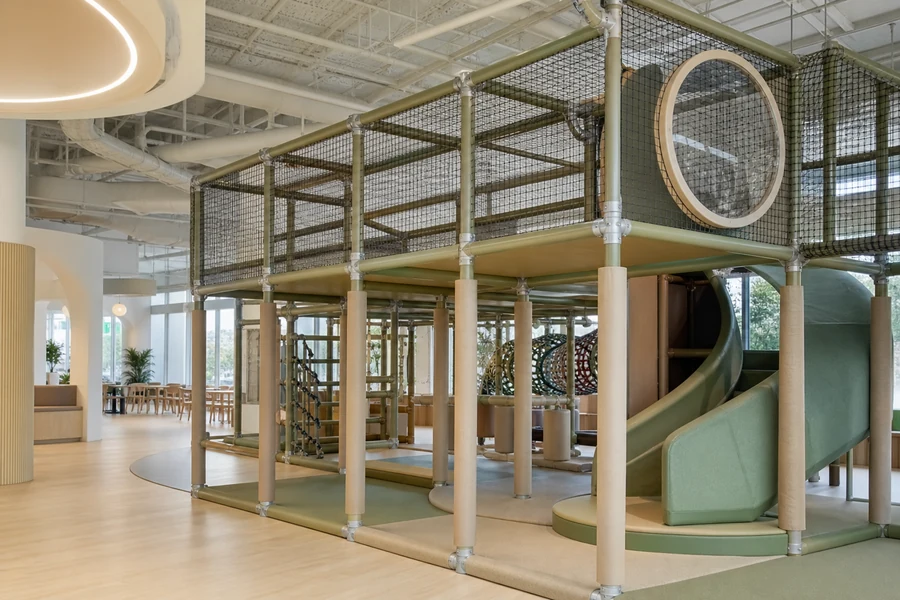
A galvanized vs painted steel playground frame decision is about more than the steel itself. The finish — galvanized, painted, or both — determines whether the frame is still solid in ten years or starting to rust through at the joints in two.
The failure mode is predictable and expensive. Paint looks fine for a while, then chips at a high-traffic rail or a weld seam, and the bare steel underneath starts rusting from that exact spot. By the time it’s visible, the damage is already happening from the inside, and replacing a structural frame is a very different cost than replacing a cover or a foam pad.
Die Kurzfassung: galvanized steel outlasts painted steel, especially when it’s finished with a powder-coat topcoat on top of the galvanizing rather than paint alone. Galvanizing protects the steel underneath even after the surface gets scratched, while paint only protects as long as the coating itself stays intact. Most commercial manufacturers, including KoalaPlay, build frames from hot-dip galvanized steel with a powder-coated finish for exactly this reason — not one or the other. The rest of this guide explains why, and what to check before you buy.
How galvanizing and painting actually protect steel
The difference comes down to what happens after the coating gets damaged, not how it looks on day one.
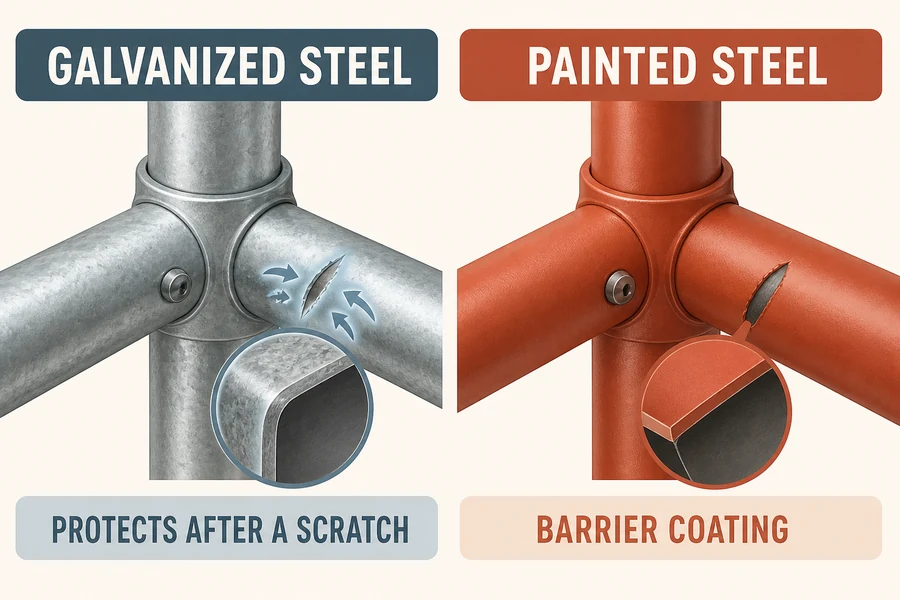
Hot-dip galvanizing submerges steel in molten zinc, forming a metallurgically bonded zinc layer on the surface. That zinc layer doesn’t just sit on top — it sacrifices itself to protect the steel underneath through a process called cathodic protection. Even if the surface gets scratched down to bare metal, the surrounding zinc keeps corrosion from starting at that spot.
Paint, including powder coating used on its own, is a barrier coating only. It works by physically sealing the steel away from air and moisture. The moment it chips, peels, or wears through — which happens fastest at high-touch points like handrails and grips — the exposed steel underneath has no more protection, and rust starts right there.
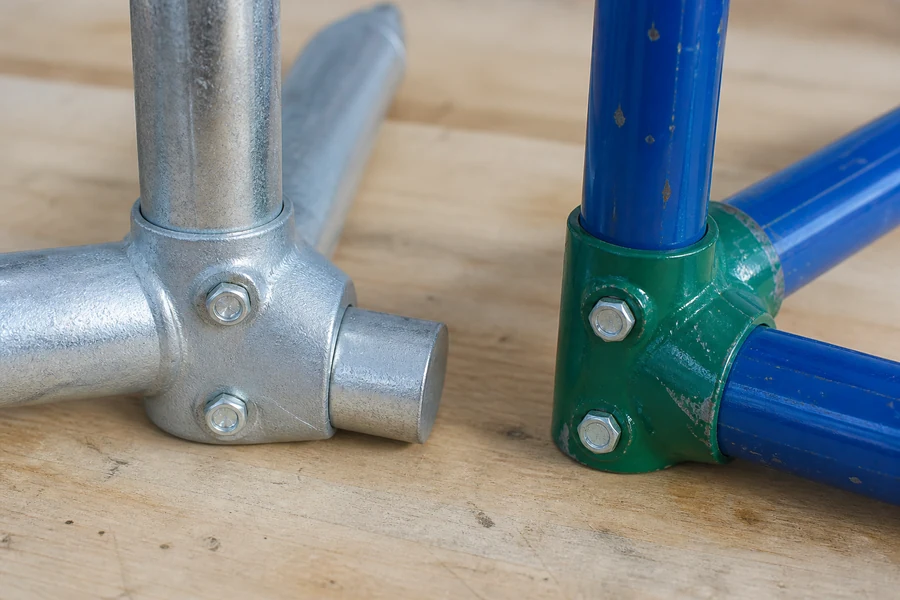
Galvanized vs painted steel playground frame comparison
| Verzinkter Stahl | Painted Steel | |
|---|---|---|
| Protection mechanism | Sacrificial zinc layer (cathodic protection) | Surface barrier only |
| Behavior when scratched | Surrounding zinc keeps protecting the exposed spot | Bare steel exposed, rust starts immediately |
| Maintenance need | Minimal for decades | Requires periodic repainting |
| Upfront cost | Higher | Nach unten |
| Long-term cost | Lower — little to no maintenance | Higher — repeated repainting over the equipment’s life |
| Optimale Passform | Structural frames, high-traffic and outdoor-exposed components | Lower-stakes, easily inspected and repainted surfaces |
Industry life-cycle cost studies commonly cite galvanized steel lasting 40 to 70 years with no extensive repair, against painted steel needing attention within 5 to 10 years and multiple repaint cycles over 30 years. Treat those as commonly cited industry benchmarks rather than a guarantee for any specific piece of equipment — actual lifespan depends heavily on the environment the steel sits in, not just the coating itself.
Why the real answer is usually "galvanized steel plus a powder-coat topcoat"
Framing this as a strict either/or misses how most quality commercial equipment is actually built. Galvanizing handles the long-term corrosion protection that matters most structurally. A powder-coat topcoat on top of that adds color, a smoother touch surface for children’s hands, and extra abrasion resistance at the points that get gripped and rubbed the most.
Unter KoalaPlay, that combination is exactly how frames are built: the main structure uses Q235 galvanized steel at 48mm pipe diameter with 2.0–3.0mm wall thickness, finished with full hot-dip galvanization plus an electrostatic powder coating. Trampoline frames use heavier 80mm x 80mm tubing at 4mm wall thickness, sandblasted and powder coated for a rust-proof, chip-resistant finish. It’s the same principle behind the equipment’s foam padding system: the structural material does the heavy lifting, and the outer layer protects it and finishes the look.
Where frames actually fail, even on galvanized steel
Galvanizing is strong, but it isn’t invincible everywhere on a structure — and knowing the real failure points is what separates a useful buyer’s guide from a marketing pitch.
Field-cut ends, drilled holes, and welded repairs made after the original galvanizing process are common weak points, since cutting or welding removes the zinc layer at that exact spot and it needs to be re-sealed. Fasteners and brackets are another common failure interface, especially when mixed metals are used together and create galvanic corrosion between them. Ground-line post bases and anchor connections tend to be the first places corrosion shows up outdoors, since that’s where moisture collects.
For indoor commercial soft play, most of these risks are lower — there’s no rain, road salt, or coastal air to worry about — but humidity, cleaning chemicals, and years of heavy contact still make the coating matter. It’s part of the same durability picture covered in how soft play equipment differs from hard play equipment in terms of what components need to withstand daily use.
What to ask your supplier before you buy
Before signing off on a frame material, get specific answers to these:
- What coating process is used — hot-dip galvanizing, electroplating, or paint only?
- Is the galvanizing done to a recognized standard, such as ASTM A123, the standard specification for zinc (hot-dip galvanized) coatings on steel?
- What’s the pipe or tube wall thickness on the main structural members?
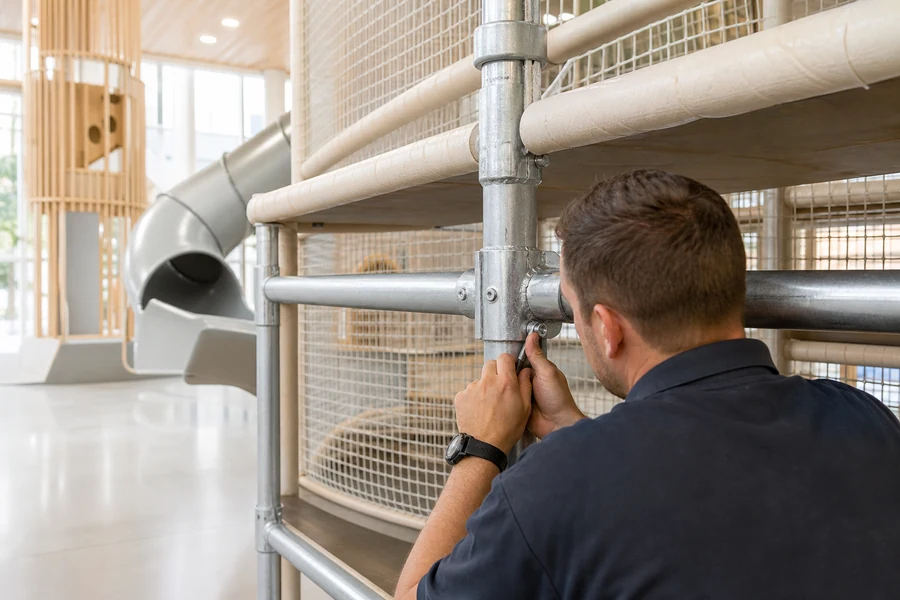
- Are connectors and fasteners corrosion-treated too, not just the main frame tubes?
- Is there load-test documentation for the connectors and joints, not just the coating claims?
As a reference point for the level of detail worth asking for, KoalaPlay’s connectors are precision-molded, rust-resistant galvanized steel with a dual-layer powder coating, tested to over 500kg load capacity — that’s the kind of spec sheet a serious quote should be able to produce.
Indoor vs outdoor: does the environment change the answer?
Environment changes how urgent the difference is, not which material wins. Indoor commercial soft play sees far less corrosive exposure than an outdoor playground — no rain, no deicing salt, no direct sun cycling the coating through heat and cold. That means the visible gap between galvanized and painted steel takes longer to show up indoors.
It doesn’t disappear, though. Indoor equipment still deals with humidity, frequent sanitizing chemicals, and years of heavy daily contact, and a structural frame is expected to last far longer than a cover or a foam pad. Galvanized steel remains the safer long-term specification either way, which is why it’s the standard most commercial manufacturers build to, alongside compliance with EN 1176, ASTM F1918, and GB/T 27689-2011.
Explore playground solutions and product categories
The frame specification should match the attraction and operating environment you are planning. Explore Indoor-Spielplatzgeräte for multi-level commercial structures, Kleinkind- und Softplay-Bereiche for low-impact early-years zones, and indoor sports parks for higher-energy installations. If your venue combines play with food and parent seating, see KoalaPlay’s Spielcafé-Lösungen; for story-led add-ons, browse Rollenspielumgebungen. You can also use the Leitfaden für die Kosten von Indoor-Spielplatzgeräten to prepare a more detailed supplier brief.
Häufig gestellte Fragen
Is galvanized steel more expensive than painted steel?
Yes, upfront. Hot-dip galvanizing costs more initially than a paint-only finish, but industry life-cycle cost studies generally find it more economical over the equipment’s full lifespan because it avoids repeated repainting and maintenance labor.
Can galvanized steel be painted or powder coated on top?
Yes, and it’s a common and recommended approach. A powder-coat topcoat over galvanized steel adds color and extra surface abrasion resistance while the galvanizing underneath continues providing the long-term corrosion protection.
How long does a galvanized steel playground frame last?
It depends heavily on the environment and how the frame is installed and maintained, but industry life-cycle studies commonly cite 40 to 70 years for galvanized steel with minimal repair, compared to 5 to 10 years before painted steel needs attention. Ask your supplier for their specific warranty terms rather than assuming a general industry figure applies to your equipment.
What standard governs galvanized steel coatings?
ASTM A123 is the standard specification for zinc (hot-dip galvanized) coatings on iron and steel products in North America. Asking whether a supplier’s galvanizing process is done to this standard is a reasonable way to verify coating quality.
Ask for the coating spec, not just "steel frame"
A quote that just says "steel frame" without naming the coating process, wall thickness, or a relevant standard is a gap worth closing before you commit. The frame is the part of the equipment you’re relying on to hold up for the life of the venue, not just look good at installation.
KoalaPlay builds indoor playgrounds three ways: auswählen ein bewährtes Design aus unserer Bibliothek, anpassen eines, das zu Ihrem Grundriss und Ihrer Marke passt, oder erstellen something entirely original. Most venues start with Adapt, using a field-tested structure while putting the budget into the visible theme, layout, and equipment mix. Share your floor plan and opening target to compare the right frame specification, or explore indoor playground equipment first. *Not sure which route fits? If full custom is genuinely the better call for your project, we’ll say so.*
Referenzen
- Material & Quality — KoalaPlay
- EPE vs EVA vs PU Foam: Which Padding Material Is Best for Soft Play Equipment? — KoalaPlay
- Soft Play vs Hard Play Equipment — KoalaPlay
- Kosten für Indoor-Spielgeräte: Vollständiger Preisleitfaden 2026 — KoalaPlay
- Galvanized Steel vs Painted Steel: Life Cycle Cost Analysis — Parco Engineers
- Powder-Coated vs. Galvanized vs. Stainless Steel: Which Playground Equipment Finishes Last Longest — AAA State of Play
- ASTM A123-17: Standard Specification for Zinc (Hot-Dip Galvanized) Coatings — ANSI Blog


 English
 Spanish
 German