
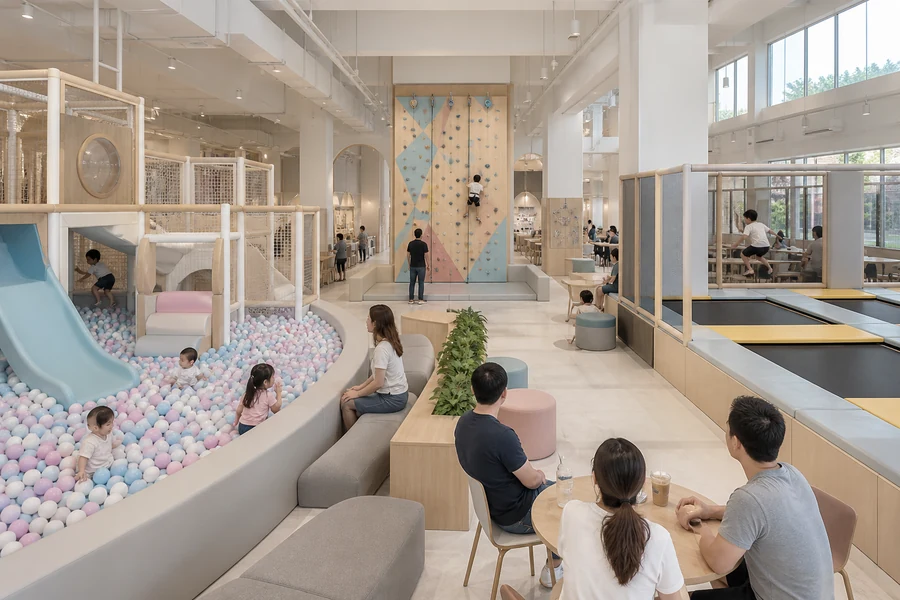
Ball pit vs climbing wall vs trampoline ROI starts with your actual space, audience, and operating model—not the attraction that looks best in a supplier pitch. A ball pit is cheap and easy to install. A climbing wall photographs beautifully for social media. A trampoline court promises the biggest ticket sales.
Pick based on hype instead of your actual space, ceiling height, and target customer, and the mistake is expensive to unwind. A trampoline court crammed into a space with the wrong ceiling height fails inspection. A climbing wall installed for teen traffic in a toddler-dominated market sits underused. A ball pit alone in a large venue leaves square footage generating far less revenue than it could.
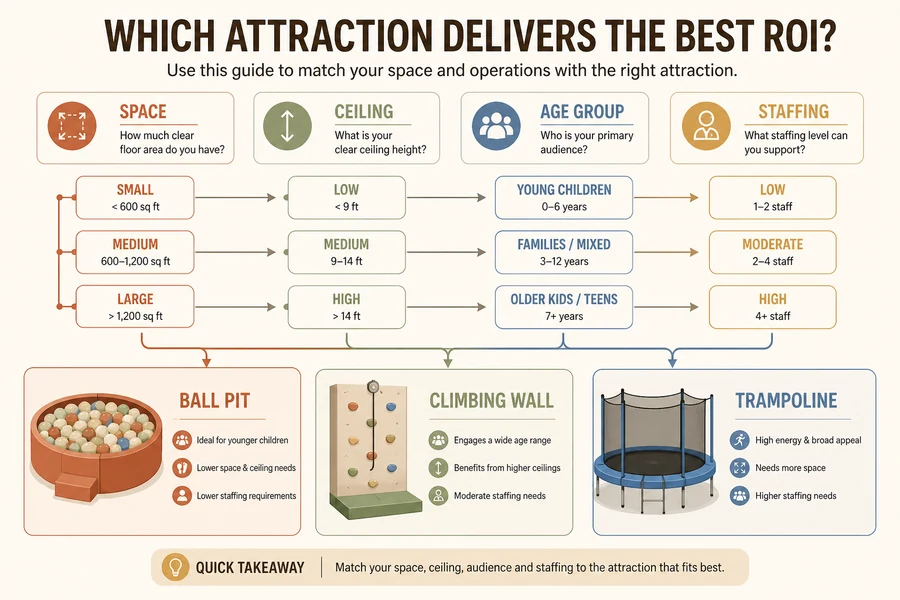
The honest answer is that there’s no single winner — ball pits have the lowest cost of entry but the weakest revenue ceiling, climbing walls add strong marketing and repeat-visit value without huge throughput, and trampolines usually offer the highest revenue potential but demand far more space, capital, staffing, and insurance. Which one wins for you depends on your square footage, ceiling height, and who’s actually walking through your door. The rest of this guide gives you a framework to work that out.
How to actually measure ROI for a play attraction
Before comparing the three attractions, it helps to agree on what "ROI" should actually measure. Raw popularity or upfront cost alone doesn’t tell you much — the number that matters is revenue per square foot (or per square meter) once you account for what an attraction actually costs to run.
That means adding up equipment and installation cost, the rent you’re effectively paying for the floor space it occupies, ongoing labor and maintenance, insurance, and then weighing that against revenue per visit and repeat-visit rate. An attraction that looks cheap upfront can still underperform on a per-square-foot basis if it needs a large footprint and doesn’t drive much repeat traffic.
Ball pit: lowest cost of entry, limited ceiling on revenue
A ball pit is usually the smallest, least expensive attraction to add. Based on KoalaPlay’s published 2026 equipment cost guide, a soft play and ball pit setup for roughly 500 square feet typically runs $8,000 to $25,000 — well below the cost of a climbing structure or a trampoline court of comparable footprint.
The ongoing cost that catches operators off guard is cleaning labor, not equipment wear. Industry guidance on ball pit sanitation generally recommends a quick surface check daily, a full ball-cycle clean weekly, and a deeper sanitization monthly, with documentation kept against standards like ASTM F1918 and EN 1176. Skipping this isn’t just a hygiene risk — it’s usually the single biggest recurring line item tied to a ball pit.
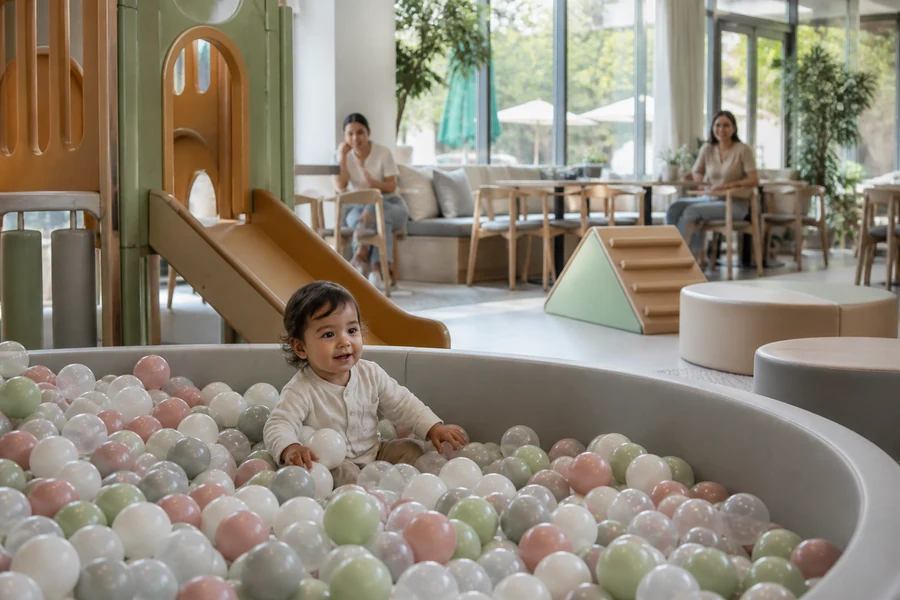
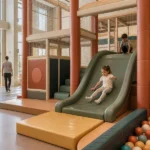
Ball pits are the strongest fit for toddlers and young families, where repeat visits are common and the attraction doubles well as a birthday-party add-on. Revenue per visit tends to be modest, but so is the space and capital commitment.
Climbing wall: moderate cost, strong marketing value, lower per-capita revenue
Climbing structures need vertical clearance and generally cost more than a ball pit for a comparable footprint. KoalaPlay’s cost guide puts multi-level play structures — climbing nets, towers, and similar vertical elements — at roughly $30,000 to $80,000 for a 1,000 to 1,500 square foot area, a useful reference point when comparing quotes.
Industry commentary on climbing walls at family entertainment centers generally reports that climbing ranks lower on a per-visitor revenue basis than perennial draws like bowling or go-karts. Where it earns its keep is indirectly: climbing walls are unusually photogenic, which drives organic social sharing and parent engagement, and equipment rental (harnesses, shoes) adds a secondary revenue stream similar to bowling shoe rentals. Auto-belay systems are also commonly cited as a way to cut staffing costs and increase throughput compared to manual belaying, since they don’t require a trained belay partner for every climber.
Trampoline: highest revenue potential, highest capital and compliance burden
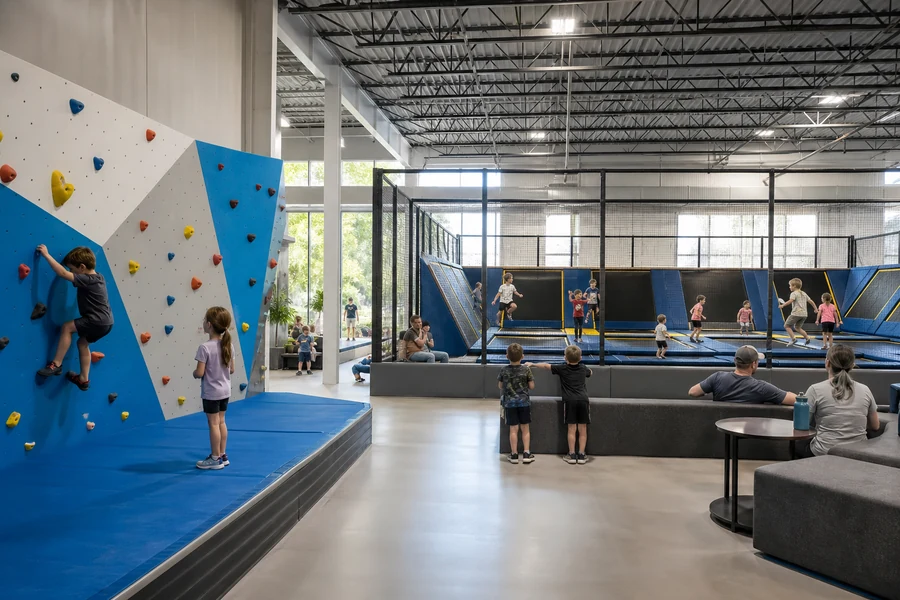
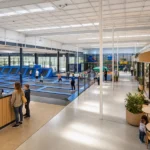
Trampoline courts are usually where the biggest revenue numbers come from — and also where the biggest capital commitment sits. Industry sources commonly cite a minimum of roughly 1,000 square meters and a ceiling height around 5.5 meters (18 feet) as the practical threshold for a trampoline park to feel like a real destination rather than a cramped afterthought; treat these as general industry benchmarks to verify against your own site, not fixed rules.
Trampolines also carry a distinct compliance path — commonly ASTM F2970 in North America and EN ISO 23659:2022 in Europe, separate from the ASTM F1918/EN 1176 standards that apply to soft play — plus mandatory safety monitoring staff and insurance premiums that are widely reported as several times higher than a comparable soft play footprint.
KoalaPlay’s published cost guide doesn’t break out a trampoline-specific equipment figure, since trampoline court sizing and pricing vary enormously by court configuration and site conditions. If a trampoline court is on your shortlist, the more useful next step is working through KoalaPlay’s guide to opening a trampoline park, which walks through the fuller capital-planning picture rather than a single headline number.
Ball pit vs climbing wall vs trampoline ROI comparison
| Ball Grube | Kletterwand | Trampolin | |
|---|---|---|---|
| Typical footprint | Smallest | Moderate, needs vertical clearance | Largest, needs high ceiling |
| Relative upfront cost | Lowest | Mäßig | Highest |
| Main ongoing cost driver | Cleaning/sanitation labor | Equipment rental restocking, belay maintenance | Staffing, insurance, spring/mat maintenance |
| Staffing need | Low | Low with auto-belay, higher with manual belay | Highest — mandatory safety monitoring |
| Best-fit age group | Toddlers, young families | Kids 8-12 through teens | Jugendliche und Erwachsene |
| Insurance burden | Lowest | Mäßig | Highest |
| Revenue potential | Lower, steady | Moderate, strong marketing value | Highest, but traffic-dependent |
Treat the qualitative ratings above as directional — actual figures shift by region, market, and how well an attraction is run, not just which one you pick.
The hybrid model most operators land on
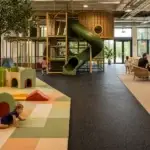
Rather than choosing one attraction exclusively, many successful venues combine a soft play or ball pit area as the steady traffic base with a smaller climbing or trampoline zone as a higher-value highlight feature. This spreads age-group coverage across a single venue and avoids putting all the capital risk into one attraction. If you’re planning a venue around a trampoline zone alongside softer play areas, KoalaPlay’s guide to planning a family entertainment center with a trampoline zone covers the layout and zoning tradeoffs in more depth.
Explore attraction and venue solutions
Verwenden Sie Indoor-Spielplatzgeräte to compare multi-level play structures and soft-play components. For a toddler-first offer, explore Kleinkind- und Softplay-Bereiche; for a high-energy mix, see Lösungen für Indoor-Sportparks. A Spielcafé can pair a compact ball pit with visible parent seating, while Rollenspielumgebungen add another lower-impact reason to return. Before requesting quotes, review the Leitfaden für die Kosten von Indoor-Spielplatzgeräten.
Questions to ask before you commit capital
- What’s your actual usable ceiling height, and does it rule out a trampoline court before you even start?
- Who is your realistic target age group — toddlers, school-age kids, or teens — and does your shortlist match them?
- Have you gotten an insurance quote for each attraction type, not just an equipment quote?
- Does your market lean toward rotational ticket traffic or birthday/group bookings, and which attraction supports that better?
- What’s your staffing model, and can you realistically cover a trampoline court’s supervision requirements?
Häufig gestellte Fragen
Which attraction has the fastest payback period?
It varies by market and venue, but ball pits generally have the shortest payback window because the upfront cost and space commitment are both low. Climbing walls and trampolines can generate more total revenue, but they also take longer to recoup given their higher capital and ongoing costs.
Do trampolines need more insurance than soft play or climbing walls?
Yes. Insurance premiums for trampoline attractions are widely reported as several times higher than soft play, reflecting the higher injury risk profile and the distinct compliance standards trampolines fall under, such as ASTM F2970 and EN ISO 23659:2022.
Can I combine ball pits, climbing walls, and trampolines in one venue?
Yes, and it’s a common approach. Many operators use a soft play or ball pit area as the steady traffic base and add a smaller climbing or trampoline zone as a highlight feature, spreading age-group coverage without betting everything on one attraction.
What’s the minimum ceiling height for a climbing wall versus a trampoline court?
Climbing walls need enough vertical clearance for the wall height plus a safety buffer, which varies by wall design. Trampoline courts are commonly built around a ceiling height near 5.5 meters (18 feet), noticeably taller than what a typical soft play or climbing installation requires — always confirm against your specific site and equipment.
Plan your attraction mix with real numbers, not guesses
Choosing between a ball pit, climbing wall, and trampoline isn’t really about which one is "best" — it’s about which one fits your ceiling height, budget, and the families or teens actually walking through your door. Getting real equipment cost ranges before you commit to a floor plan is what turns this from a guess into a plan.
KoalaPlay builds indoor playgrounds three ways: auswählen ein bewährtes Design aus unserer Bibliothek, anpassen eines, das zu Ihrem Grundriss und Ihrer Marke passt, oder erstellen something entirely original. Adapt is the natural starting point for most hybrid venues: the core structure is field-tested, while the layout, theme, and attraction mix fit your business. Send your floor plan and opening target for a planning conversation, or browse indoor playground equipment to compare solution types. *Not sure which route fits? If full custom is genuinely the better call for your project, we’ll say so.*
Referenzen
- Kosten für Indoor-Spielgeräte: Vollständiger Preisleitfaden 2026 — KoalaPlay
- How to Open a Trampoline Park: Investor Planning Checklist — KoalaPlay
- How to Plan a Family Entertainment Center with a Trampoline Zone — KoalaPlay
- Soft Play vs Hard Play Equipment: Which Should You Choose? — KoalaPlay
- Soft Play vs. Trampoline Park: The $100k Truth — Weiroo
- A Playroom or a Trampoline Park: Which Investment Pays Off Faster? — Global Fun Sports
- Climbing Walls at FECs: ROI Considerations — Skywalker Adventure Builders
- Ball Pit Cleaning & Sanitization Standards for Indoor Playgrounds — Dreamland Manufacturer


 English
 Spanish
 German