When a prospective parent tours your childcare facility, they scan the room in less than three seconds. Before you even mention your curriculum or staff credentials, they have already made a subconscious decision about whether they trust you with their child. At Koalaplay, we have partnered with hundreds of childcare professionals, and we know that the physical environment speaks volumes. In this comprehensive guide, you will learn how to choose the right indoor playground equipment for daycare centers, understand critical safety standards, and discover why adding immersive play zones is the ultimate strategy for boosting enrollment.
Why Your Daycare’s Indoor Play Space Is a Business Asset
For a long time, indoor play areas in daycares were viewed merely as a solution for rainy days—a place to burn off energy when going outside was not an option. However, the industry has shifted dramatically. Today, a well-designed indoor playground is one of your most powerful marketing assets. Parents are no longer just looking for basic childcare; they are looking for a premium experience that feels safe, intentional, and developmentally enriching.
When a play space is thoughtfully designed, it communicates value and professionalism. It shows parents that you have invested in their child’s physical and cognitive growth. This is the concept of experience-led design, where the environment itself builds trust. A cohesive, high-quality play area can justify higher tuition rates and create a waitlist for your facility. If you want to understand how design impacts profitability, our guide on profitable play cafe design offers valuable insights that apply directly to premium daycare environments.
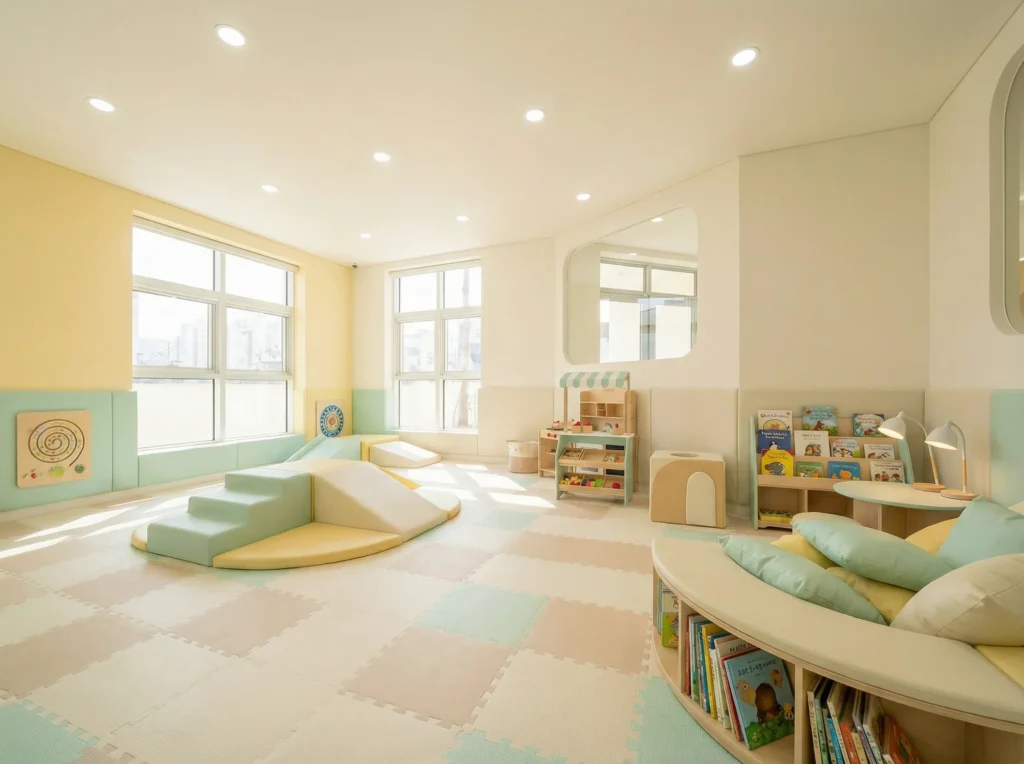
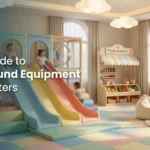
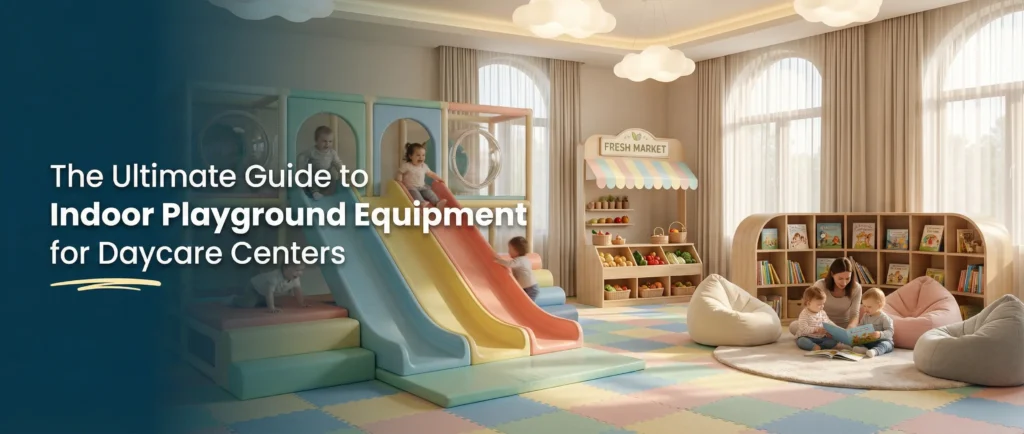
A modern, experience-led daycare indoor playground uses cohesive pastel colors and low-profile equipment to create a calming, premium environment that parents instantly trust.
Understanding the Two Categories of Daycare Indoor Playground Equipment
When selecting indoor playground equipment for daycare, it is crucial to understand that not all equipment is suitable for all ages. Children develop at vastly different rates between the ages of six months and five years, requiring distinct types of play structures to keep them safe and engaged. Generally, commercial playground equipment is divided into two main categories based on age and safety standards.
The first category is soft play equipment, designed specifically for infants and toddlers under two years old. This equipment is governed by the ASTM F2373 standard, which dictates strict rules regarding fall heights, foam density, and the absence of entrapment hazards. The second category is structured play equipment, designed for children aged two to twelve, governed by the ASTM F1487 standard for public use playgrounds. This includes more complex climbing structures, slides, and interactive panels.
| Equipment Category | Target Age Group | Applicable Safety Standard | Key Features |
| Soft Play Zones | 6 to 23 months | ASTM F2373 | Low height, high-density foam, padded floors, no sharp edges |
| Structured Play | 2 to 12 years | ASTM F1487 | Ramps, slides, commercial-grade plastics, powder-coated steel |
| Pretend Play | 2 to 6 years | CPSC Guidelines | Scaled wooden furniture, immersive themes, interactive elements |
To ensure you are meeting the developmental needs of your students, you must choose age-appropriate playground equipment that provides the right level of challenge without compromising safety.
The 5 Essential Equipment Categories for a Daycare Indoor Playground
Creating a dynamic and engaging environment requires a mix of different play activities. A successful daycare indoor play area should incorporate five essential categories of equipment to support holistic child development.
First, every facility needs a dedicated toddler soft play zone. This area allows early walkers and crawlers to practice balance and motor skills safely on foam wedges, low steps, and small ball pits. Second, wall-mounted sensory play panels are excellent space-saving additions that promote fine motor skills, logic, and hand-eye coordination without taking up valuable floor space.
Third, gross motor structures such as small jungle gyms, slides, and crawling tunnels are necessary for physical exertion and cardiovascular health. Fourth, quiet zones or calm-down corners with soft seating provide children with a safe space to self-regulate when they feel overwhelmed. Finally, the fifth and most impactful category is the role play area, which we will explore in detail below.
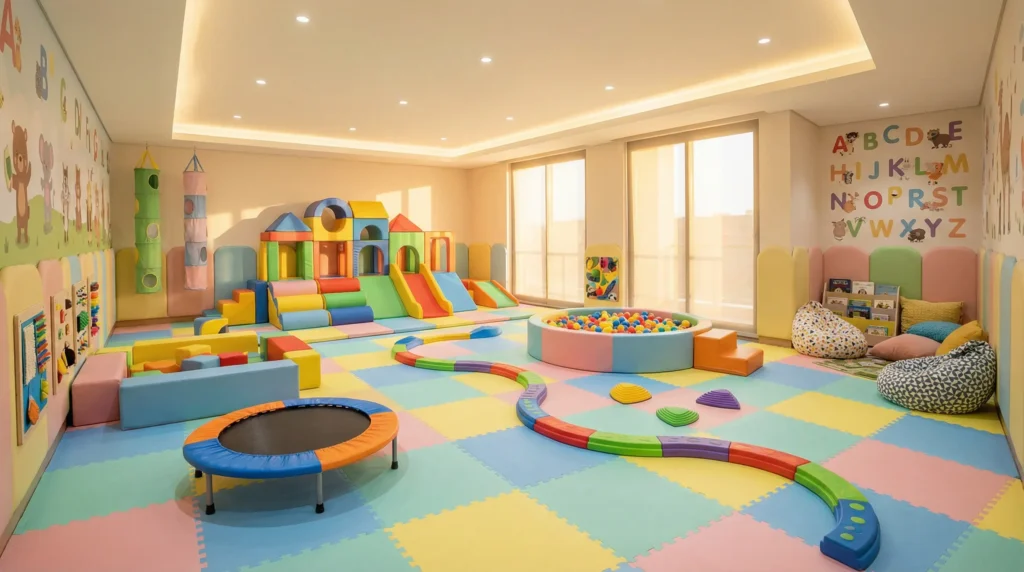
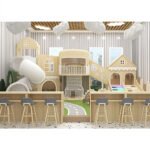
A dedicated soft play zone with padded barriers keeps infants and toddlers safe from older, more active children while allowing them to explore independently.
The Role Play Area: The Most Underrated Upgrade for Daycares
While most daycares focus heavily on slides and climbers, they often overlook the immense value of pretend play. A dedicated role play area is arguably the most underrated upgrade you can make to your childcare center. Between the ages of two and six, children engage heavily in imaginative play, which is critical for developing social skills, empathy, language, and problem-solving abilities.
Instead of a scattered collection of plastic toys, modern daycares are installing immersive, miniature villages. These can include a tiny supermarket, a pediatric clinic, a fire station, or a café. When children step into these scaled-down environments, they engage in deep, cooperative play. From a business perspective, these aesthetic, highly photogenic areas are incredibly appealing to touring parents.
At Koalaplay, our custom pretend play villages are designed to transform ordinary rooms into extraordinary learning environments. Partnering with a professional role play equipment supplier ensures that your wooden structures are durable, safe, and visually cohesive. If you want to learn more about why this matters, read our article on the importance of pretend play.
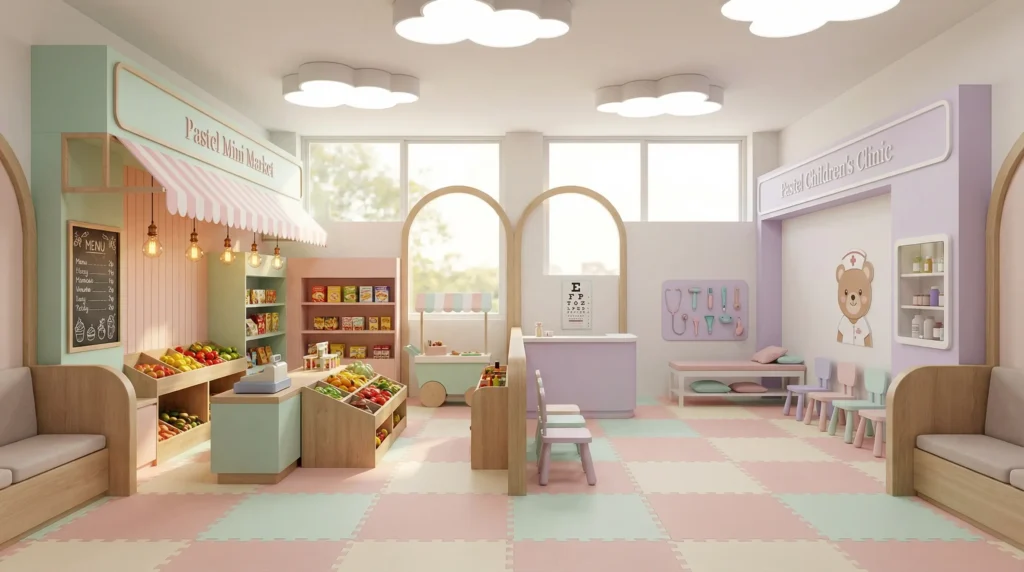
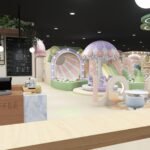
Immersive role play areas, like this pastel market and clinic, encourage cooperative play and serve as a major selling point for prospective parents touring your facility.
Safety Standards Every Daycare Owner Must Know
Safety is the non-negotiable foundation of any childcare business. When purchasing indoor playground equipment for daycare, you cannot rely on residential-grade toys purchased from big-box retailers. Commercial environments require commercial-grade safety compliance to protect the children and shield your business from liability.
In the United States, equipment must adhere to the guidelines set forth by the Consumer Product Safety Commission (CPSC) and the standards developed by ASTM International. As mentioned earlier, ASTM F2373 covers equipment for children under two, while ASTM F1487 covers equipment for children aged two and older. These standards dictate everything from the maximum height of a slide to the exact spacing required between railings to prevent head entrapment.
Furthermore, the surfacing beneath the equipment is just as important as the equipment itself. Falls are the leading cause of playground injuries, making proper impact-attenuating flooring essential. Before you open your new play area, we highly recommend reviewing a comprehensive indoor playground installation checklist to ensure every bolt is tightened and every safety zone is measured correctly.
Space Planning & Layout: The Sightline Rule
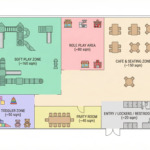
Even the most expensive playground equipment will fail if the room layout is poorly planned. One of the most critical concepts in daycare playground design is the “sightline rule.” This rule dictates that a caregiver standing in a designated supervision spot must be able to see every child in the room without having to move around large obstacles.
When planning your layout, you must carefully zone the room. Active, high-energy areas (like slides and climbers) should be separated from quiet, focused areas (like reading nooks or role play villages) to prevent collisions. Additionally, equipment should be low-profile enough that it does not create blind spots. At Koalaplay, our indoor playground equipment solutions are specifically designed with supervision and flow in mind, ensuring that your staff can monitor the room effortlessly while children play freely.
How Much Does Indoor Playground Equipment Cost for a Daycare?
Budgeting for a commercial indoor playground requires a clear understanding of the costs involved. Unlike residential toys, commercial equipment is built with high-density materials designed to withstand years of daily use by dozens of children.
For a small daycare setup (approximately 200 to 500 square feet) focusing primarily on soft play blocks, sensory panels, and a small role play corner, you can expect to invest between $8,000 and $25,000. A mid-sized play area (500 to 1,000 square feet) that includes a small structured climbing frame alongside soft play will typically range from $25,000 to $60,000. For large, comprehensive commercial systems spanning over 1,000 square feet, the investment can exceed $60,000.
Working directly with a manufacturer like Koalaplay, rather than a third-party reseller, can significantly reduce these costs while allowing for greater customization. For a more detailed breakdown of pricing factors, explore our comprehensive guide on indoor playground equipment cost 2026.
Conclusion
Upgrading your daycare with commercial indoor playground equipment is more than just a facility improvement; it is a strategic business decision that drives enrollment, builds parent trust, and supports early childhood development. By prioritizing safety standards, embracing experience-led design, and incorporating immersive role play areas, you can create a space that stands out in a competitive childcare market.
Ready to transform your daycare’s indoor play area? Contact the Koalaplay team today for a free consultation and custom design proposal tailored to your space and budget.
Frequently Asked Questions
What equipment does a daycare need for an indoor playground?
A well-rounded daycare indoor playground should include age-appropriate soft play equipment for infants, gross motor climbing structures for older toddlers, sensory wall panels to save space, and a pretend play area (like a mini market or kitchen) to encourage social and cognitive development.
What safety standards apply to daycare indoor playground equipment?
Commercial daycare equipment must comply with CPSC guidelines and ASTM standards. Specifically, ASTM F2373 applies to equipment designed for children under two years of age, while ASTM F1487 applies to public use playground equipment for children aged two to twelve.
How much does indoor playground equipment for a daycare cost?
Costs vary widely based on the size of the space and the type of equipment. A basic soft play package for a small room can start around $8,000, while a comprehensive, custom-designed indoor playground system for a larger facility typically ranges from $30,000 to $60,000 or more.
What is the difference between soft play and structured play equipment?
Soft play equipment is made of high-density foam covered in durable vinyl, featuring no hard edges, making it ideal for infants and toddlers learning to crawl and walk. Structured play equipment includes rigid materials like steel and commercial plastics, featuring slides and complex climbers suited for older, more coordinated children.
Can a daycare have a role play area?
Yes, adding a role play area is highly recommended for daycares. Miniature villages, play kitchens, and pretend clinics provide immense developmental benefits for children aged two to six, fostering imagination, language skills, and cooperative play, while also serving as a major selling point for parents.
What flooring is best for a daycare indoor playground?
The best flooring for a daycare indoor playground is impact-attenuating safety surfacing, such as commercial-grade EVA foam puzzle mats, poured-in-place rubber, or padded vinyl tiles. The flooring must be thick enough to cushion falls based on the highest point of the play equipment. For more details, see our guide on how to choose the right playground flooring system.