

Indoor playground cafe membership pricing in the USA is usually built around one simple question: how often will a family visit each month? A normal cafe sells coffee, food, and a place to sit. An indoor playground cafe sells a longer family visit that includes child admission, supervised caregiver presence, play value, cleaning, safety rules, and cafe spending.
For families, a play cafe membership often starts making sense after 3 to 5 visits per month. For operators, the right pricing model can turn occasional visitors into predictable recurring revenue while still leaving room for day passes, birthday parties, classes, and cafe sales.
Based on current U.S. play cafe examples, many venues price a 2-hour day pass around $12-$20 per child, while monthly memberships often range from about $35-$80 for one child. Premium plans, sibling plans, coworking bundles, or unlimited family memberships can go higher. A normal cafe visit may only include a $3.65 drip coffee or a $5.58 cold brew before food and tip, but it also has a shorter dwell time and no child play admission.
The Core Difference: A Play Cafe Is Not Just a Cafe With Toys
A normal cafe competes on drinks, food, speed, seating comfort, brand, and neighborhood habit. Customers may stay 15 minutes for takeaway or 1-2 hours for work or conversation.
An indoor playground cafe has a different value stack:
| Item | Normal Cafe | Indoor Playground Cafe |
|---|---|---|
| Main purchase | Coffee, drinks, pastries | Child play admission plus cafe sales |
| Typical visit driver | Caffeine, snack, work, meeting | Safe indoor play, parent comfort, repeat family routine |
| Stay time | Short to medium | Often 1.5-2.5 hours |
| Main capacity limit | Seats, service speed | Play capacity, age zones, cleaning, safety supervision |
| Membership logic | Beverage loyalty or subscription | Repeat play access, sibling value, party/event perks |
| Operational burden | Food service and seating | Food service plus play equipment, waivers, socks, sanitation, layout control |
This is why play cafe operators should not copy normal cafe pricing too closely. A play cafe can charge admission because it provides a child-centered activity. But it also needs stronger rules, more cleaning, better zoning, and commercial-grade equipment.
If you are still defining the business model, Koalaplay’s guide on how to start a play cafe and how much it costs is a useful starting point before finalizing your admission and membership strategy.
What U.S. Indoor Playground Cafe Membership Pricing Looks Like in 2026
Current U.S. examples show a few common pricing patterns.
Some venues use a simple day pass plus monthly membership model. Busy Bee Play Cafe in Georgia lists a $13 child day pass for 2 hours of play and a $45 monthly membership per child. Sip n’ Slide Play Cafe lists a $47 monthly membership for one child, with sibling pricing and a coworking bundle. Playgrounds Cafe lists unlimited monthly memberships at $54.99 for one child, $79.99 for two children, and $99.99 for three or more children. Desert Bloom Play Cafe lists a $12 two-hour play option, plus higher membership tiers such as lite and standard plans.
These examples suggest a practical U.S. pricing range:
| Pricing Type | Common U.S. Range | When It Works Best |
|---|---|---|
| 2-hour day pass | $12-$20 per child | First-time visitors, tourists, weekend families |
| Monthly one-child membership | $35-$80 | Families visiting weekly or more |
| Monthly sibling plan | $55-$110+ | Households with two or three children |
| Premium monthly plan | $80-$150+ | Includes guest passes, cafe discount, priority booking, classes, coworking, or events |
| Annual pass | 8-11 months of monthly value | Loyal local families and holiday gift buyers |
| Party discount for members | 10%-15% common | Helps convert members into birthday bookings |
Do not treat these ranges as fixed national averages. Rent, labor, insurance, local income, play area size, and capacity rules vary widely. A play cafe in a dense coastal city may need a higher price than a small suburban venue with lower rent.
How Normal Cafe Spending Changes the Comparison
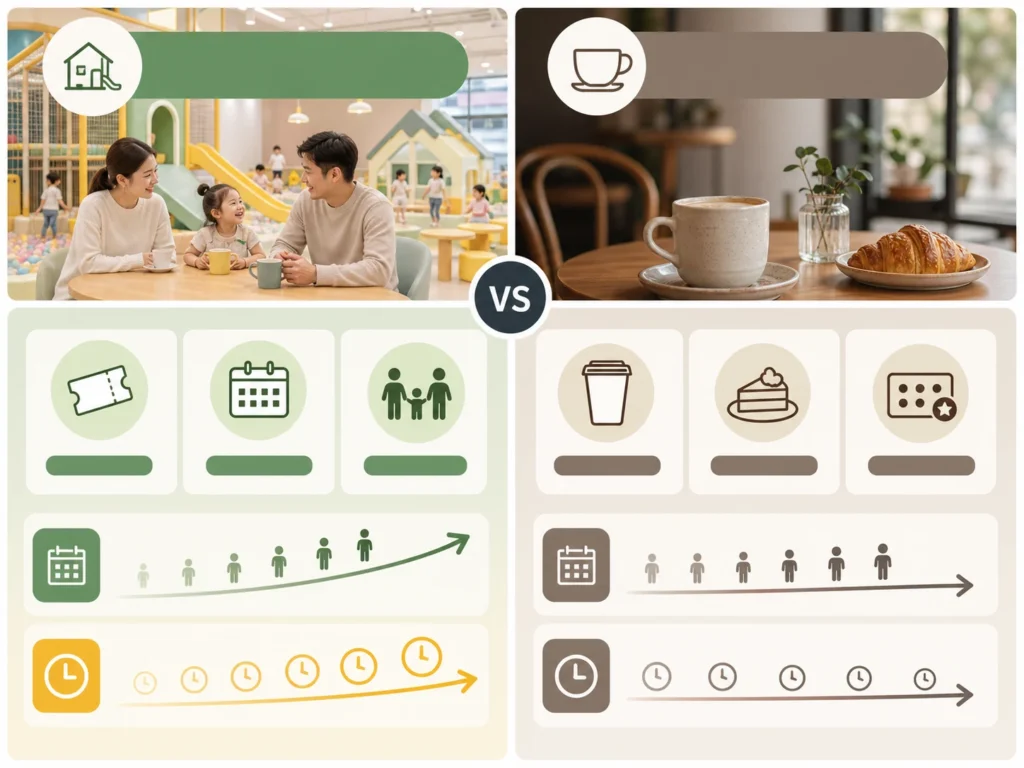
A normal cafe visit looks cheaper at first. Toast reported that the median restaurant price for a regular drip coffee was $3.65 in February 2026, while cold brew was $5.58. Add a pastry, snack, sales tax, and tip, and a caregiver’s cafe ticket may easily move into the $8-$15 range.
But a normal cafe does not usually solve the parent’s bigger problem: “Where can my child play safely while I sit, talk, work briefly, or meet another parent?”
That difference matters. Parents may compare a play cafe against:
- A coffee shop visit.
- A park visit.
- A library story time.
- A children’s museum.
- A trampoline park.
- A daycare drop-in program.
- A birthday party venue.
- A mall play area.
So the membership price should not be justified only by coffee. It should be justified by repeat indoor play, predictable routines, weather-proof convenience, social time, and parent comfort.
The strongest play cafe pricing usually makes the day pass feel fair and the membership feel obviously better for regular families.
Break-Even Math: When Does a Membership Make Sense?
A simple break-even formula helps families understand the value:
Monthly membership price ÷ day pass price = visits needed to break even
Example:
| Day Pass | Monthly Membership | Break-Even Visits |
|---|---|---|
| $12 | $45 | 3.75 visits |
| $15 | $55 | 3.7 visits |
| $18 | $70 | 3.9 visits |
| $20 | $80 | 4 visits |
For most U.S. play cafes, a good membership breaks even around the fourth visit. This is easy for parents to understand: “If you come once a week, the membership pays for itself.”
Operators should avoid making the break-even point too low. If a $40 membership replaces four $15 visits, the venue loses too much revenue from frequent users. If the break-even point is too high, families may feel the plan is not worth it.
A balanced membership should reward loyalty without overcrowding the play space.
Pricing Models That Work for Indoor Playground Cafes
1. Day Pass Plus Monthly Membership
This is the cleanest model.
Use a 2-hour day pass for casual visitors. Then offer a monthly membership for families who visit weekly. Keep the language simple.
A good structure might look like this:
| Plan | Example Price | Includes |
|---|---|---|
| Day Pass | $15 per child | 2 hours of play |
| Monthly Member | $55 per child | Unlimited open play, 2-hour sessions |
| Sibling Add-On | +$25-$35 | Same household |
| Family Plan | $85-$110 | 2-3 children |
| Premium Plan | $90-$140 | Guest pass, cafe discount, event access, party discount |
This model works well for toddler-first venues, compact play cafes, and neighborhood family cafes.
2. Visit-Pack Model
A visit pack is useful for families who dislike subscriptions.
Examples:
- 5 visits for the price of 4.5.
- 10 visits with a 10%-15% discount.
- Visits expire in 90 or 180 days.
This protects revenue better than unlimited memberships. It also reduces the fear of monthly billing.
3. Off-Peak Membership
Many play cafes are busiest on weekends and quiet on weekday mornings or afternoons. An off-peak membership can fill dead hours without crowding prime time.
For example:
| Plan | Access | Best For |
|---|---|---|
| Weekday Morning Pass | Monday-Friday before noon | Stay-at-home parents, toddlers |
| After-School Mini Pass | Weekdays after 3 PM | Preschool and early elementary families |
| Full Access Plan | Weekdays plus weekends | Higher-price loyal users |
This works especially well when the venue has clear capacity limits.
4. Coworking Bundle
Some play cafes offer parent coworking bundles. This can work, but it needs careful wording.
Caregivers usually must remain on-site and responsible for their children. A coworking bundle should not sound like childcare unless the business is licensed and staffed for drop-off care.
A coworking bundle can include:
- Unlimited open play.
- One coworking session per day.
- Better seating.
- Wi-Fi.
- One included drink.
- Member-only quiet hours.
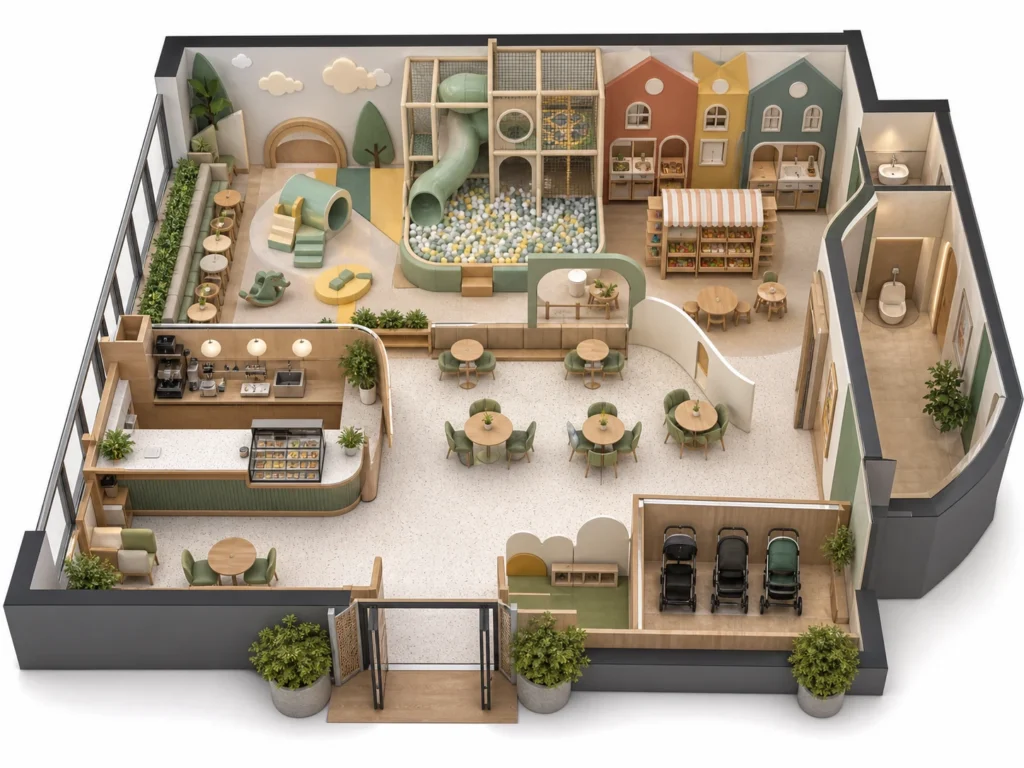
The layout must support it. Parent seating needs direct sightlines into play zones, power access, stroller storage, and a clear boundary between food and active play. Koalaplay’s open sightline play cafe layout concept shows why the seating zone is part of the revenue model, not just decoration.
What Should Be Included in a Play Cafe Membership?
A membership should include enough value to change behavior, but not so many perks that staff cannot manage it.
Useful perks include:
- Unlimited or limited monthly play sessions.
- Sibling discounts.
- 10% cafe discount.
- One free drink per month.
- One guest pass per month or quarter.
- Early access to classes or events.
- Birthday party discount.
- Priority booking during peak times.
- Member-only weekday events.
Be careful with “unlimited.” It sounds strong in marketing, but it can create capacity problems. Add clear rules:
- Sessions may be limited during peak times.
- Reservations may be required.
- Membership applies only to children in the same household.
- Socks and waivers are required.
- Caregivers must remain on-site.
- Outside food policies still apply.
- Party use is not included unless stated.
A good membership page should reduce awkward front-desk conversations.
How Equipment and Layout Affect Pricing Power
A higher membership price is easier to defend when the play experience feels rich, clean, and repeatable. Families notice when a play cafe has only a small toy corner. They also notice when a venue has a real toddler zone, a role play area, climbing, sensory panels, and seating that lets adults relax without losing visibility.
Commercial equipment changes the pricing conversation because it supports:
- Higher play value per visit.
- More repeat visits.
- Better age separation.
- Safer movement flow.
- Faster cleaning.
- More attractive photos.
- Stronger party bookings.
- Longer useful life under daily use.
For equipment planning, compare your concept with Koalaplay’s commercial indoor playground equipment solutions and the indoor playground equipment cost guide. These resources help connect membership pricing to real investment decisions instead of guessing from competitor menus.
Koalaplay Team Experience: Price Follows Flow
In Koalaplay project discussions, we often see owners focus first on admission price. But the price is usually a result of the layout.
A compact play cafe with poor sightlines may need more staff reminders, more parent movement, and more conflict between food areas and play areas. That makes families less likely to stay, buy another drink, or become members.
A better-designed play cafe lets parents understand the space quickly. They can enter, store shoes or strollers, order coffee, see the play zone, and guide children between age-appropriate areas. That flow supports membership pricing because repeat visits feel easy.
This is why parent seating, stroller parking, restroom access, play entry control, and cleaning routes should be designed before the membership menu is finalized.
For a more detailed explanation of terms such as play cafe, soft play, role play, and indoor play structures, see Koalaplay’s indoor playground names and definitions guide.
Safety and Cleaning Are Part of the Price
Parents may not say they are paying for ASTM awareness, padded edges, staff cleaning routines, or controlled access. But they feel the difference.
ASTM F1918 covers soft contained play equipment and is intended to reduce serious injury risk for that equipment category. CPSC guidance also points manufacturers and importers toward relevant playground safety recommendations and voluntary standards. The CDC notes that preschool-aged children should be active throughout the day, while children ages 6-17 need at least 60 minutes of activity daily.
For operators, these references matter because a play cafe membership is not only an entertainment product. It is also a trust product.
Your pricing should support:
- Daily cleaning labor.
- Ball pit and soft play sanitation routines.
- Replacement socks and hygiene supplies.
- Equipment inspections.
- Padding repairs.
- Staff training.
- Waiver management.
- Capacity control.
- Insurance and compliance support.
If prices are too low, cleaning and maintenance often suffer first. Families notice that quickly.
Play Cafe Pricing vs. Normal Cafe Pricing: Practical Comparison
Here is a realistic monthly family comparison.
| Scenario | Monthly Behavior | Estimated Spend |
|---|---|---|
| Normal cafe, one caregiver | 4 visits, coffee only | $15-$25 |
| Normal cafe, caregiver plus snack | 4 visits, drink and pastry | $35-$60 |
| Play cafe day pass | 4 visits for one child at $15 | $60 plus cafe purchases |
| Play cafe membership | Monthly pass for one child | $45-$70 plus cafe purchases |
| Play cafe family membership | 2 children | $70-$110+ plus cafe purchases |
A normal cafe is cheaper when the family only wants coffee. A play cafe becomes more valuable when the family needs a repeat indoor destination for children.
This is the central message for marketing:
Do not sell the membership as cheaper coffee. Sell it as a reliable weekly family routine.
How to Set Your Own Membership Price
Use these steps before publishing your menu.
1. Calculate Capacity
Estimate how many children can safely use the play area at one time. Do not base this only on square footage. Consider age zones, choke points, slides, ball pits, role play houses, and parent movement.
2. Set the Day Pass First
Your day pass anchors the membership.
If your day pass is $15, a $55-$65 monthly membership feels logical. If your day pass is $20, an $80 plan can still feel fair.
3. Decide the Break-Even Visit Count
For most venues, aim for 3.5-5 visits. Lower than that may underprice heavy users. Higher than that may reduce signups.
4. Add Sibling Logic
Families with two or three children need a reason to join. A full-price membership per child can feel too expensive.
Options include:
- 50%-70% sibling add-on.
- Family cap.
- Different plan for 2 children and 3+ children.
- Same-household-only rule.
5. Protect Peak Hours
If weekends fill up, do not let unlimited members crowd out day-pass families and parties. Use reservations, session limits, or off-peak plans.
6. Add Cafe Incentives Carefully
Cafe discounts can help, but do not train families to buy only discounted drinks. A monthly free drink is often cleaner than a deep everyday discount.
7. Recheck After 60-90 Days
Track:
- Member visits per month.
- Day-pass conversion rate.
- Cafe spend per member visit.
- Weekend capacity issues.
- Cancellation reasons.
- Cleaning labor.
- Party bookings from members.
Then adjust. Pricing should be tested, not guessed.
Membership Menu Example for a U.S. Play Cafe
Here is a simple sample structure for a small to mid-size indoor playground cafe:
| Plan | Price | Includes |
|---|---|---|
| 2-Hour Day Pass | $15 per child | Open play session |
| 5-Visit Pack | $67 | Save $8, valid 90 days |
| Monthly One Child | $59 | Unlimited weekday play, weekend reservations required |
| Monthly Two Children | $89 | Same household |
| Monthly Three Children | $109 | Same household |
| Premium Family | $139 | Full access, 1 guest pass, 10% party discount, 1 drink credit |
| Annual One Child | $590 | Pay 10 months, get 12 months |
This is only a model. A high-rent city, larger structure, or premium role play cafe may need higher prices. A smaller suburban soft play cafe may need a lower day pass and more birthday-party revenue.
Design Choices That Support Higher Membership Value
If you want parents to pay monthly, the space must feel repeatable. Children should find enough variety to return often, and caregivers should feel comfortable staying.
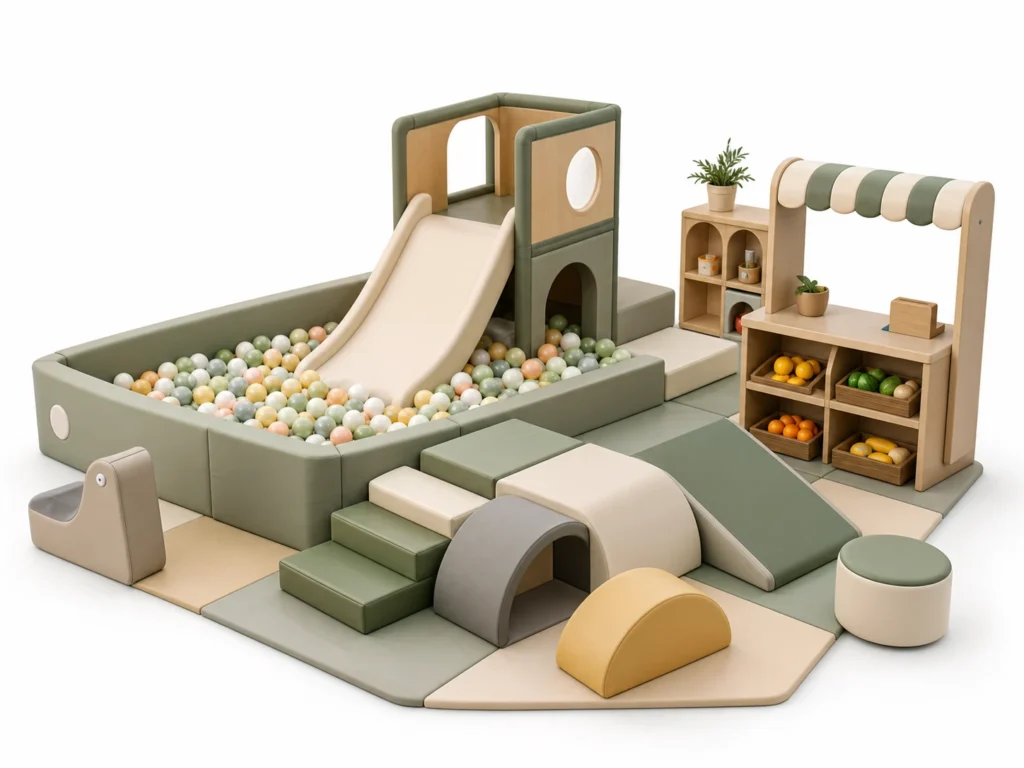
Strong membership-friendly features include:
- A toddler soft play zone for ages 0-3.
- A small climbing and slide structure for active play.
- A role play corner, such as market, kitchen, clinic, fire station, or mini town.
- Sensory walls and interactive panels.
- Clear shoe and sock storage.
- Cafe seating around the play perimeter.
- Easy restroom path.
- Stroller parking near entry.
- Party room or flexible event area.
- Durable padded flooring.
- Surfaces that are easy to clean.
Koalaplay’s space-themed parent lounge design is a good example of how the cafe zone can support dwell time, visibility, and premium positioning.
Common Pricing Mistakes to Avoid
Pricing Like a Normal Cafe
A play cafe has more costs than a standard cafe. If you price only around coffee margins, you may not cover cleaning, equipment wear, and staffing.
Making Unlimited Too Cheap
Heavy users are valuable, but they also consume capacity. Price unlimited memberships with real visit behavior in mind.
Ignoring Sibling Families
Many loyal customers have more than one child. If the second-child price feels unfair, they may stay with day passes or choose a free public option.
Hiding Rules
Rules should be clear before purchase. Mention session length, peak reservations, cancellation rules, socks, guest policies, age limits, and caregiver requirements.
Forgetting the Cafe Ticket
Admission brings families in. Food and drinks increase revenue per visit. Design the menu so parents can easily buy coffee, water, snacks, and child-friendly items without leaving the play sightline.
Related Guides
- Learn the full startup budget in Koalaplay’s play cafe cost guide.
- Compare equipment options through commercial indoor playground equipment solutions.
- Estimate investment with the indoor playground equipment cost guide.
- Review key industry terms in the indoor playground definitions guide.
- Explore a play cafe layout with open sightlines.
- See how a parent lounge can support revenue in this space-themed play cafe seating concept.
- Learn more about Koalaplay as an indoor playground and play cafe manufacturer.
FAQ
How much should an indoor playground cafe charge for a monthly membership?
Many U.S. play cafes price one-child monthly memberships around $35-$80. The right number depends on rent, capacity, equipment quality, local income, session length, and how many visits you expect members to make.
Is a play cafe membership worth it for parents?
It is usually worth it when a family visits 3-5 times per month. If the day pass is $15 and the monthly pass is $60, the membership breaks even at four visits.
Should a play cafe offer unlimited play?
Unlimited play can work, but it needs rules. Use session limits, reservation requirements, peak-hour controls, and same-household policies to protect capacity and customer experience.
How is an indoor playground cafe different from a normal cafe?
A normal cafe mainly sells drinks, food, and seating. An indoor playground cafe sells play admission, parent comfort, safe indoor activity, birthday potential, and repeat family routines, with cafe sales layered on top.
Should cafe drinks be included in the membership?
A small drink credit or monthly free drink can increase perceived value. Large ongoing discounts may reduce cafe margin, so operators should test carefully.
Plan Your Playground Project With Koalaplay
If you are planning an indoor playground cafe in the USA, send Koalaplay your site size, target age range, city or country, budget range, preferred theme, and installation needs. Our team can help you think through layout, play zones, parent sightlines, equipment mix, and membership-friendly design before you commit to production.
A strong pricing model starts with a strong space. When children want to return and parents feel comfortable staying, the membership becomes much easier to sell.
References
- Playgrounds Cafe Memberships
- Busy Bee Play Cafe Pricing
- Sip n’ Slide Play Cafe Membership
- The Play Cafe Marion Memberships
- Desert Bloom Play Cafe Memberships and Pricing
- Toast 2026 Restaurant Trends: Coffee Prices and Habits
- National Coffee Association Spring 2026 Coffee Data Release
- Specialty Coffee Association 2025 NCDT Specialty Coffee Report Summary
- ASTM F1918 Soft Contained Play Equipment Standard
- CPSC Playground Equipment Business Guidance
- CDC Child Physical Activity Guidelines




 English
 Spanish
 German