
Choosing indoor playground equipment for ages 2–5 is not just a product decision. It is also a design, safety, and revenue decision. At Koalaplay, we help clients build indoor playgrounds, play cafés, and role play spaces that match how preschool children move and interact. In this guide, we explain which six equipment types deliver the strongest value for children ages 2–5 and why the best results usually come from combining them into one intentional layout rather than buying one oversized structure.
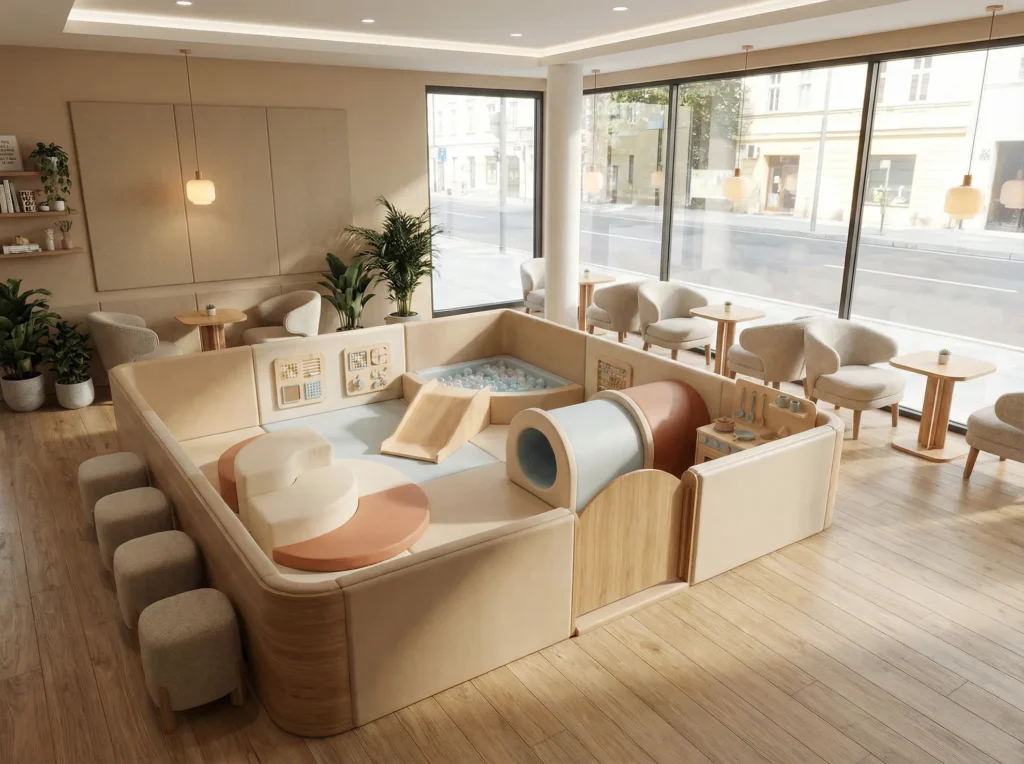
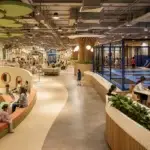
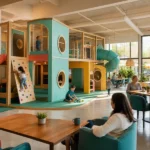
A well-zoned play café for ages 2–5 balances soft movement play, sensory interaction, role play, and comfortable parent seating.
Why ages 2–5 need a different indoor playground equipment mix
According to the U.S. Consumer Product Safety Commission, preschool-age children are ages 2 through 5, which is a meaningful category because their physical ability, risk awareness, and play behavior differ from older children’s . In practice, this means equipment for this age group should prioritize lower heights, softer landings, simple circulation, strong visibility, and more opportunities for guided imagination. The goal is not to make the environment boring. The goal is to make it confident, repeatable, and easy for children to use successfully.
That is especially important in commercial indoor play settings. Michele Caruana’s writing on play cafés emphasizes parent sightlines, seated supervision, calm traffic flow, and a memorable guest experience . For a broader look at commercial planning, see Koalaplay’s Indoor Playground Equipment Solutions and our guide on choosing age-appropriate playground equipment.
The best 6 indoor playground equipment choices for ages 2–5
The table below shows the six equipment categories we recommend for preschool-focused projects. The ranking reflects developmental value, operational practicality, and fit for modern indoor play businesses.
| Rank | Equipment type | Why it works for ages 2–5 | Best business use |
| 1 | Soft play climbers | Builds balance, climbing confidence, and whole-body movement with low-height risk | Core toddler and preschool zone |
| 2 | Toddler soft slides | Delivers excitement with predictable traffic flow and easy supervision | Small and medium indoor playgrounds |
| 3 | Ball pits | Adds sensory attraction and strong visual appeal | High-repeat family venues and play cafés |
| 4 | Crawling tunnels | Encourages exploration without requiring a large footprint | Compact layouts and perimeter circulation |
| 5 | Sensory play panels | Supports quiet engagement and inclusive play | Waiting areas, walls, calmer corners |
| 6 | Role play stations | Strengthens language, social play, and longer dwell time | Play cafés and role play businesses |
1. Soft play climbers
If we had to choose one foundational category, we would start with soft play climbers. They help young children practice climbing, crawling, stepping, balancing, and body control in a format that feels achievable rather than intimidating. Because the modules are low to the ground and heavily padded, children can repeat the same movement patterns many times, which is exactly how confidence develops in this age range.
Soft play climbers also make business sense. They are modular, easy to scale, and suitable for both open toddler areas and more enclosed preschool zones. In a play café, this category often becomes the “anchor” that parents immediately understand and trust. Koalaplay’s soft foam climber solutions are especially useful when you want a safe first layer of movement before introducing more stimulating features.
2. Toddler soft slides
A toddler soft slide adds a simple thrill that younger children can master quickly. For ages 2–5, the best slides are not tall or aggressive. They are low, smooth, easy to climb, and positioned so children can enter and exit without crossing too many other traffic lines. This predictability matters because preschoolers often repeat favorite actions dozens of times in one visit.
From an operator’s perspective, low soft slides create high engagement without the ceiling height or complexity of larger structures. If your project is aimed at younger families, Koalaplay’s toddler soft slides can be combined naturally with climbers, tunnels, and ball pits to create a compact but satisfying play loop.
3. Ball pits
A ball pit remains one of the most recognizable preschool attractions because it combines movement, sensory feedback, and strong visual appeal. Children can sit, dig, climb in and out, and play socially without complex rules. For ages 2–5, the best commercial ball pits are shallow enough to feel manageable, padded on all edges, and positioned where caregivers can supervise easily.
Ball pits are also valuable because they raise the perceived richness of a venue. In a boutique play café, a well-designed ball pit often becomes a zone families notice first. That said, it works best when paired with clear cleaning routines, open sightlines, and nearby lower-energy play options. Koalaplay offers toddler ball pit solutions that fit both dedicated toddler areas and mixed-use family venues.
4. Crawling tunnels
Crawling tunnels are underrated in commercial design, especially for smaller footprints. They give children a sense of journey and discovery without forcing you to add height or large structural spans. For preschoolers, tunnels support crawling, sequencing, body awareness, and hide-and-seek style exploration in a controlled format.
Michele Caruana’s planning advice is useful here because she emphasizes intentional circulation rather than random equipment placement . A tunnel can connect zones, soften awkward corners, and keep the room feeling active even when the total footprint is limited. For owners who want to make a modest floor plan feel more dynamic, Koalaplay’s crawling tunnels are one of the highest-value additions per square meter.
5. Sensory play panels
Not every successful play feature needs to be climbed, jumped on, or entered. Sensory play panels give ages 2–5 another way to engage through touch, spinning components, textures, cause-and-effect play, and quieter concentration. They are particularly helpful in indoor spaces that need a calmer rhythm, more inclusive design, or activities along walls and transitions.
This matters commercially because parents do not always want every minute of a visit to feel chaotic. Sensory panels create useful “pause points” while still supporting meaningful play. They also help use vertical surfaces efficiently, which is important in cafés, waiting zones, and party circulation routes. Koalaplay’s sensory play panels are often combined with soft play structures so the venue serves both active preschoolers and children who prefer lower-intensity interaction.
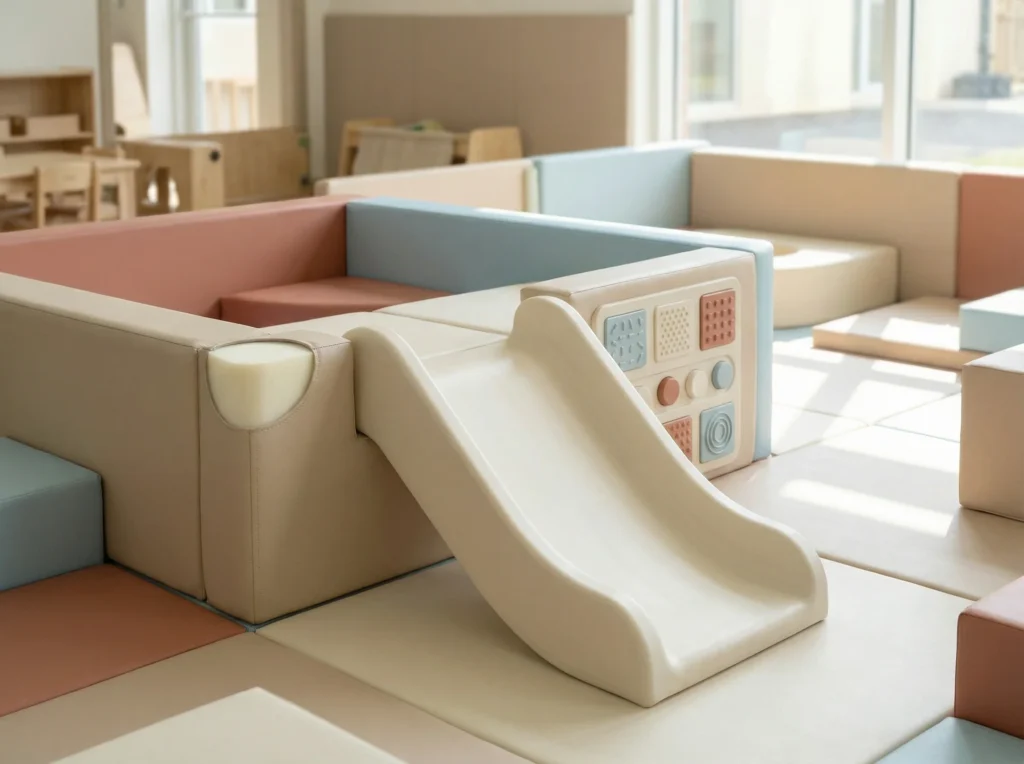
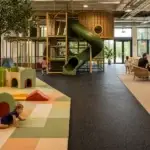
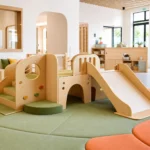
Caption: For ages 2–5, rounded edges, thick padding, and easy-clean materials matter as much as the play feature itself.
6. Role play stations
For many buyers, the surprise recommendation in this list is role play equipment. Yet it is often one of the smartest investments, especially in play cafés and themed preschool environments. The American Academy of Pediatrics notes that pretend play helps children socialize, strengthen language development, and build key life skills such as communication, teamwork, and problem solving . NAEYC also treats dramatic play as a meaningful early childhood learning topic tied to language, literacy, storytelling, and broader development .
That developmental value translates into business value. Role play stations such as mini markets, play kitchens, doctor corners, or pretend cafés slow the pace of the visit in a positive way. They give children reasons to talk, negotiate, imitate adults, and stay engaged longer. They also align closely with what many modern family businesses want: a space that feels enriching, not just energetic. If your concept leans toward imaginative or educational play, explore Koalaplay’s children’s role-playing equipment and our article on the importance of pretend play.
How to combine the six into a profitable play café or preschool layout
The most effective preschool indoor playgrounds usually combine all six categories in different proportions. In our experience, the strongest layout starts with a soft play core, adds one slide and one ball pit for high-repeat attraction, uses tunnels and sensory panels to distribute activity, and finishes with a role play corner that extends dwell time. This balance matters because too much high-energy equipment can create visual stress for caregivers, while too little movement play can reduce excitement.
The image below shows a direct six-equipment display, which is often easier for buyers to evaluate than an abstract diagram.
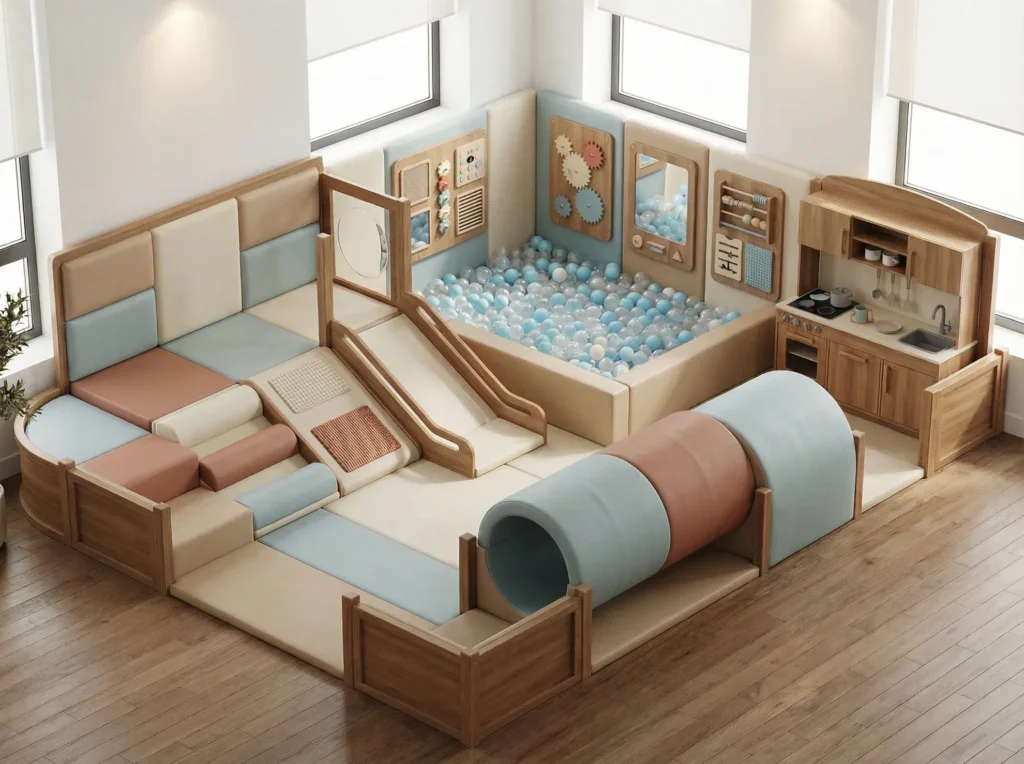
Caption: A preschool-friendly equipment mix should balance movement play, sensory play, and pretend play rather than over-relying on one feature type.
A useful planning principle from Michele Caruana’s content is that parents should be able to understand the room quickly and supervise comfortably from where they sit . That is why we often recommend placing the most active equipment in the center, quieter sensory features along walls, and role play zones near café seating. If you are building a new concept, Koalaplay’s guides to profitable play café design and indoor play café manufacturing for commercial venues offer a useful next step.
| Layout goal | Recommended equipment priority | Why it matters |
| Strong first impression | Ball pit + slide + soft play core | Creates immediate visual appeal and easy understanding |
| Longer dwell time | Role play stations + sensory panels | Encourages slower, richer engagement |
| Better supervision | Low partitions + central active zone | Improves sightlines and parent comfort |
| Smaller footprint efficiency | Tunnels + wall panels + modular climbers | Uses floor and wall space more intelligently |
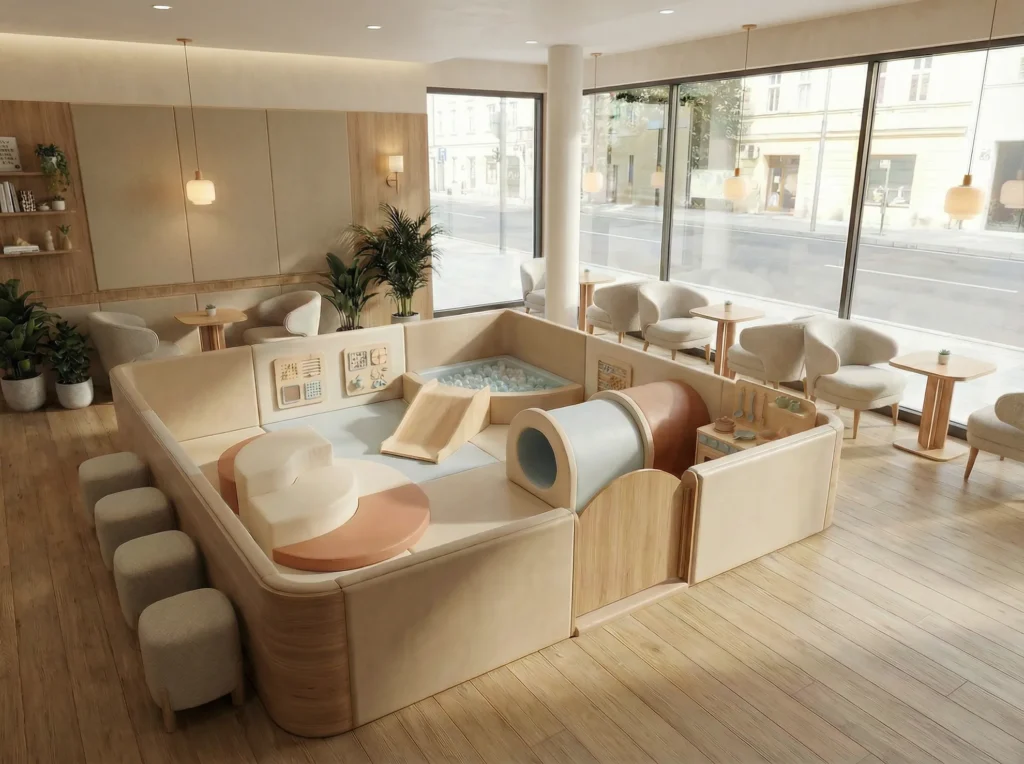
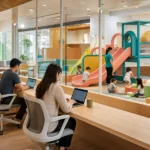
Caption: A profitable preschool layout often combines an active center zone with sensory walls, role play corners, and direct parent sightlines.
Conclusion
The best indoor playground equipment for ages 2–5 is not a single hero product. It is a carefully layered mix of soft play climbers, low slides, ball pits, tunnels, sensory panels, and role play stations that fits both child development and business operations. When these features are planned together, the result is a safer, calmer, and more commercially effective environment for modern families.
Ready to get started? Contact the Koalaplay team for a free consultation and a custom equipment concept for your play café, preschool zone, or indoor playground project.
Frequently Asked Questions
What indoor playground equipment is best for children ages 2–5?
The best starting mix usually includes soft play climbers, toddler slides, a shallow ball pit, crawling tunnels, sensory panels, and a role play station. Together, these features support movement, sensory engagement, and imaginative play while staying manageable for preschool users.
How do you choose safe indoor playground equipment for toddlers and preschoolers?
Look for low-height equipment, rounded edges, padded flooring, simple circulation paths, and clear visibility for caregivers. It is also important to choose equipment scaled specifically for preschool-age children rather than downsizing products intended for older kids .
Do play cafés need role play equipment or only soft play?
Play cafés work best when they include both. Soft play creates movement and excitement, while role play equipment encourages language, cooperation, and longer dwell time, which can support café spending and repeat visits .
What is the best starter equipment mix for a small indoor play café?
For a compact venue, we usually recommend one modular soft play climber, one low slide, a small ball pit, one tunnel route, wall-mounted sensory panels, and a compact role play station.
References
[1] U.S. Consumer Product Safety Commission. Public Playground Safety Handbook (2025)
[2] HealthyChildren.org. Pretend Play: Ways Children Can Exercise Their Imagination (2023)
[3] NAEYC. Dramatic Play topic page
[4] Michele Caruana. 2026 Play Cafe Trends
[5] Michele Caruana. 6 Tips for Planning Your Play Cafe or Indoor Playground Space




 English
 Spanish
 German