
You’ve noticed the pattern: families with young children visit once, maybe twice, then disappear. Parents arrive stressed about keeping kids quiet during services. Your nursery volunteers spend more time managing restless toddlers than connecting with families. Meanwhile, churches across town are seeing packed parking lots on Sunday mornings—not because of better sermons, but because they invested in something simple: a dedicated indoor play space.
The reality is harsh. When children associate church with “sit still and be quiet,” they don’t want to come back. Parents feel it too—the constant negotiation, the apologetic glances, the early exits. You’re losing families not because your ministry isn’t strong, but because your facility doesn’t signal “kids are genuinely welcome here.”
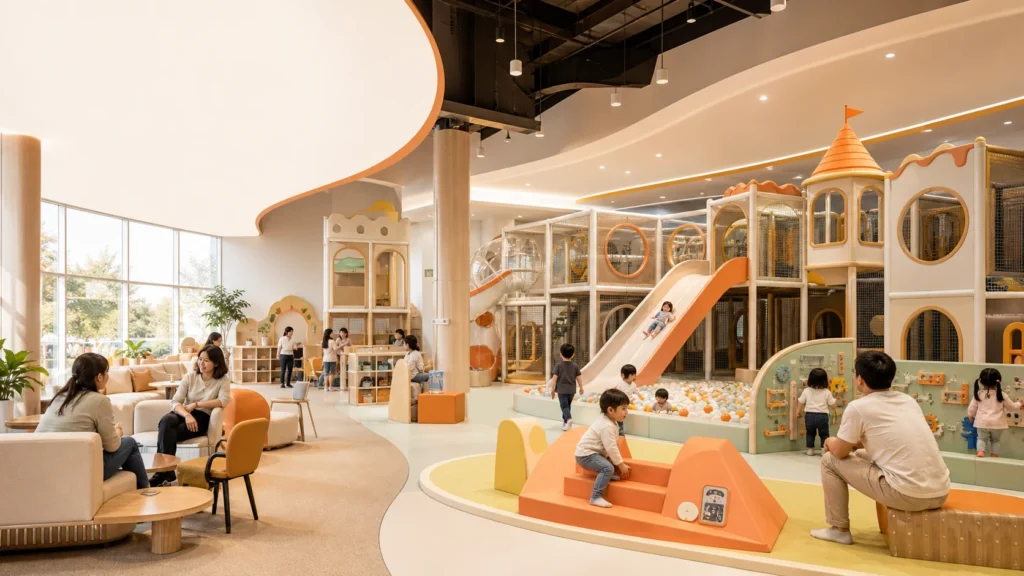
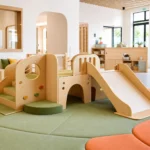
A church indoor playground changes this conversation entirely. It transforms your fellowship hall, gym, or family life center into a space where children actually want to be—rain, snow, or summer heat. Parents relax knowing their kids are safe, engaged, and building friendships with other church families. Your volunteers shift from crowd control to genuine ministry. And when families ask “where should we visit this Sunday,” your church becomes the obvious answer.
This guide covers everything you need to make an indoor playground project successful: themes that connect to biblical stories, realistic budget ranges, safety standards that protect both children and your church, and the practical details of sizing, installation, and long-term operation.
Why Churches Are Choosing Indoor Playgrounds in 2026
The decision to add indoor play equipment isn’t about entertainment—it’s about removing barriers that keep young families from fully participating in church life.
Weather-independent fellowship: Outdoor playgrounds sit empty from November through March in most U.S. climates. Ice, rain, and extreme heat make outdoor play unpredictable. An indoor space works every single week, creating consistent programming for children’s ministry, mother’s day out groups, and midweek Bible studies.
Extended dwell time: When families arrive 20 minutes early because kids are excited to play, you gain time for genuine connection. Post-service play means parents actually participate in fellowship instead of rushing home for naps. Churches report 30–45 minute increases in campus time when indoor play is available.
Childcare that attracts rather than obligates: Many churches struggle to recruit nursery volunteers. When you install quality play equipment, volunteering becomes more appealing—kids are engaged, parents check in happier, and the space itself does half the work of keeping children occupied during services.
Ministry beyond Sunday mornings: Indoor playgrounds open your facility for weekday community programs—play groups, homeschool co-ops, special needs family events, and even revenue-generating rentals that help fund other ministry areas.
Churches like The Woodlands Church in Texas built a 40-foot atrium playground that now serves as a community hub Monday through Thursday, with families driving 30+ minutes just to use the space. It’s become an entry point for unchurched families who later join weekend services.
The 7 Church Spaces That Work for Indoor Play
Not every church needs to build a massive climbing structure. The best playground fits your actual space and congregation size.
Fellowship Hall
The most common location for church indoor playgrounds. Fellowship halls offer open floor plans, existing HVAC systems, and multi-purpose flexibility. Key considerations: storage for tables and chairs, sound dampening for adjacent worship spaces, and parent seating with clear sightlines.
Typical ceiling height needed: 12–16 feet for multi-level structures, or 8–10 feet for toddler-only soft play zones.
Church Gym or Family Life Center
Ideal for larger congregations. High ceilings (18–25 feet) allow for dramatic vertical structures that create “wow factor” and accommodate wider age ranges. Gyms already have durable flooring and can handle high traffic volume.
Trade-off: scheduling conflicts with youth sports, VBS, and special events. Many churches zone half the gym for permanent play equipment and leave half open for basketball courts or multipurpose use.
Dedicated Children’s Wing
Purpose-built spaces near check-in areas or Sunday school classrooms. These work well for churches with consistent children’s programming throughout the week. Parents appreciate the proximity—they can see the play area while picking up older kids from class.
Church Basement or Lower Level
Often underutilized space that’s naturally separated from worship areas for sound control. Basements stay cooler in summer and are easier to climate-control year-round. Watch for: lower ceiling heights (requiring compact designs), potential moisture issues, and accessibility for families with strollers or mobility limitations.
Converted Classrooms
Small to mid-sized churches repurpose 2–3 adjoining classrooms into a single play zone. Removing one interior wall creates 600–900 square feet—enough for a well-designed toddler area plus parent seating. Requires structural engineering approval but costs less than new construction.
Church Foyer or Commons Area
Creates immediate visibility when families enter. Children see the play space first thing, which sets a welcoming tone. Works best for compact, visually appealing structures that don’t obstruct traffic flow. Consider noise levels if adjacent to sanctuary.
Outdoor-to-Indoor Hybrid
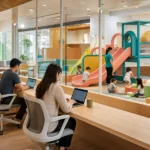
Some churches install covered, climate-controlled pavilions that function year-round. Glass walls let parents supervise from indoor seating while children play in a semi-outdoor environment. Higher initial cost but solves the “wasted outdoor equipment” problem.
Biblical Themes That Connect Faith and Play
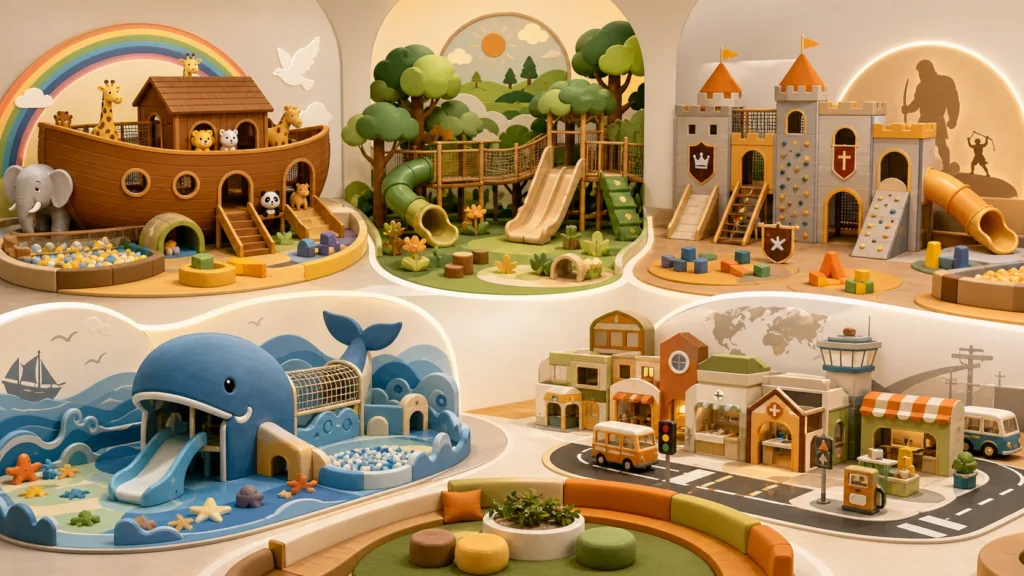
Generic playground equipment is fine—but themed structures create storytelling opportunities that reinforce the biblical narratives children learn in Sunday school.
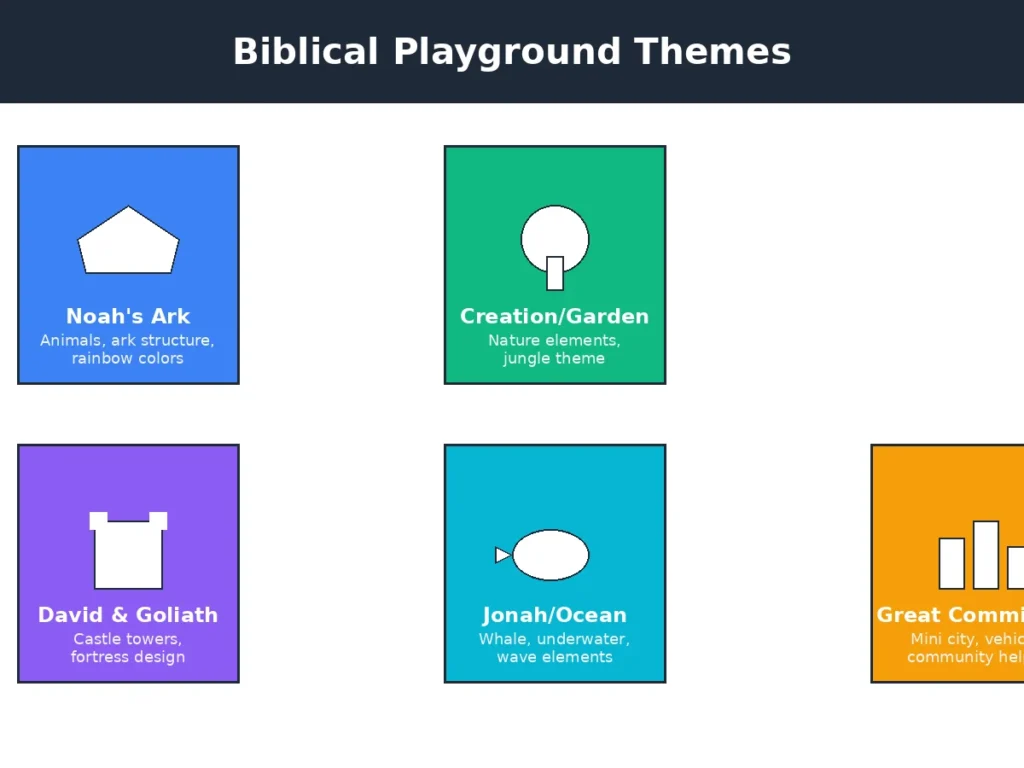
Noah’s Ark Theme
The most requested church playground theme in 2026. Animal figures, ark-shaped structures, and rainbow color schemes make immediate visual connections to Genesis. Children naturally play out the story—loading animals two-by-two, navigating the “flood,” reaching safe harbor.
Design elements: ship bow and stern, animal cutouts (elephants, giraffes, lions), gangplank climbers, wave-pattern soft play elements. Works well with animal and farm theme playground structures.
Creation Story / Garden of Eden
Jungle and forest themes tie directly to Genesis creation narrative. Greenery, earth tones, nature-inspired climbing elements, and “garden” role play zones let kids explore the world God made.
Best for: churches emphasizing environmental stewardship, outdoor ministry programs, or nature-based VBS themes. Pairs naturally with jungle theme or natural forest theme equipment.
David and Goliath Castle
Castle structures represent both the stronghold of faith and the battlefield where David defeated Goliath. Towers, climbing walls, and fortress-style play areas create natural teaching moments about courage, faith, and trusting God in difficult circumstances.
Design elements: castle turrets, stone-texture panels, shields and armor imagery, “giant” height measurements. Connects to castle and princess theme structures.
Jonah and the Whale
Ocean themes provide a natural backdrop for the Jonah story. Whale-shaped structures, underwater panels, fishing boats, and wave slides help children visualize obedience, consequence, and God’s mercy.
Works particularly well for: coastal churches, summer VBS programs, and churches with baptism-focused children’s teaching. Ocean theme playground equipment available at Koalaplay’s ocean collection.
Great Commission / Missions Focus
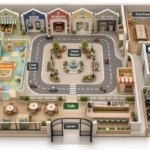
City or transportation themes can represent the Great Commission—going into all the world. Mini cities, vehicles, roads, and community buildings teach children about serving others and sharing faith globally.
Best paired with mini city theme structures and role play zones like markets, hospitals, and community helpers.
Neutral Faith-Friendly Options
Not every church wants explicit biblical imagery. Space themes (reaching for heaven, God’s infinite creation), candy/macaron themes (sweetness of God’s love), and abstract colorful designs work beautifully while remaining welcoming to unchurched visitors.
The key is intentionality—whatever theme you choose, train your volunteers to use the space as a teaching tool during kids’ ministry activities.
Age Zoning: Designing for Nursery Through Elementary
One universal playground rarely serves all ages well. Churches see better engagement and safety when zones are clearly defined by developmental stage.
Nursery (0–2 years): Soft foam structures, low-height climbing (under 24 inches), sensory panels, crawling tubes, and cushioned ball pits. Parent supervision is mandatory, so locate this zone within direct sightline of seating areas. Requires impact-absorbing flooring even at low heights.
Toddler (2–4 years): Gentle slides under 4 feet, small climbers, simple imaginative play elements (steering wheels, mirrors, activity boards). Toddlers need visual barriers from older kids but should still feel connected to the larger play area. Dedicated toddler zones reduce collision accidents by 60–70%.
Preschool (4–6 years): Multi-level structures up to 6 feet high, tube slides, bridges, climbing walls with large handholds. This age group benefits from imaginative play zones—mini kitchens, market stalls, pretend vehicles—that encourage social interaction and role play.
Early Elementary (6–9 years): Taller climbing structures (8–12 feet), more challenging routes, longer slides, and physical skill elements like rope climbers or ninja course obstacles. This group needs space to burn energy and test growing physical capabilities.
Pre-Teen (10–12 years): Often excluded from traditional playgrounds but still benefit from dedicated space. Consider: basketball hoops, foosball tables, interactive gaming zones, or smaller ninja courses that feel “age-appropriate” rather than “babyish.”
Multi-age considerations: If your budget allows only one structure, design around the 2–9 age band with 50% easy access and 50% challenging routes. Add a separate toddler corner with portable soft foam blocks. Avoid designs where one age group blocks another’s play path.
Sizing Your Space: From Compact to Flagship Builds
Church playgrounds range from 200 square feet (single toddler zone) to 2,000+ square feet (multi-level structures serving 50+ kids simultaneously).
Under 500 sq ft — Compact Solutions
Perfect for small churches (under 150 weekly attendance). Focus on one age group or a tight multi-age design. Ceiling height becomes critical—8-foot ceilings limit you to single-level toddler play; 12+ feet open up two-story structures.
Budget range: $10,000–$25,000 including installation and safety surfacing.
500–1,000 sq ft — Mid-Size Builds
Accommodates 20–30 children with distinct zones for toddlers and elementary ages. Room for themed elements, parent seating, and basic amenities (cubby storage, hand sanitizer stations, first aid). Most mid-sized churches (150–400 attendance) land here.
Budget range: $25,000–$60,000.
1,000–1,500 sq ft — Full-Feature Installations
Multi-age structures, dedicated toddler zones, role play areas, and ample parent seating. Can include special features like separate entrance/exit for crowd control, storage rooms for ministry supplies, and flex space for small group activities.
Budget range: $60,000–$120,000.
1,500+ sq ft — Flagship Projects
Large churches (800+ attendance) creating community destinations. These spaces rival commercial play centers—multiple structures, diverse play types (active + imaginative + quiet zones), café-style parent areas, and full ministry programming capabilities.
Budget range: $120,000–$250,000+.
Ceiling height matters more than footprint: A 600 sq ft room with 18-foot ceilings can hold a more impressive playground than a 900 sq ft room with 9-foot ceilings. Vertical space creates visual impact and allows older kids to climb high while toddlers play safely below.
Safety Standards Every Church Should Require
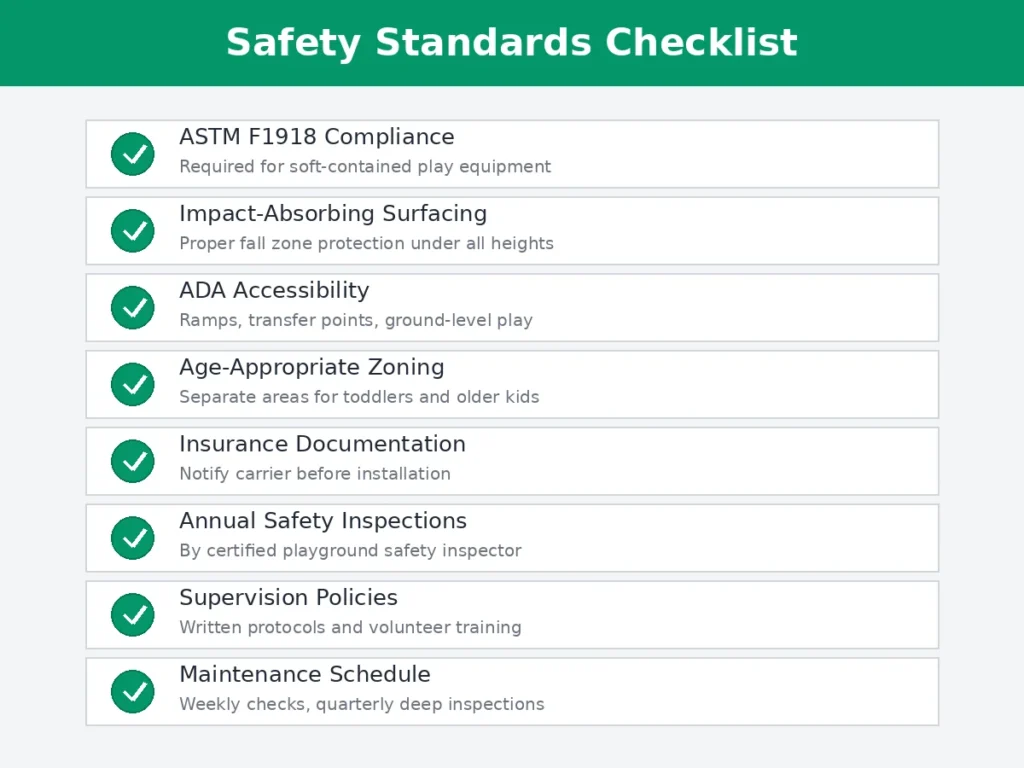
Church insurance companies increasingly require documented safety compliance for indoor play equipment. These aren’t optional recommendations—they’re liability protection.
ASTM F1918 Standard
The primary U.S. safety standard for soft-contained play equipment (the official term for commercial indoor playgrounds). ASTM F1918 covers structural integrity, entrapment hazards, fall zones, and maintenance requirements.
What it means for you: Any manufacturer should provide ASTM F1918 compliance documentation before installation. This proves the equipment was designed to prevent common injury scenarios—head entrapment, fall hazards, sharp edges, and structural failure.
CPSC Guidelines
The Consumer Product Safety Commission publishes playground safety handbooks that supplement ASTM standards. Key requirements include impact-absorbing surfaces under all elevated structures, proper clearances between moving parts, and age-appropriate challenge levels.
ADA Accessibility
Federal law requires public accommodations—including churches—to provide accessible play opportunities for children with disabilities. This doesn’t mean every element must be wheelchair-accessible, but you need multiple ground-level play activities and accessible routes to some elevated components.
Practical implementation: ramps instead of stairs for one route, sensory play panels at wheelchair height, transfer platforms, and adequate maneuvering space (60-inch diameter minimum).
State and Local Requirements
Some states add specific requirements beyond ASTM standards. California requires annual inspections by certified playground safety inspectors. Florida mandates specific fall surface depths. Check your state’s playground safety regulations before finalizing designs.
Insurance Documentation
Before purchasing, confirm your church insurance will cover the equipment. Most carriers require:
- Proof of ASTM compliance
- Installation by manufacturer-certified installers (volunteer labor may void coverage)
- Annual safety inspection records
- Posted age range signs and supervision policies
- Incident reporting procedures
Churches that skip this step face coverage denials when injuries occur—even minor ones.
Real Budget Ranges and What Drives the Cost
Church playground budgets vary dramatically based on size, complexity, and installation scope. Here’s what the numbers actually look like in 2026.
Entry-Level Builds: $10,000–$20,000
Small footprint (200–400 sq ft), single structure or toddler-focused soft play. Includes basic safety surfacing, shipping, and manufacturer installation. Works for churches with 50–150 attendance wanting a meaningful but modest upgrade.
Mid-Range Projects: $20,000–$60,000
Multi-zone designs (600–1,000 sq ft) with age-appropriate structures, themed elements, and quality construction. Most churches land here. This budget allows custom colors, biblical theme integration, and professional site preparation.
Premium Installations: $60,000–$150,000
Flagship builds for larger congregations. Multi-story structures, extensive theming, integrated role play zones, premium materials, and complete space transformation. Includes architectural planning, electrical work for lighting, and higher-end finishes.
Cost drivers you control:
- Ceiling height: Taller structures cost more but create bigger visual impact
- Custom theming: Off-the-shelf colors cost less; custom Noah’s Ark detailing adds 15–25%
- Site prep: Level concrete floors need minimal prep; older gym floors or basements may require subfloor work
- Installation method: Manufacturer installation is safer but costs 25–40% more than volunteer labor (which may void warranty)
- Additional zones: Each separate area (toddler zone, role play, active play) increases cost
Cost drivers you can’t control:
- Safety surfacing requirements (non-negotiable)
- Structural engineering for elevated components
- Compliance with local building codes
- Shipping distance from manufacturer
Manufacturer-direct vs. dealer pricing: Working directly with manufacturers like Koalaplay typically saves 20–35% compared to U.S. distributor markup. The trade-off is longer lead times (international shipping) and managing project coordination yourself versus having a local representative handle details.
How Churches Fund Indoor Playground Projects
Few churches have $30,000–$100,000 sitting in the general budget. Here’s how most projects actually get funded.
Capital campaigns: The most common path. Churches announce the vision, set a fundraising timeline (typically 6–12 months), and invite congregation members to give above regular tithes. Campaigns work best when paired with naming opportunities—donors who give $5,000+ might fund specific themed elements or dedicate the space in memory of a loved one.
Grant funding: Several foundations specifically fund playground projects at faith-based organizations. The KaBOOM! Community Grant Program has funded hundreds of church playgrounds. The Community Development Block Grant (CDBG) program covers playground costs for churches in qualifying low-income neighborhoods. State-level faith-based grant programs exist in Texas, Florida, and Pennsylvania.
Start your grant search at KaBOOM.org and your state’s economic development office.
Donor matching: Announce that a church member or family will match all contributions up to $X amount. Matching challenges typically double participation rates and shorten fundraising timelines from 12 months to 4–6 months.
Phased installation: Install the core structure now, add themed elements and role play zones later when additional funds are raised. Most manufacturers accommodate phased projects—just ensure the initial design leaves logical expansion points.
Memorial or celebration gifts: Position the playground as a memorial opportunity. Families dealing with loss often want meaningful ways to honor loved ones. Similarly, major life celebrations (50th anniversaries, pastoral milestones) can inspire large gifts.
Financing options: Several manufacturers offer financing through Wells Fargo or Affirm. Monthly payments of $800–$2,000 make projects accessible without waiting for full fundraising. Watch for interest rates—church loans often qualify for lower rates than standard commercial financing.
What not to do: Don’t launch a playground project without board approval and clear financial commitment. Abandoned half-funded playground campaigns damage giving culture and leadership credibility.
Installation Timeline: Design to Opening Day
Realistic project timelines prevent frustration and help manage congregation expectations.
Phase 1: Planning and Design (2–6 weeks)
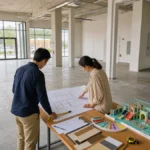
Submit floor plans, photos, and project requirements to manufacturer. Receive 3D design concepts, refine layout, select colors and themes, confirm budget. Churches working with Koalaplay receive free preliminary design at this stage—no purchase commitment required.
Phase 2: Manufacturing (10–25 days)
Custom playground structures are built to order. Production time depends on complexity and current order volume. Themed elements, custom colors, and integrated role play zones take longer than standard designs.
Phase 3: Shipping (15–45 days)
International shipping from China-based manufacturers typically takes 25–35 days ocean freight, plus customs clearance. Delays happen—factor buffer time into your announcement plans. Domestic shipping (if buying from U.S. distributor) cuts this to 7–14 days but increases total cost.
Phase 4: Site Preparation (3–7 days)
Floor cleaning, marking installation zones, electrical work for LED lighting (if included), and minor construction for access gates or safety barriers. Some churches handle this with volunteer labor; others hire contractors.
Phase 5: Installation (5–20 days)
Professional installation ensures safety compliance and warranty coverage. Small structures (under 500 sq ft) install in 1 week. Complex multi-zone builds take 2–3 weeks. Manufacturer-certified installers know how to anchor structures properly, test safety zones, and document compliance for insurance.
Phase 6: Inspection and Opening (1–2 weeks)
Conduct final walk-through, test all components, document safety features, train ministry volunteers on supervision protocols, and create usage policies. Some churches invite families for a “soft opening” before the official launch.
Total timeline: 8–16 weeks from signed contract to first use. Rushing installation creates safety risks and poor quality outcomes. Churches that add buffer time for unexpected delays report smoother projects and less congregational frustration.
Questions to Ask Before Choosing a Supplier
Not all indoor playground manufacturers are equal. Ask these questions before committing to a vendor.
Do you provide ASTM F1918 compliance documentation?
If the answer isn’t an immediate “yes” with specifics about testing and certification, walk away. Compliance isn’t optional.
Who performs installation, and is it included in pricing?
Some manufacturers quote equipment-only pricing, leaving you to coordinate shipping, site prep, and installation separately. Others bundle everything. Understand what’s included before comparing bids.
What’s your warranty structure?
Typical warranties: 2 years structural, 1 year on moving parts and soft components. Ask specifically about: structural frame, foam padding, plastic components, climbing elements, and slide surfaces. Who pays shipping if a warranty claim requires replacement parts?
Can you accommodate phased builds?
If budget constraints mean starting smaller and expanding later, confirm the manufacturer designs with expansion in mind. Retrofit additions are possible but costlier than planned expansion.
Do you offer free preliminary design?
Reputable manufacturers provide concept designs based on your floor plan before requiring payment. This lets you evaluate feasibility and make informed budget decisions. Koalaplay offers free design service for church projects—submit your space details, receive 3D renders showing what’s possible.
How do you handle site-specific challenges?
Support columns, low ceilings, irregular room shapes, multiple exits, and HVAC placement all affect layout. Experienced manufacturers design around obstacles. Inexperienced ones deliver generic structures that don’t fit well.
What references can you provide from other churches?
Ask for contact information for 3–5 recent church installations. Call them. Ask about communication, timeline accuracy, installation quality, and post-installation support. A supplier unwilling to share references is hiding problems.
What happens if there’s a defect or safety issue post-installation?
Understand the response protocol. Reputable manufacturers send replacement parts or technicians for genuine safety defects. Less reputable ones point to warranty fine print and stall.
What to Avoid: Common Church Playground Mistakes
Learn from churches that stumbled so yours doesn’t have to.
Mistake 1: Buying residential-grade equipment for church use
Backyard playsets aren’t built for 40–100 kids per week. They fail within months under commercial use, leaving you with broken equipment and wasted money. Commercial-grade construction costs more but lasts 10–15 years instead of 2–3.
Mistake 2: Skipping proper safety surfacing
Foam tiles, rubber matting, or poured rubber surfacing aren’t optional luxuries—they’re injury prevention. Falls from elevated structures onto concrete or thin carpet cause the majority of playground injuries. Budget $3–$8 per square foot for proper impact-absorbing surfaces.
Mistake 3: No clear supervision plan
Who’s responsible when 20 kids are playing? Churches without written supervision policies face liability exposure and volunteer confusion. Define: volunteer ratios, check-in procedures, behavior rules, injury protocols, and who’s in charge during different service times.
Mistake 4: Undersized toddler zones
Families with infants and toddlers are your fastest-growing demographic. If toddlers can’t play safely because older kids dominate the space, you’ve solved nothing. Dedicate minimum 20% of total playground square footage to 0–4 year age group.
Mistake 5: Ignoring acoustics
Indoor playgrounds are loud. Without acoustic treatment (foam panels, ceiling baffles, soft surfaces), sound bounces off gym walls and becomes overwhelming. Budget $1,500–$5,000 for sound dampening if your playground is in a high-echo space.
Mistake 6: No parent seating or sightlines
Parents won’t relax unless they can see their children while sitting comfortably. Design parent seating into the space from day one—benches, café tables, or lounge seating with clear views of all play zones.
Mistake 7: Launching without insurance review
Adding playground equipment changes your liability profile. Review your policy with your insurance agent before installation. Some carriers exclude injury claims from play equipment unless specific coverage is purchased.
Working with Koalaplay: Manufacturer-Direct Church Projects
Koalaplay specializes in custom indoor playgrounds for commercial venues worldwide, including faith-based organizations across the United States. As a direct manufacturer, we offer several advantages for church projects.
Free design consultation: Submit your floor plan, photos, ceiling height, and project goals. Our design team creates 3D renderings showing multiple layout options, themed variations, and budget tiers. No purchase required—this helps your leadership team evaluate feasibility before fundraising begins.
Biblical theme integration: We map our existing theme library (castle, ocean, jungle, animal/farm, space) to biblical narratives churches request—Noah’s Ark, Creation, David and Goliath, Great Commission cities, and more. Custom color schemes match your sanctuary or children’s wing branding.
Certified safety compliance: Every structure is engineered to meet ASTM F1918 standards with documentation for your insurance carrier. We provide installation manuals, maintenance guides, and safety inspection checklists.
Project coordination support: Our team guides you through site preparation requirements, coordinates shipping logistics, and provides installation scheduling. While we’re based in China, our U.S. project managers handle communication in your timezone.
Role play zones integration: Beyond climbing structures, we manufacture immersive pretend-play environments—mini markets, kitchens, hospitals, and community helper stations. These work beautifully in church settings for VBS activities, children’s ministry lessons, and imaginative play that teaches biblical values.
Churches appreciate manufacturer-direct pricing without dealer markup. The trade-off is longer lead times compared to buying from local U.S. distributors—but most congregations prefer saving 20–35% and planning around a 12–16 week timeline.
Contact our team at koalaplayground2025@gmail.com or +86-15355987193 (WhatsApp available) to start your church playground project.
FAQ: Church Indoor Playground Questions
How much space do we need for a church indoor playground?
Minimum 200 square feet for a toddler-only zone. 500–800 square feet accommodates multi-age designs serving 15–25 children simultaneously. 1,000+ square feet allows for distinct age zones, themed areas, and parent seating. Ceiling height matters as much as floor space—8 feet limits you to single-level designs, while 14+ feet enables impressive vertical structures.
What’s the typical lifespan of church playground equipment?
Commercial-grade indoor playgrounds last 10–15 years with proper maintenance. Structural frames (steel or heavy-duty plastic) last longest. Soft foam padding and vinyl surfaces need replacement every 5–7 years in high-traffic churches. Slide surfaces and climbing nets typically last 7–10 years. Budget 2–3% of original cost annually for maintenance and part replacement.
Do we need special insurance for indoor playground equipment?
Most church general liability policies cover playground equipment, but you must notify your carrier before installation. Some insurers require additional premium or specific coverage riders. Expect questions about ASTM compliance, supervision policies, maintenance schedules, and installation methods. Never assume coverage—confirm in writing before children use the equipment.
Can we install playground equipment ourselves to save money?
Volunteer installation is possible but rarely recommended. Self-installation may void manufacturer warranty, create insurance coverage gaps, and risk improper assembly that compromises safety. If budget constraints require volunteer labor, hire the manufacturer’s installer for structural assembly and safety-critical components, then use volunteers for finishing work like padding, panels, and non-load-bearing elements.
How do we handle supervision and liability?
Establish written policies before opening: age restrictions, adult supervision ratios (minimum 1:8 for toddlers, 1:12 for elementary), check-in procedures, behavior rules, injury protocols, and posted emergency contacts. Train all children’s ministry volunteers on policies. Post rules visibly at playground entrance. Document all incidents, even minor ones, for insurance purposes.
What maintenance does indoor playground equipment require?
Weekly: visual inspection for loose bolts, torn padding, or damaged components. Monthly: thorough cleaning of all surfaces with approved disinfectants. Quarterly: detailed safety inspection checking structural integrity, fall zone surfacing, and wear points. Annually: professional inspection by certified playground safety inspector (required by some insurance carriers). Keep maintenance logs documenting all inspections and repairs.
Start Your Church Indoor Playground Project
Building an indoor playground isn’t just facilities improvement—it’s a family retention strategy that removes barriers keeping young parents from fully engaging in church life.
Whether you’re planning a modest toddler zone or a flagship community destination, the principles remain the same: design for the ages you serve, prioritize safety and supervision, choose themes that reinforce your ministry, and work with suppliers who understand faith-based environments.
Ready to explore what’s possible in your space? Get a free church playground design from Koalaplay’s team:
Submit your project details:
- Current floor plan or space dimensions
- Ceiling height and photos of the area
- Target age range (nursery, preschool, elementary, or multi-age)
- Approximate budget range
- Preferred theme or visual style
- Your timeline and any installation constraints
- Location (city, state, country)
What you’ll receive:
- Custom 3D layout showing how equipment fits your space
- Multiple design options at different budget tiers
- Theme recommendations that connect to biblical narratives
- Preliminary cost estimate including equipment, shipping, and installation
- Project timeline from design approval to opening day
Contact Koalaplay:
- Email: koalaplayground2025@gmail.com
- WhatsApp: +86-15355987193
- Website: koalaplayground.com
Most churches receive initial design concepts within 48 hours of submitting space details. There’s no obligation to purchase—this helps your leadership team make informed decisions before launching fundraising or capital campaigns.
Your church facility should signal “families belong here” the moment visitors walk through the door. An indoor playground makes that message unmistakable.
References
- ASTM International. (2023). ASTM F1918 Standard Safety Specification for Soft Contained Play Equipment. Retrieved from astm.org
- U.S. Consumer Product Safety Commission. (2015). Public Playground Safety Handbook. Publication #325.
- Americans with Disabilities Act. (2010). 2010 ADA Standards for Accessible Design – Play Areas. Section 240.
- GameTime. (2024). Church Playground Equipment: Cost Planning Guide. Retrieved from gametime.com/solutions-environments/churches-playground-equipment
- Playworld. (2024). Church Playground Funding Options and Grant Resources. Retrieved from playworld.com/church-playground-equipment
- National Recreation and Park Association. (2023). Standards for Indoor Commercial Play Equipment.
- Church Executive Magazine. (2024). Survey: How Churches Use Indoor Play Spaces for Ministry Growth.




 English
 Spanish
 German