
Thinking about opening an indoor playground business? Before diving into wonderful play land, you need to determine if your venture can actually turn a profit. The indoor play industry offers exciting opportunities, but success requires thorough evaluation and strategic planning.
This comprehensive guide will walk you through the essential factors that determine indoor playground profitability. From market analysis and startup costs to revenue models and operational expenses, we’ll provide the frameworks and tools you need to make an informed business decision.
Market Analysis: Is There Demand for a Profitable Indoor Playground?

The foundation of any profitable indoor playground business is a thorough understanding of your target market. Without sufficient demand, even the most innovative play space will struggle to generate revenue.
Demographic Research Methods
Start by analyzing the demographic profile within a 20-30 minute driving radius of your potential location. Indoor playgrounds typically attract families with children aged 1-12, with parents willing to drive further for unique experiences.
Population density analysis: Use census data to identify areas with high concentrations of families with young children.
Income level assessment: Research median household incomes to ensure families can afford your services (typically middle to upper-middle income brackets).
Lifestyle and values research: Identify communities that prioritize children’s development, education, and active play.
Seasonal considerations: Evaluate weather patterns that might drive indoor activity (areas with extreme temperatures or precipitation often support indoor play businesses).
Competition Assessment
Map out existing indoor play options within your target area, including direct competitors (other indoor playgrounds) and indirect competitors (trampoline parks, children’s museums, etc.).
| Competitor Type | What to Analyze | Impact on Profitability |
| Direct competitors | Pricing structure, facility size, equipment quality, cleanliness,service,customer reviews | High – May require differentiation or premium offerings |
| Indirect competitors | Overlap in target audience, pricing comparison, seasonal patterns | Medium – May create opportunity for partnerships |
| Public facilities | Free playground access, community center programs | Low to Medium – Weather-dependent competition |
Market Gap Identification
The most profitable indoor playgrounds identify and fill specific market gaps. Look for underserved segments or unmet needs in your community:Age-specific play areas (toddler-focused or tween-friendly)Specialized equipment not available elsewhereInclusive facilities for children with disabilitiesParent-friendly amenities (quality coffee, comfortable seating)Educational or themed play experiencesExtended hours for working parentsPremium party packagesMembership models not currently offered
Free Market Analysis Template
Download our comprehensive market analysis worksheet to systematically evaluate your local market potential and identify profitable opportunities.Download Market Analysis Template
Startup Cost Breakdown: What’s Your Initial Investment?
Understanding the full scope of startup costs is critical when evaluating indoor playground profitability. Initial investments typically range from $20,000 to $50,000 depending on size, location, and equipment quality.

Facility Costs
Your physical space represents one of the largest startup expenses:Lease deposits and improvements: Typically 3-6 months’ rent plus $50-100 per square foot for renovationsSize requirements: Most profitable indoor playgrounds need 1,000-15,000 square feet minimumLocation considerations: High-visibility locations cost more but may reduce marketing expensesUtilities and infrastructure: HVAC upgrades, electrical work, plumbing for restrooms/café
Equipment Investment
Play equipment quality directly impacts customer experience and safety:
| Equipment Category | Estimated Cost Range | Lifespan | Profitability Impact |
| Soft play structures | $10,000-$100,000 | 5-8 years | High – Primary attraction |
| Climbing equipment | $3,000-$8,000 | 5-7 years | Medium-High – Popular feature |
| Toddler area | $3,000-$6,000 | 5-7 years | Medium – Expands customer base |
| Interactive elements | $3,000-$15,000 | 3-5 years | Medium – Enhances experience |
| Safety flooring | $8-$20 per sq ft | 8-10 years | High – Essential for safety |
Licensing, Insurance, and Legal Costs
These essential expenses protect your business and ensure compliance:Business licenses: $500-$1,500 depending on locationInsurance premiums: $5,000-$10,000 annually for liability coverageLegal fees: $2,000-$5,000 for entity formation, contracts, and waiversHealth and safety inspections: $500-$2,000 for initial certificationsSoftware and systems: $1,000-$3,000 for POS, booking, and management tools
Pre-Opening Expenses
Don’t overlook these critical costs before opening your doors:Marketing and grand opening: $2,000-$4,000 for initial promotionInventory for café/retail: $2,000-$4,000 for initial stockWorking capital: 3-6 months of operating expenses ($20,000-$50,000)
Startup Cost Calculator
Access our interactive startup cost calculator to estimate your specific investment needs based on your location and business model.Get the Startup Calculator
Revenue Stream Models: Maximizing Income Potential
The most profitable indoor playgrounds diversify their income sources rather than relying solely on admission fees. Let’s explore the primary revenue models and their profit potential.

Admission and Play Fees
While admission fees form the foundation of most indoor playground revenue, strategic pricing is essential:Age-based pricing: Different rates for different age groups (typically $10-$20 per child)Time-based options: Hourly vs. all-day passes to accommodate different needsPeak/off-peak pricing: Higher rates during weekends and school breaksAdult admission: Charging nominal fees for accompanying adults ($0-5)Special event pricing: Premium rates for themed events or special activities
Membership Programs
Memberships create predictable revenue and encourage repeat visits:
| Membership Type | Typical Pricing | Benefits to Business | Profit Margin |
| Monthly individual | $30-$50/month | Predictable revenue, increased visits | High (70-80%) |
| Family membership | $60-$100/month | Higher value, multiple users | High (65-75%) |
| Annual membership | $250-$500/year | Upfront cash flow, commitment | Very High (80-90%) |
| Premium/VIP tier | $75-$150/month | Higher revenue, exclusive perks | Medium-High (60-70%) |
Birthday Party Packages
Many successful indoor playgrounds generate 30-50% of their revenue from birthday parties:Basic packages: $200-$350 for 10-15 children (50-60% profit margin)Premium packages: $400-$800 with exclusive areas and add-ons (60-70% margin)Add-on services: Character appearances, custom themes, photography (70-80% margin)Food and cake options: In-house or partner with local vendors (40-60% margin)Party host staffing: Dedicated staff to manage the event (built into package)
Food and Beverage Sales
A well-designed café area can significantly boost profitability:Quick-service items: Pizza, sandwiches, snacks (40-60% margin)Coffee bar: Premium coffee for parents (70-80% margin)Healthy options: Fresh fruit, smoothies (30-50% margin)Kid-friendly meals: Packaged options for children (50-60% margin)Vending machines: Low maintenance option (40-60% margin)Birthday cake services: In-house or partner options (50-70% margin)
Additional Revenue Opportunities
Diversify your income with these supplementary revenue streams:Special events: Holiday-themed events, parent’s night out, seasonal camps (50-70% margin)Classes and programs: Fitness, art, educational offerings (60-80% margin)Retail sales: Toys, branded merchandise, convenience items (40-60% margin)Field trips and group rates: Schools, daycares, organizations (40-60% margin)Private rentals: Corporate events, after-hours bookings (70-80% margin)Drop-in childcare: Supervised play while parents shop/work (50-70% margin)
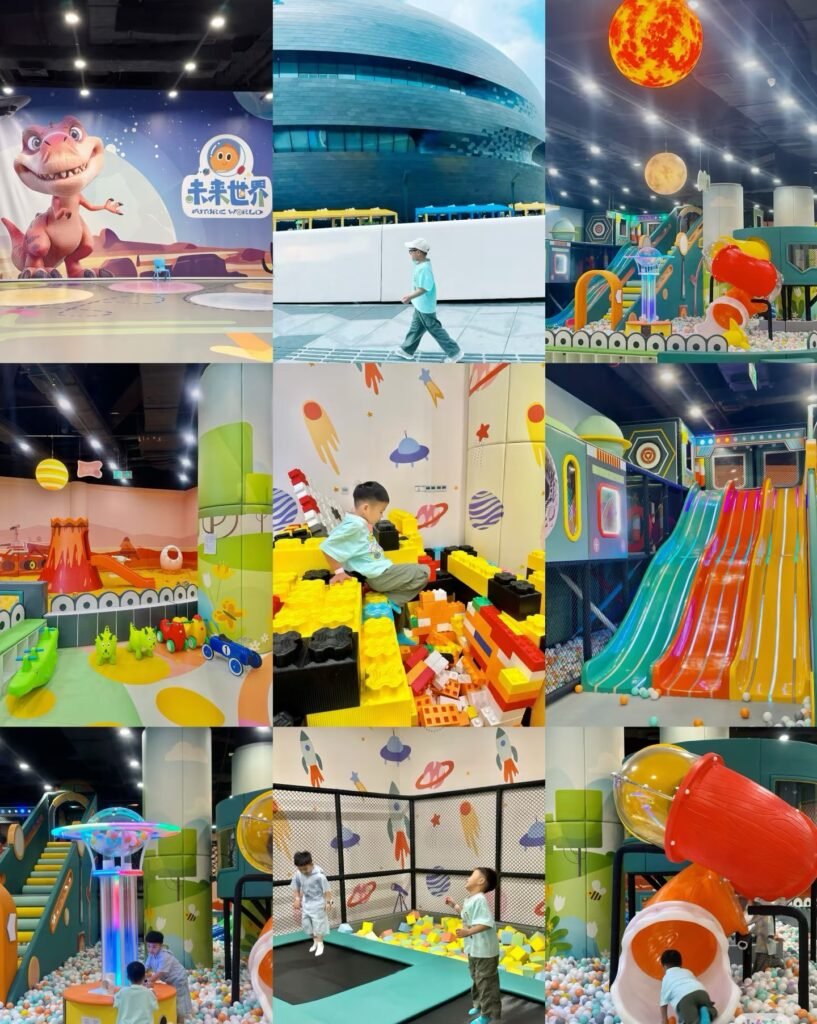
Revenue Projection Tool
Download our revenue projection spreadsheet to model different pricing strategies and estimate potential income across multiple revenue streams.Get Revenue Projection Tool
Operational Expense Analysis: Managing Ongoing Costs
Controlling operational expenses is crucial for maintaining profitability in your indoor playground business. Understanding these costs helps you set appropriate pricing and identify efficiency opportunities.

Staffing Requirements and Costs
Labor typically represents 25-35% of an indoor playground’s operating expenses:
| Position | Typical Wage | Staffing Ratio | Cost Management Strategies |
| Front desk/check-in | $10-$15/hour | 1 per shift | Cross-train with other roles |
| Play area monitors | $10-$14/hour | 1 per 20-30 children | Adjust based on capacity |
| Party hosts | $12-$18/hour | 1 per party | Schedule only during booked parties |
| Café/food service | $10-$15/hour | 1-2 during peak times | Simplified menu, self-service options |
| Manager/supervisor | $15-$25/hour | 1 per shift | Working manager model |
Facility and Maintenance Expenses
Your physical space requires ongoing investment to maintain safety and appeal:Rent/mortgage: Typically $1-$3 per square foot monthly (15-25% of revenue)Utilities: HVAC, electricity, water (5-10% of revenue)Equipment maintenance: Regular inspections, repairs, cleaning (3-7% of revenue)Cleaning supplies and services: Daily cleaning and periodic deep cleaning (2-5% of revenue)Facility repairs: Ongoing maintenance and unexpected repairs (2-5% of revenue)
Insurance and Compliance Costs
Protecting your business requires these ongoing investments:Liability insurance: $5,000-$15,000 annually based on size and featuresProperty insurance: $2,000-$5,000 annuallyWorkers’ compensation: Varies by state and payroll size (typically 1-3% of payroll)Health and safety compliance: Ongoing inspections and certificationsLicense renewals: Annual business license and permit fees
Marketing and Customer Acquisition
Ongoing promotion is essential for sustainable growth:Digital marketing: Social media, SEO, email (3-7% of revenue)Local advertising: Community publications, partnerships (1-3% of revenue)Loyalty programs: Rewards, referral incentives (1-2% of revenue)Special promotions: Seasonal offers, discounts (varies)Community engagement: Events, sponsorships (1-3% of revenue)Customer retention: Birthday cards, follow-ups (0.5-1% of revenue)
Inventory and Supplies
Consumable goods require regular replenishment:Food and beverage inventory: 30-40% of café sales revenueParty supplies: 20-30% of party package revenueRetail merchandise: 40-60% of retail sales revenueCleaning and sanitizing supplies: 1-2% of overall revenueOffice supplies and operational materials: 0.5-1% of revenue
Operational Expense Tracker
Download our customizable expense tracking template to monitor and optimize your operational costs for maximum profitability.Get Expense Tracker Template (Leave us a message to get it)
Location Evaluation: Finding the Perfect Spot for a Profitable Indoor Playground
Your location significantly impacts both revenue potential and operating costs. A strategic location analysis helps identify sites with the highest profit potential.

Accessibility and Visibility Factors
Consider these critical location attributes:Driving distance from residential areas: Ideally within 15-20 minutes of target neighborhoodsParking availability: Sufficient spaces for peak capacity (typically 1 space per 100-150 sq ft)Public transportation access: Important in urban areasRoad visibility and signage opportunities: Affects walk-in traffic and brand awarenessEntry/exit convenience: Easy for parents with children to navigateProximity to complementary businesses: Retail, restaurants, other family activities
Facility Requirements
Evaluate physical spaces against these criteria:Ceiling height: Minimum 10-15 feet for play structuresColumn spacing: Open floor plan for flexible equipment layoutBathroom facilities: Adequate for capacity and family-friendlyHVAC capacity: Sufficient for high-activity environmentNatural light: Windows and skylights enhance appealSeparate areas: Space for different age groups and functionsStorage space: For supplies, equipment, and maintenanceUtility access: Water, electrical capacity, internet
Lease Considerations
Negotiate lease terms that support long-term profitability:Lease length: 5-10 years with renewal options to amortize build-out costsRent structure: Fixed vs. percentage rent (typically 8-15% of gross sales)Tenant improvement allowances: Negotiate landlord contributions to build-outCAM charges: Common area maintenance fees and what they includeExclusivity clauses: Prevent similar businesses in the same complexSignage rights: Exterior visibility and branding opportunitiesExpansion options: Right of first refusal on adjacent spaces
Competition Proximity Analysis
Map the competitive landscape to identify optimal positioning:
| Competitor Distance | Potential Impact | Strategic Considerations |
| Less than 1 mile | High direct competition | Requires strong differentiation or superior offering |
| 1-3 miles | Moderate competition | Focus on unique features and convenience factors |
| 3-5 miles | Limited competition | Emphasize proximity for local neighborhoods |
| 5+ miles | Minimal direct competition | Verify sufficient population density in service area |

Location Evaluation Checklist
Download our comprehensive location evaluation checklist to systematically assess potential sites for your indoor playground business.Leave Us a Message to Get Location Checklist
Financial Projections: Forecasting Your Indoor Playground’s Profitability
Accurate financial projections help you assess viability, secure funding, and set realistic expectations for your indoor playground business.

Break-Even Analysis
Determine how long it will take to recover your initial investment:Fixed costs: Rent, insurance, base staffing, loan paymentsVariable costs: Additional staffing, utilities, supplies, maintenanceRevenue projections: Admission, parties, food, retail, membershipsBreak-even calculation: Fixed Costs ÷ (Average Revenue per Customer – Variable Cost per Customer)
Example Break-Even Calculation:
Monthly Fixed Costs: $20,000
Average Revenue per Customer: $15
Variable Cost per Customer: $5
Break-Even Point: $20,000 ÷ ($15 – $5) = 2,000 customers per month
Cash Flow Projections
Model your monthly cash flow to identify potential shortfalls:Seasonality patterns: Account for busier periods (winter, school breaks) and slower monthsWorking capital needs: Maintain 3-6 months of operating expenses in reservePayment timing: Factor in delays between expenses and revenue collectionGrowth projections: Realistic customer acquisition and retention rates
Profitability Metrics
Key indicators to monitor your financial health:
| Metric | Calculation | Target Range | Improvement Strategies |
| Gross Profit Margin | (Revenue – COGS) ÷ Revenue | 65-75% | Optimize pricing, reduce food costs |
| Net Profit Margin | Net Profit ÷ Revenue | 15-25% | Control labor costs, increase efficiency |
| Revenue per Square Foot | Annual Revenue ÷ Total Square Footage | $150-$250 | Maximize space utilization |
| Revenue per Customer | Total Revenue ÷ Number of Customers | $12-$20 | Upsell food, retail, memberships |
| Customer Acquisition Cost | Marketing Expenses ÷ New Customers | $5-$10 | Referral programs, targeted marketing |
Return on Investment Calculation
Estimate your expected return on initial investment:Initial investment: Total startup costs including equipment, renovations, and working capitalAnnual net profit: Projected revenue minus all expenses including depreciationROI calculation: (Annual Net Profit ÷ Initial Investment) × 100Payback period: Initial Investment ÷ Annual Net Profit
Example ROI Calculation:
Initial Investment: $120,000
Annual Net Profit: $180,000
ROI: ($180,000 ÷ $120,000) × 100 = 150%
Payback Period: $120,000 ÷ $180,000 = 0.6years
Financial Projection Templates
Download our comprehensive financial projection templates including break-even analysis, cash flow forecasting, and ROI calculators.Get Financial Templates
Risk Factors and Mitigation Strategies
Every business faces risks, but identifying them early allows you to develop effective mitigation strategies. Here are the key risk factors for indoor playground businesses and how to address them.

Seasonal Revenue Fluctuations
Indoor playgrounds often experience significant seasonal variations in attendance:
Mitigation Strategies
- Develop special programming for off-peak periods
- Create membership models to stabilize cash flow
- Offer seasonal promotions and packages
- Partner with schools for weekday field trips
- Implement dynamic pricing based on demand
Warning Signs
- More than 50% revenue variance between seasons
- Inability to cover fixed costs during slow months
- Consistent staff layoffs during off-peak periods
- Heavy reliance on weather-dependent traffic
- Lack of diversified revenue streams
Safety and Liability Concerns
Indoor playgrounds face inherent safety risks that must be managed:
Mitigation Strategies
- Implement comprehensive safety protocols and staff training
- Maintain adequate liability insurance coverage
- Use proper waivers and release forms
- Conduct regular equipment inspections and maintenance
- Install security cameras and monitoring systems
Warning Signs
- Increasing frequency of minor injuries
- Rising insurance premiums or coverage limitations
- Equipment deterioration or safety concerns
- Inadequate staff-to-child ratios during busy periods
- Customer complaints about safety issues
Competition and Market Saturation
The indoor play industry can become competitive in certain markets:
Mitigation Strategies
- Develop unique selling propositions and experiences
- Focus on underserved niches or age groups
- Build strong brand loyalty through exceptional service
- Continuously refresh and update play equipment
- Develop proprietary programs or attractions
Warning Signs
- Multiple similar businesses opening nearby
- Price wars and increasing discounts
- Declining customer loyalty and retention
- Difficulty differentiating your offering
- Shrinking market share despite marketing efforts
Operational Challenges
Day-to-day management presents ongoing challenges:
Mitigation Strategies
- Implement efficient scheduling and staffing systems
- Develop comprehensive training and operations manuals
- Utilize technology for booking and customer management
- Create clear policies and procedures for all situations
- Build redundancy in critical operational areas
Warning Signs
- High staff turnover and training costs
- Inconsistent customer experiences
- Frequent equipment downtime or maintenance issues
- Scheduling conflicts and capacity management problems
- Rising operational costs without corresponding revenue
Risk Assessment Toolkit
Download our comprehensive risk assessment toolkit to identify and mitigate potential threats to your indoor playground business.Get Risk Assessment Toolkit
Case Studies: Successful Profitable Indoor Playgrounds
Learning from successful indoor playground businesses provides valuable insights into profitability factors. These case studies highlight different approaches that have led to financial success.


Urban Premium Model: PlayHaven
Located in a densely populated urban area, PlayHaven targets affluent families with children aged 0-8.Key success factors: Premium experience, upscale café, parent amenitiesRevenue breakdown: 40% admissions, 30% memberships, 20% café, 10% partiesProfit margin: 25-35% net profitInvestment recovery: 5-12months

Suburban Party Focus: FunZone
Located in a suburban shopping center, FunZone built its business model around premium birthday experiences.Key success factors: Multiple party rooms, themed packages, excellent hostsRevenue breakdown: 60% parties, 25% admissions, 10% food, 5% retailProfit margin: 26-32% net profitInvestment recovery: 8months

Diversified Revenue: KidSpace
Located in a mid-sized community, KidSpace created multiple revenue streams to maximize facility usage.Key success factors: Classes, camps, drop-off programs, partnershipsRevenue breakdown: 30% admissions, 25% programs, 20% parties, 15% memberships, 10% caféProfit margin: 15-20% net profitInvestment recovery: 1.2 years
Common Success Factors
Despite different business models, these successful indoor playgrounds share several key attributes:Clear target market: Specific focus on particular demographics or needsMultiple revenue streams: Not relying solely on admission feesExcellent customer service: Creating memorable experiences that drive word-of-mouthStrategic location: Accessible to target demographic with sufficient parkingOperational efficiency: Careful management of staffing and expensesConsistent reinvestment: Regular updates to maintain appeal and safetyCommunity engagement: Strong local presence and partnerships
Complete Case Study Collection
Access our full library of indoor playground business case studies with detailed financial breakdowns and success strategies.Get Case Study Collection
Tools and Resources for Ongoing Financial Monitoring
Once your indoor playground is operational, continuous financial monitoring is essential for maintaining and improving profitability. These tools and resources will help you track performance and make data-driven decisions.

Essential Financial Tracking Systems
Implement these core systems to maintain visibility into your business performance:Point-of-sale (POS) system: Track sales by category, time of day, and staff memberBooking and reservation software: Manage party bookings, special events, and capacityMembership management: Track member usage patterns and renewal ratesAccounting software: Monitor expenses, revenue, and profitabilityPayroll and scheduling tools: Optimize staffing based on projected attendanceInventory management: Track food, retail, and supply costs
Key Performance Indicators (KPIs)
Monitor these critical metrics to assess your playground’s financial health:
| KPI Category | Specific Metrics | Monitoring Frequency | Target Benchmarks |
| Revenue | Daily/weekly/monthly sales, revenue per customer, revenue by category | Daily/Weekly | 15-20% year-over-year growth |
| Attendance | Customer count, peak times, average duration, repeat visits | Daily/Weekly | 60-70% capacity during peak hours |
| Expenses | Labor costs, COGS, utilities, marketing expenses | Weekly/Monthly | Labor: 25-35% of revenue |
| Profitability | Gross margin, net profit, profit by revenue stream | Monthly/Quarterly | 15-25% net profit margin |
| Marketing | Customer acquisition cost, conversion rates, ROI by channel | Monthly | 5:1 return on marketing spend |
Financial Review Practices
Establish these regular review processes to maintain financial discipline:Daily sales review: Compare to same day previous week/month/yearWeekly staff cost analysis: Adjust scheduling based on attendance patternsMonthly profit and loss review: Identify trends and areas for improvementQuarterly business review: Assess performance against projections and adjust strategyAnnual financial planning: Set targets, budgets, and investment priorities
Profitability Improvement Strategies
Continuously implement these approaches to enhance financial performance:Revenue optimization: Dynamic pricing, package bundling, upsellingCost control: Energy efficiency, waste reduction, supplier negotiationCapacity utilization: Off-peak promotions, group bookings, facility sharingStaff efficiency: Cross-training, scheduling optimization, productivity metricsCustomer retention: Loyalty programs, exceptional service, regular engagementContinuous innovation: New offerings, equipment updates, fresh experiences
Financial Monitoring Toolkit
Download our comprehensive financial monitoring toolkit including KPI tracking templates, financial review checklists, and profitability enhancement strategies.Get Financial Monitoring Toolkit
Critical Profitability Indicators: Is Your Indoor Playground Concept Viable?
After conducting a thorough evaluation using the frameworks in this guide, focus on these critical indicators to determine if your indoor playground concept has strong profit potential:

Profitability Potential Assessment
Use this framework to rate your concept’s potential across key success factors:
Market Demand
0/5
Location Quality
0/5
Competitive Advantage
0/5
Revenue Diversification
0/5
Operational Efficiency
0/5
Financial Projections
0/5
Next Steps for Serious Investors
If your concept shows strong profit potential, follow these steps to move forward:Develop a comprehensive business plan incorporating the analysis from this guideSecure financing through SBA loans, investors, or personal fundingFinalize your location and negotiate favorable lease termsDesign your facility with professional playground equipment vendorsEstablish legal structure and obtain necessary permits and insuranceImplement systems and processes for operations, booking, and financial managementDevelop marketing strategy to build pre-opening buzz and customer baseHire and train staff with customer service and safety as priorities
Remember that successful indoor playgrounds balance creative play experiences with sound business fundamentals. By thoroughly evaluating profitability factors before investing, you’ll position your business for long-term success in this rewarding industry.
Complete Indoor Playground Business Planning Kit
Ready to move forward? Download our comprehensive business planning kit with all templates, checklists, and resources featured in this guide.Get Complete Business Planning Kit







 English
 Spanish
 German