
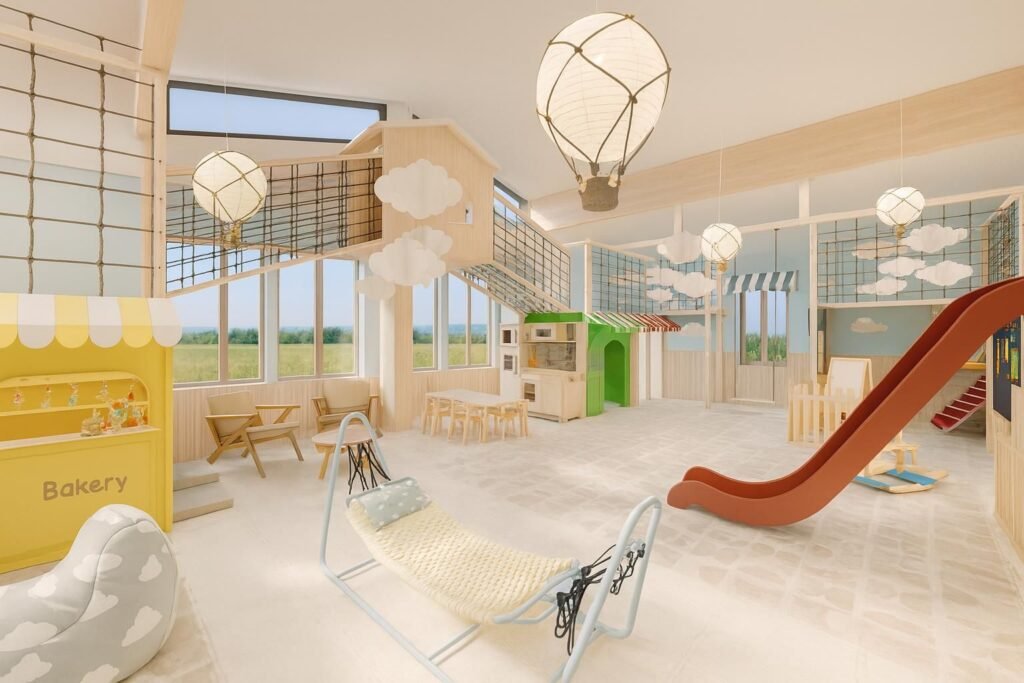
A play cafe can look busy and still underperform—because layout, capacity, and operating friction quietly erase margin. Design it for revenue per square meter, not just aesthetics.
A profitable play cafe design aligns three things: (1) predictable capacity and traffic flow, (2) safety-minded zoning that keeps supervision simple, and (3) durable equipment + maintainable finishes that protect uptime and repeat visits.
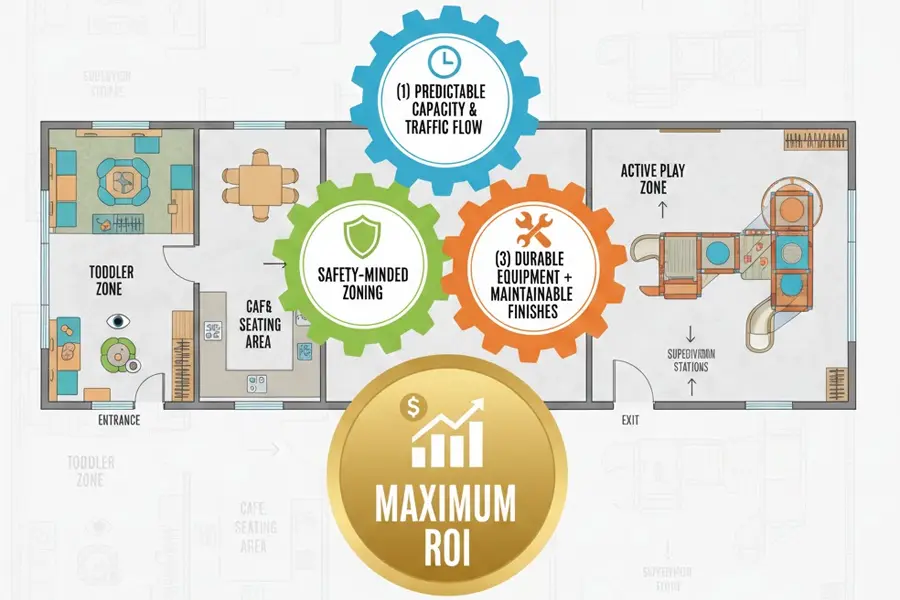
When ROI is the goal, “design” is not decoration—it’s a business system. Your floor plan determines how many families you can serve per hour, how long they stay, how hard the space is to staff and clean, and how often you have to stop operations for repairs or inspections.
What layout and zoning choices lift revenue per square meter?
If the space feels crowded, parents leave early. If it feels empty, you’re paying rent for unused capacity. The solution is zoning that controls flow, sightlines, and time-on-site.
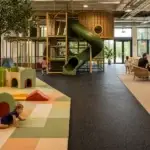
The highest ROI layouts separate ages, manage queues, and place monetizable zones (party rooms, retail, premium play) where guests naturally pass—without creating blind spots or bottlenecks.
From a manufacturer and project-support perspective, profitable zoning starts with measurable capacity and repeatable operations—not just a “big centerpiece.” Begin by mapping your usable area (net of back-of-house), ceiling height, and columns. Then design circulation: entry → shoes/cubbies → order point → seating → play zones → party/exit. The goal is to avoid cross-traffic that creates collisions and supervision stress.
A proven ROI pattern is three-layer zoning:
- Front-of-house monetization layer: reception/check-in, retail add-ons, birthday upsells, and a queue that doesn’t block the café line.
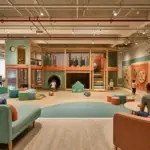
- Core play layer: soft play + contained play with clear perimeter visibility.
- Support layer: party rooms, storage, staff-only cleaning access, and stroller parking—placed to reduce aisle obstruction.
Use sightline logic: parents seated should see toddlers without standing up; staff should see major junctions. This is where an equipment partner can contribute real value with CAD layout and 3D rendering—because you can test choke points and supervision lines before you build. For practical examples of how a supplier supports zoning decisions, see safe, fun zone planning.
Table: Zone mix that typically improves ROI (design logic, not a promise)
| Zone / Feature | Why it impacts ROI | Typical design notes |
|---|---|---|
| Toddler soft play (0–3) | Increases weekday conversion; reduces conflict | Fully separated entry, low-height features, soft boundary |
| Main contained play (3–10) | Drives dwell time; supports repeat visits | Clear rules signage, visible exits, controlled entry/exit |
| Party rooms | Highest margin upsell | Near entry but acoustically buffered; easy cleaning access |
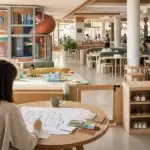
| Parent seating + café | Converts dwell time into spend | Seating facing play; stroller-friendly paths |
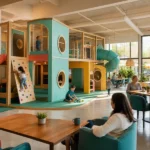
| Role-play corners | Premium experience; photo-driven marketing | “Shopfront” style at circulation edges, not dead corners |
If you’re comparing play café formats and feature sets, the benchmark-style breakdown in Top 3 cafe with play comparison helps you sanity-check your mix.
How do you balance safety standards and throughput without overbuilding?
Overbuilding inflates capex; underbuilding creates incident risk and shutdown risk. The solution is standards-minded design logic that targets high-risk points while preserving smooth movement.
Design to reference relevant safety frameworks and build operations around supervision, egress, and maintenance access—so capacity is usable, not theoretical. Final compliance depends on local regulations and the authority having jurisdiction.
A profitable play cafe is a hybrid: children’s play + food service + assembly-like occupancy patterns. Throughput depends on how easily guests enter, circulate, and exit—especially during parties and peak weekends. From an engineering viewpoint, “safe design” should focus on predictable behaviors: where kids climb, where they jump, where parents stop, and where staff must intervene.
Practical risk-control areas that protect both safety and ROI:
- Entrapment/pinch awareness: consistent gaps, guarded hardware, covered junctions.
- Fall risk control: height management, barrier strategy, and impact-absorbing surfacing where required by your market expectations.
- Contained-play entry control: fewer uncontrolled exits reduces staff chasing and improves supervision.
- Egress and corridor clarity: do not place queues, strollers, or retail displays in paths that should remain open.
Throughput is an outcome of “friction reduction.” For example, a wide, straight path from entrance to seating reduces collisions and keeps café service moving. A dedicated birthday check-in reduces reception congestion. A cleaning-access corridor behind high-touch zones shortens daily resets.
If you’re planning for mall traffic or mixed-use venues, the principles in how to design a mall playground translate well—especially around visibility, entry control, and circulation near public corridors.
Table: Capacity and throughput checks you can do on a draft floor plan
| Check | What to look for | Why it matters for ROI |
|---|---|---|
| Sightlines | Can one staff member observe key junctions? | Lower staffing cost per shift |
| Bottlenecks | Narrow points near café line or play entry | Reduces peak-hour revenue |
| Queue placement | Party check-in and café queues separated | Improves order conversion |
| Stroller flow | Parking doesn’t block egress/corridors | Fewer complaints and incidents |
| Cleaning access | Can staff reach high-touch zones quickly? | Less downtime; faster resets |
What equipment and materials reduce lifecycle cost and downtime?
If the space looks great on day one but wears poorly, your ROI drops through repairs, closures, and negative reviews. The solution is commercial-grade material choices and modular engineering that simplify maintenance.

Choose systems that are durable, easy to inspect, and fast to replace—supported by clear part numbering, installation logic, and a maintenance checklist.
Lifecycle cost is where many first-time operators get surprised. In manufacturing terms, your ROI depends on how the system performs after thousands of climbs, impacts, and cleanings—not how it photographs at opening.
Key equipment/material decisions that protect uptime:
- Modular structure + repeatable connections
Modular design makes replacements faster. If a panel, net, or platform can be swapped without dismantling a large area, you reduce closure time. Engineering outputs like CAD drawings, part numbering, and installation reference packages directly lower rework risk during build and later repairs. - High-touch surfaces and cleanability
In a play cafe, “cleaning minutes” per day becomes a real operating cost. Favor surfaces that resist staining and repeated wipe-downs, and avoid detailing that traps debris in corners. Place high-touch features where staff can reach them without ladders. - Plastics and wear components
Slide materials, guard panels, and decorative pieces should be chosen with abrasion and impact in mind. If you’re evaluating plastic options for commercial play, why we trust HDPE, ABS & more gives a practical, buyer-oriented comparison. - Consumables planning
Build a small “spares kit” into your procurement: net ties, fasteners, padding covers, and common wear parts. It’s cheaper than emergency air shipments and weekend closures.
Table: Common lifecycle cost traps (and the design fix)
| Trap | What happens operationally | Better design/spec approach |
|---|---|---|
| Decorative dead corners | Hard to clean; becomes messy | Use open sightlines + cleaning access |
| One-piece large assemblies | Repairs require major teardown | Modular sections with replaceable parts |
| Under-specified padding | Early wear, safety complaints | Commercial-grade padding and coverings |
| Poor access to anchors/hardware | Inspections take longer | Accessible inspection points + cover strategy |
For a broader view of play cafe equipment planning from concept to operations, the foundation guide in The Complete Guide to Play Cafes is a useful reference.
How should you plan the build timeline and budget to protect ROI?
Delays and budget surprises don’t just increase cost—they postpone revenue and weaken launch momentum. The solution is a project plan that links design freeze, manufacturing lead time, shipping, installation method, and pre-opening readiness.
Treat timeline and budget as an integrated chain: layout approval → engineering output → production → freight/duties → installation → inspection readiness → opening operations.
From an end-to-end supplier perspective, ROI protection is mainly risk control: fewer redesign loops, fewer on-site surprises, and fewer “last-mile” delays. Start by locking the constraints early: site measurement (including ceiling height and column grid), MEP conditions, entrances/exits, and any landlord requirements.
A practical timeline approach:
- Design freeze: finalize zoning, circulation, and key features. This is where 3D rendering prevents later changes that cause rework.
- Engineering package: CAD drawings, part lists, and installation logic. This reduces labor uncertainty and helps local contractors coordinate.
- Manufacturing + QC: specify materials and finish requirements up front to avoid substitutions and delays.
- Shipping planning: confirm shipping method, packaging, and duties/taxes assumptions.
- Installation method: professional install support vs guided self-install. Labor availability can change your opening date more than production lead time.
Budgeting should separate “must-have” items from “upgrade” items. A common mistake is overspending on visuals while underfunding party room operations, back-of-house storage, and maintenance planning. If you want a baseline cost map for a typical venue size, use the structure in 200 sqm play cafe investment cost guide and adapt it to your rent and labor reality.
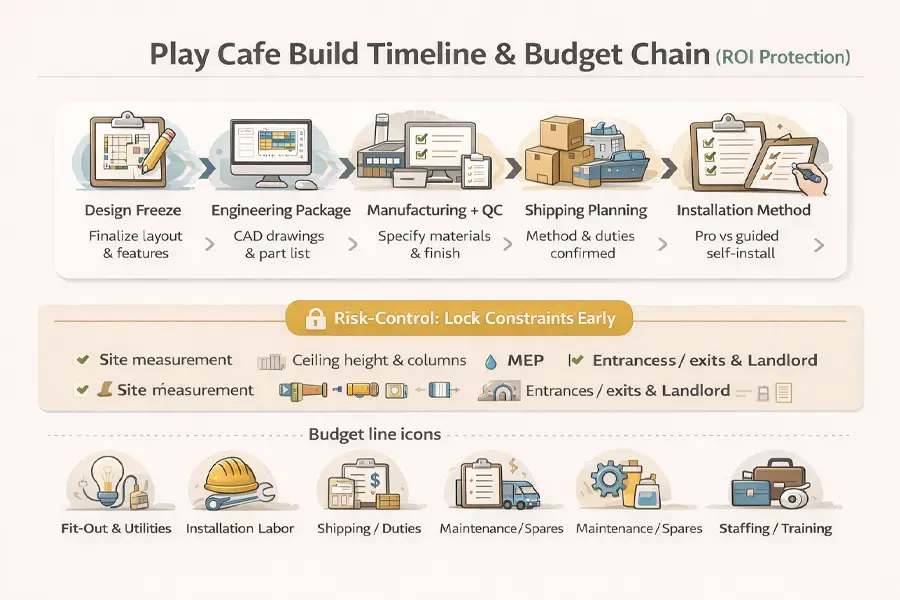
Table: Budget lines that most affect ROI (and how design changes them)
| Cost line | ROI risk | Design strategy to control it |
|---|---|---|
| Fit-out & utilities | Scope creep and change orders | Freeze layout early; plan café + party MEP from day one |
| Installation labor | Overtime and rework | Installation-ready engineering + clear part numbering |
| Shipping/duties | Unplanned landed cost | Confirm packing volume/weight; plan incoterms and local taxes |
| Maintenance & repairs | Downtime and bad reviews | Modular design + consumables plan + inspection access |
| Staffing | High labor per guest | Sightlines, queue separation, simplified supervision |
If you’re still validating the business side, how to evaluate whether an indoor playground can be profitable provides a structured way to pressure-test your assumptions.
Conclusion
A profitable play cafe is designed like an operating system: clear zoning for age separation, predictable traffic flow, strong supervision sightlines, and durable, maintainable equipment that protects uptime. When you connect layout decisions to throughput, staffing, cleaning, and lifecycle maintenance, ROI becomes a design outcome—not a hope. If you want a fast starting point, send your floor plan (or rough dimensions), ceiling height, and column positions—we can suggest a basic zoning approach and a budget checklist you can use to compare options with confidence.
FAQ
1) What is a “profitable” play cafe design KPI to track from day one?
Track revenue per occupied seat-hour and revenue per square meter (or square foot). These KPIs connect layout choices (seating count, circulation, party rooms, play capacity) directly to sales and help you see whether peak-time congestion or low conversion is the real constraint.
2) How much space should be allocated to play vs seating vs back-of-house?
A common planning starting point is 50–65% play, 20–30% seating/café, and 10–20% back-of-house + storage + party support. Adjust based on your ticket model (time-based play vs free play with minimum spend) and how much birthday business you expect.
3) How do I decide the right age zoning for better ROI and fewer incidents?
Separate at least two groups: toddlers (0–3) and general kids (3–10/12). Use controlled entry/exit for the main play zone and keep toddler play fully visible from parent seating. Age zoning reduces conflict, improves supervision efficiency, and protects reviews.
4) What design features reduce staffing cost without harming the guest experience?
Prioritize clear sightlines, one main control point for entry to contained play, and queue separation (party check-in vs café line). Add stroller parking and cubbies away from egress paths to prevent constant staff “traffic control.”
5) Should I charge admission, sell memberships, or rely on café spend?
Many operators combine: paid play (or timed sessions) + birthday packages + memberships + café. If your rent is high, timed sessions and party rooms typically improve predictability. If your local market is price-sensitive, a free/low-fee play model often requires strong café conversion and disciplined capacity control.
6) What mistakes most often destroy ROI after opening?
The most common are: underestimating storage and cleaning workflow, building blind spots that increase staffing needs, overbuilding “instagram features” that wear quickly, and skipping maintenance access that later forces partial shutdowns for repairs.
7) How can I design party rooms to maximize weekend revenue?
Place party rooms near reception for controlled arrivals, but acoustically buffered from seating. Include a direct service path for staff and a layout that supports fast reset (wipeable surfaces, minimal clutter points). Party rooms work best when check-in, gift table, and cake service don’t block the café queue.
8) What materials and equipment choices best protect long-term maintenance cost?
Choose commercial-grade, modular systems with replaceable panels/padding, durable plastics (e.g., HDPE/ABS where appropriate), and documented part lists. Design inspection points and cleaning access so daily upkeep is fast and predictable.
9) How do I avoid safety issues while keeping good throughput?
Design the plan to reference relevant safety guidance and focus on high-risk points: fall zones, entrapment/pinch points, entry control, and clear egress paths. Most “throughput killers” are bottlenecks caused by poor circulation and mixed queues—not the play equipment itself.
10) What information should I send a supplier to get an accurate layout and ROI-minded proposal?
Send: floor plan with dimensions, ceiling height, column/beam positions, entry/exits, and your business targets (capacity, party frequency, ticket model, café concept). With that, a supplier can provide a basic zoning suggestion, an equipment concept, and a budget/timeline checklist for comparison.
References
- ASTM International. (2021). ASTM F1918-21: Standard Safety Performance Specification for Soft Contained Play Equipment. https://www.astm.org/f1918-21.html
- Royal Society for the Prevention of Accidents (RoSPA). (n.d.). EN 1176 playground equipment standard. https://www.rospa.com/play-safety/advice-and-information/en1176-playground-equipment-standard
- U.S. Food and Drug Administration. (2022). Food Code 2022. https://www.fda.gov/food/fda-food-code/food-code-2022
- National Fire Protection Association. (n.d.). NFPA 101: Life Safety Code. https://www.nfpa.org/codes-and-standards/all-codes-and-standards/list-of-codes-and-standards/detail?code=101
- International Code Council. (2021). International Building Code (IBC) 2021, Chapter 10: Means of egress. https://codes.iccsafe.org/content/IBC2021P2/chapter-10-means-of-egress


 English
 Spanish
 German