
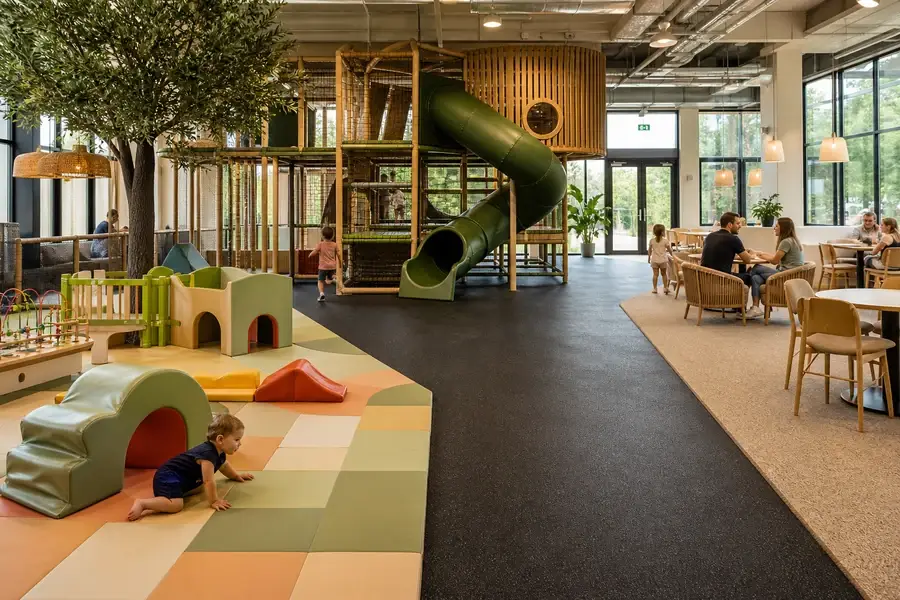
Choosing indoor playground flooring can look like a finish-selection task. It is not. The wrong surface can create awkward transitions, wear out faster than expected, make cleaning harder, or leave an active play zone without the protection its equipment and local requirements call for.
The pressure grows once a venue opens. A surface that feels pleasant in a sample room can show seams, soil quickly around food and drinks, or become difficult to repair when hundreds of small feet cross it every day. Changing flooring after equipment is installed is disruptive and expensive.
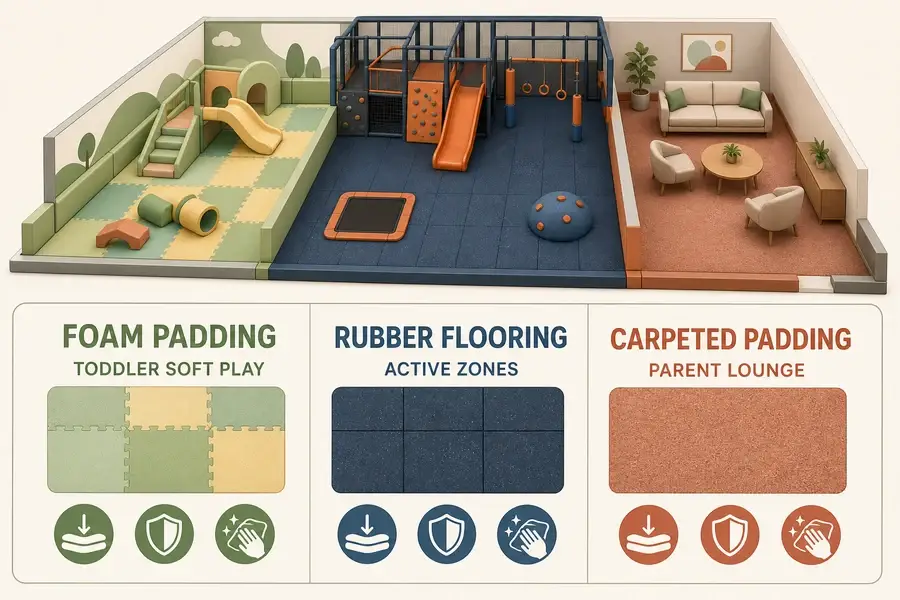
For most commercial venues, the best answer is a zoned system, not one material everywhere: foam padding for low-height toddler soft play, rubber flooring where traffic and impact demand resilience, and carpeted padding in low-risk parent or quiet zones. The final specification must match the equipment, fall risk, cleaning plan, subfloor, and applicable local code.
Why Read This Guide
Choose flooring by the way each play zone is actually used
Koalaplay works with commercial family-venue teams on indoor playground and play café planning, from early layout questions through equipment delivery and installation support.
This guide turns the foam, rubber, and carpet decision into practical questions about fall zones, traffic, hygiene, repairs, and the guest experience.
Start with risk and use, not the color sample
“Soft” is not a performance category. Flooring needs to be assessed as a finished system: the top layer, the cushioning or underlayment beneath it, the subfloor, installation method, seams, edges, and ongoing condition. A thick-looking material is not automatically suitable beneath elevated equipment.
For public playground contexts, ASTM F1292 is used to evaluate impact attenuation and critical fall height. It measures head-impact performance; it does not certify every safety question or prevent every injury. The U.S. Consumer Product Safety Commission (CPSC) likewise warns that carpet and mats are not protective surfacing beneath equipment unless the installed system has been tested to the relevant performance standard. These are useful decision principles for indoor venues, but your country, landlord, insurer, inspector, and equipment type may require a different or additional review.
Before comparing materials, mark three things on the plan:
1. The play activity and likely fall path. A crawling area, slide exit, climbing route, trampoline perimeter, and café aisle do not need the same surface.
2. The operational load. Track shoes, strollers, spilled drinks, food crumbs, party turnover, and cleaning chemicals can matter as much as impact performance.
3. The transition details. A good material can still create a trip hazard at a raised edge, loose tile, worn seam, or abrupt change in thickness.
This is one reason an early equipment layout matters. The zone plan should be developed alongside the indoor playground equipment concept rather than after structures are fixed in place.
Foam padding: the comfort-first choice for low-height soft play
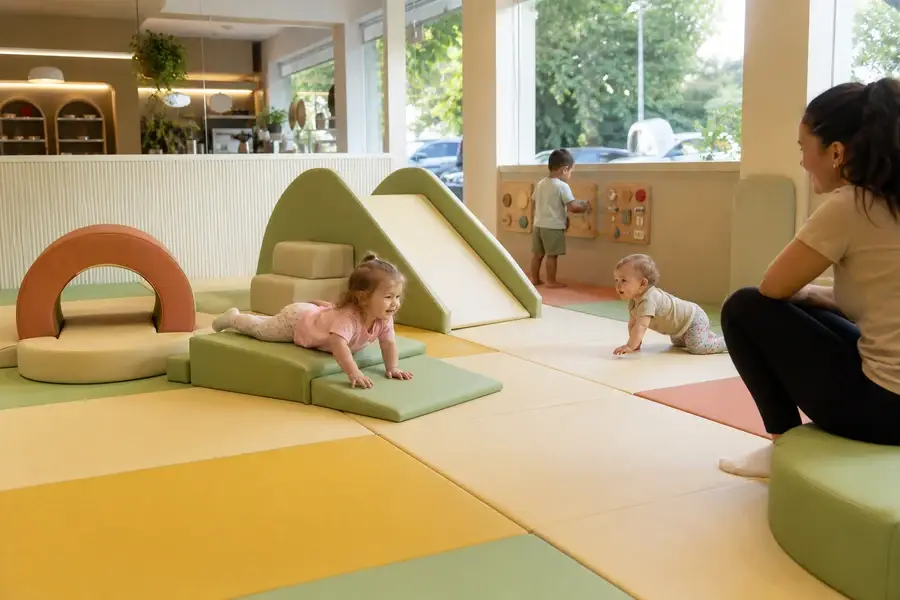
Foam padding usually means modular EVA or similar resilient mats, or foam layers integrated into soft-play flooring. It is warm under bare feet, visually flexible, and easy to use around low soft shapes. For a dedicated toddler zone, it can create a calm, forgiving feel that encourages crawling, early climbing, and parent-child play.
Where foam padding works well
- Toddler areas with low-height, age-appropriate soft equipment.
- Role-play corners, reading nooks, and floor-level activity areas.
- Small play cafés that need a quick-to-refresh, warm visual finish.
- Selected wall, post, and edge protection when specified as part of the overall system.
What to examine before specifying it
Look beyond the top color. Ask how the mat edges lock or bond, how the surface responds to repeated compression, what happens at door thresholds, and whether replacement pieces will still be available later. In food-adjacent venues, confirm the cleaning method and whether liquids can reach seams or the layer below.
Foam is not a shortcut for every fall zone. Under higher or more dynamic equipment, use the supplier’s system specification and required performance evidence for the *installed assembly*. Do not combine an attractive top mat with an unverified underlayer and assume the result has a particular critical fall height.
Rubber flooring: the hard-wearing option for active and high-traffic areas
Rubber flooring is often supplied as tiles, rolls, or a poured/bound system. In commercial settings, it is valued for resilience, wear resistance, traction, and a more continuous feel under traffic. It can be a strong candidate for busy circulation areas, slide landings, active play zones, and spaces where cleaning speed matters.
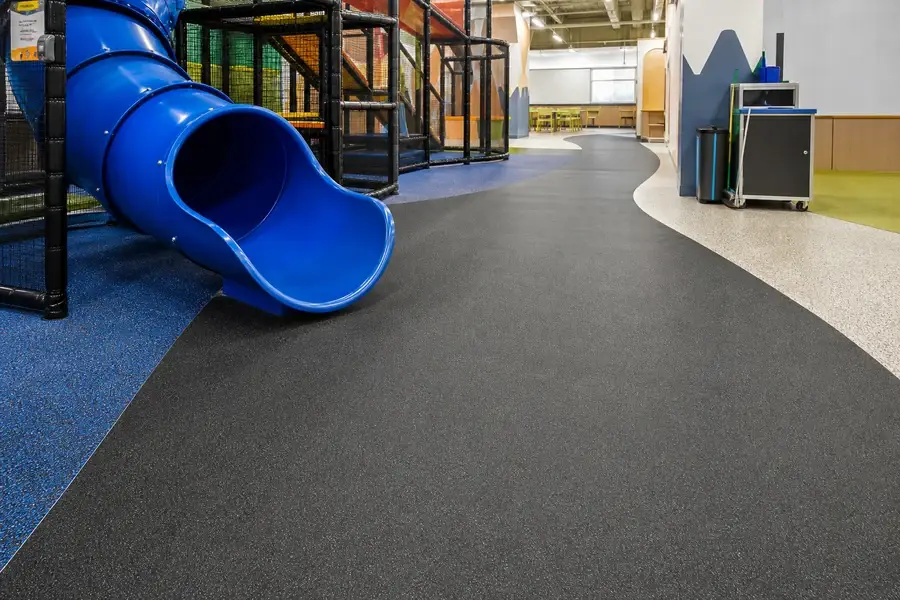
The key distinction is between a general commercial rubber floor and a surfacing system with verified impact performance for the intended use. If it sits in an equipment use zone, request the relevant test documentation for the exact product, thickness, backing, substrate, and installation configuration—not a brochure for a similar-looking material.
Rubber also asks more from installation. The subfloor needs to be assessed, the adhesive and seam treatment must suit the venue, and expansion or edge details need careful execution. A well-installed system can simplify cleaning; a poorly joined one can collect dirt or lift at edges. For a play café, plan how rubber meets café flooring and keep any food-service area compatible with local hygiene and slip-resistance requirements. Our play café planning guidance can help put those zones into a coherent guest flow.
Carpeted padding: useful for low-risk comfort, not a default fall surface
Carpeted padding can make seating and quiet activity areas feel warmer and can soften sound in a large family venue. It is especially useful for parent lounges, party seating, shoe-off areas, and reading or imaginative-play spaces where equipment stays at ground level.
Its limitations are operational. Carpet can hold crumbs and moisture, show traffic lanes, and require a clear response plan for spills. Choose commercial-grade, low-pile products and define who spot-cleans, vacuums, deep-cleans, and replaces damaged sections. Carpet tiles can make localized repairs easier, but seams must remain secure and flat.
Most importantly, carpet over ordinary padding should not be assumed to provide compliant impact attenuation under playground equipment. The CPSC handbook specifically distinguishes carpet that has not been tested to ASTM F1292 from appropriate protective surfacing. Where a design calls for a carpet-like finish near a play structure, ask whether the full tested system—not just the visible textile—matches the intended use.
A quick zoning framework for foam, rubber, and carpet
| Zone | Practical starting choice | Why it may fit | Main watch-out |
|---|---|---|---|
| Low toddler soft-play area | Foam padding | Comfortable, warm, and easy to integrate with low soft equipment | Seams, compression, and cleaning around spills |
| Slide exit, climbing-adjacent or busy active area | Verified rubber or another specified protective system | Durable, resilient, and suited to frequent traffic when properly installed | Match test data and installation details to the real system |
| Parent lounge, party seating, or quiet play | Carpeted padding | Acoustic comfort and a softer hospitality feel | Food, moisture, cleaning, and replacement planning |
| Main circulation route | Rubber or another durable resilient finish | Easier to maintain in a high-traffic route | Slip resistance and flush transitions |
Need help mapping flooring to your play zones?
Send your floor plan, equipment concept, target age group, country, budget range, theme direction, and installation needs. Koalaplay can help you identify where soft-play padding, resilient flooring, and hospitality finishes belong in the same project.
The safety questions to ask a flooring or equipment supplier
The most useful supplier conversation is specific. Start with your actual plan rather than asking which product is “best.” Ask these questions:
- Which zones are equipment use zones, and what surface does the equipment specification require there?
- What test data applies to this exact surface system and its proposed installation? What does it cover, and what does it not cover?
- Is there a recommended subfloor, adhesive, seam method, perimeter edge, and transition profile?
- How will the floor behave after regular cleaning, moisture exposure, compression, and heavy traffic?
- Can damaged tiles, rolls, or carpet sections be replaced without removing surrounding equipment?
- Which daily, weekly, and periodic inspections should the operator perform?
Include flooring in the same material and maintenance conversation as padding, nets, and soft wraps. Koalaplay’s material-quality overview and warranty and spare-parts information are useful starting points for understanding how the broader play system will be cared for.
Plan for cleaning and replacement before opening day
Durability is not simply how long a surface lasts. It is how long it remains safe, cleanable, visually acceptable, and repairable at your venue’s traffic level. Build a simple operating plan before selecting colors.
For foam, include a routine for checking seams, compressed edges, punctures, and cleaning compatibility. For rubber, inspect seams, adhesive, cracks, and worn transitions; use cleaning products approved by the flooring manufacturer. For carpeted zones, decide where food and drinks are allowed, establish immediate spill response, and keep a small replacement stock if the pattern is likely to be discontinued.
The Koalaplay Team often finds that operators get better long-term value from a modestly simpler finish with clear replacement logic than from a complex surface that looks impressive but cannot be repaired in small sections. Specify where storage, cleaning equipment, and spare material will go. That choice affects downtime just as much as the first purchase price.
Choose a system that supports the whole venue
The best indoor playground flooring is rarely one universal product. Use foam padding where low-height soft play needs comfort and warmth. Use a properly specified rubber or protective surfacing system where high traffic and the activity demand it. Use carpeted padding where it creates hospitality and acoustic value outside equipment fall zones.
Then bring the flooring plan into the project process early. Koalaplay can review the layout alongside your equipment concept, theme, and installation needs through its design-to-installation service process. This helps prevent late changes at thresholds, columns, exits, and equipment footprints.
Related Products, Categories, and Guides
- Indoor playground equipment for commercial projects
- Play café design ideas and planning support
- Indoor playground material-quality considerations
- Koalaplay service process
FAQ
Is foam flooring good for an indoor playground?
Foam flooring can work well in low-height toddler and soft-play areas because it feels comfortable and integrates easily with soft equipment. Its suitability beneath elevated equipment depends on the full installed system, the activity, and any required performance evidence.
Is rubber flooring safer than foam?
Neither material is automatically safer in every location. Rubber often suits high-traffic and active zones because of its durability and resilient feel. Foam often suits low-height soft-play zones. For equipment use zones, compare the tested installed system to the equipment and applicable requirements.
Can I put carpet over padding beneath a play structure?
Do not assume ordinary carpet and padding provide protective surfacing. In its public playground guidance, the CPSC says carpet and mats are not appropriate under equipment unless tested to and compliant with ASTM F1292. Confirm the requirement for your venue and equipment with qualified local parties.
Which floor is easiest to clean in a play café?
Rubber or other seamless resilient finishes are often practical in high-traffic or spill-prone paths. Foam can be easy to wipe when seams are well maintained. Carpeted areas need a stronger vacuuming, spot-cleaning, and replacement plan, especially where food is present.
What should I send a supplier for a flooring recommendation?
Send the floor plan, ceiling height, equipment layout or concept, target ages, location/country, expected traffic, budget range, preferred theme, and installation conditions. Also identify food-service areas, entrances, exits, and any existing subfloor information.
Plan Your Indoor Playground Flooring With Koalaplay
Choosing flooring is easier when it is reviewed with the equipment layout rather than as a separate finishing decision. Share your venue plan, age range, country, budget, theme, and installation needs with Koalaplay. We can help you create a practical zoning direction that supports safety, cleaning, traffic flow, and a comfortable family experience.








 English
 Spanish
 German