
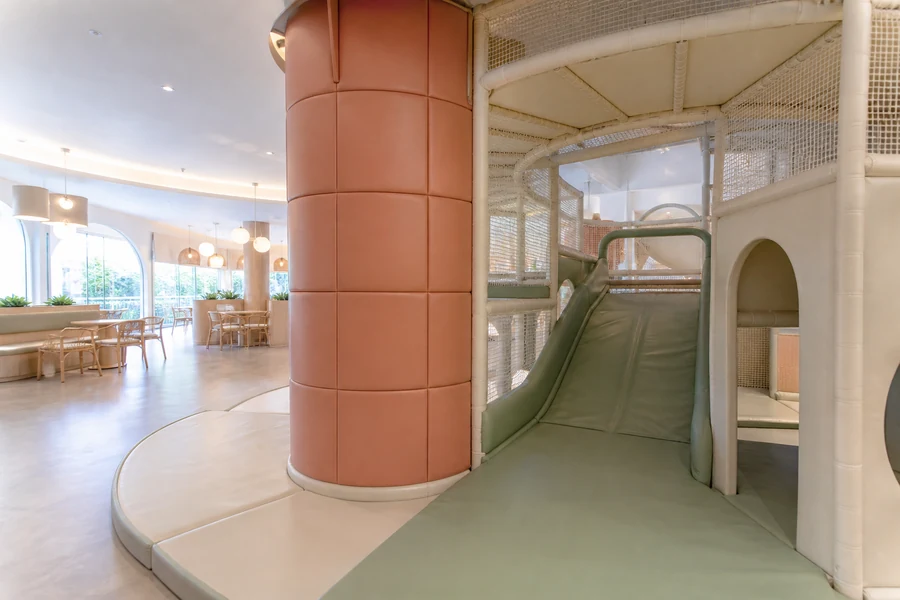
A supplier’s quote lists "leather-look cover" or "vinyl exterior" and it sounds like a finish choice — something you’d pick based on color and texture. It isn’t. The cover is the part of a soft play structure that takes the most direct abuse: hundreds of small hands and feet, spilled juice, daily wipe-downs, and years of UV exposure through windows. Get it wrong and it’s not a cosmetic problem, it’s a replacement bill.
The wrong cover material shows up as cracking and peeling within a year or two, seams that let moisture into the foam core underneath, or a surface that can’t be sanitized fast enough between groups of kids. None of that is obvious from a swatch or a photo in a quote. You find out after the equipment is installed and the cover starts failing under real daily use.
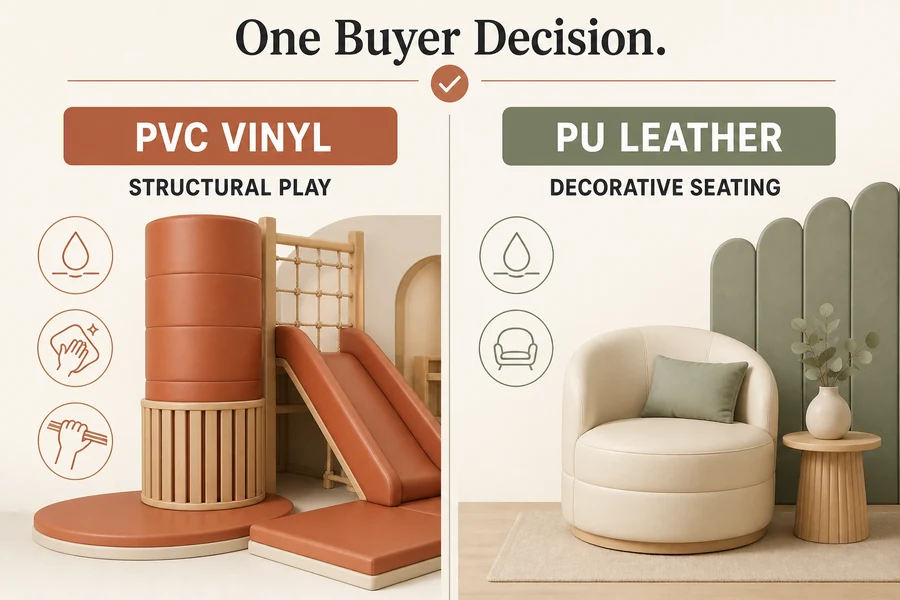
The short version: PVC vinyl is what most commercial soft play manufacturers use for structural covers — columns, decking, slides, and safety pads — because it’s waterproof, wipes clean in seconds, resists abrasion and UV fading, and takes fire-retardant treatment reliably. PU leather has a real place too, just a narrower one: softer, closer to genuine leather in feel, and better suited to low-traffic decorative surfaces than to anything that gets climbed on daily. The rest of this guide covers why, with real manufacturing specs, so you know what to ask for.
PVC vinyl and PU leather: what they actually are
Both materials are synthetic coverings applied over a fabric backing, but the coating itself is a different plastic with different behavior.
PVC (polyvinyl chloride) vinyl is a plastic coating, often reinforced with a mesh backing called a scrim, fused onto a fabric base. That reinforcement is what gives it its tear resistance and structural toughness — it’s built to be pulled, gripped, and climbed on.
PU (polyurethane) leather is a thinner polyurethane coating applied to a fabric base, engineered to mimic the softer feel and appearance of genuine leather. It prioritizes texture and look over raw durability, which is exactly why it shows up more often in fashion goods and furniture upholstery than in commercial play equipment.
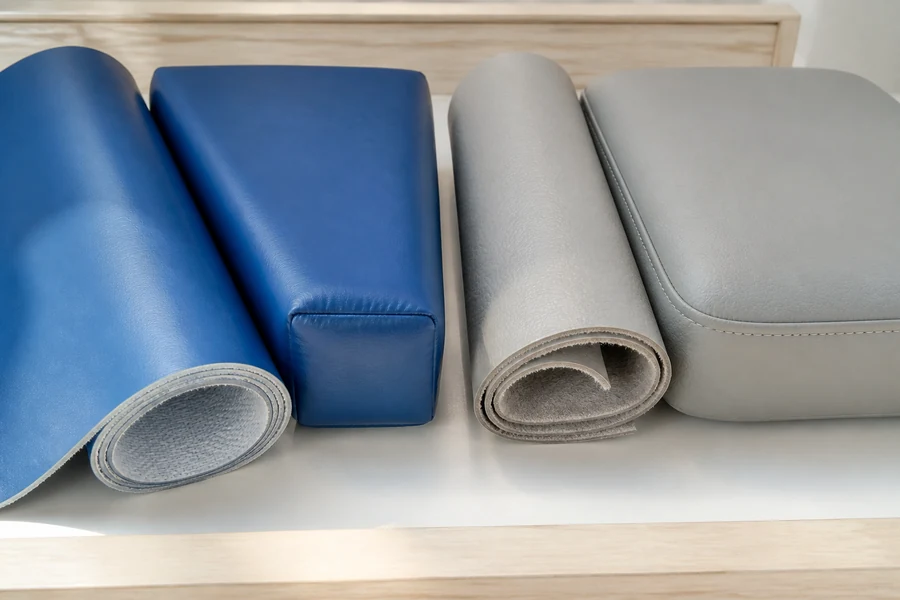
PVC vinyl vs PU leather: side-by-side for soft play use
| PVC Vinyl | PU Leather | |
|---|---|---|
| Waterproofing | Fully waterproof | Water-resistant, not fully waterproof over time |
| Abrasion/scratch resistance | High | Lower — prone to surface wear |
| Cleaning/sanitizing | Wipes clean almost instantly | Needs gentler cleaning, more care |
| Fire-retardant treatment | Treats reliably | Less commonly used in fire-rated commercial covers |
| Feel/softness | Firmer, smooth surface | Softer, closer to real leather |
| UV stability | Strong, resists fading over years | Weaker, more prone to cracking/discoloring in sun |
| Typical soft play use | Structural padding: columns, decking, slides, safety pads | Decorative, low-traffic elements: lounge seating, accent panels |
| Relative cost | Lower | Generally higher |
Treat exact lifespan and cost figures with some caution — they vary by manufacturer, grade, and climate, and there’s no single industry-wide number. What’s consistent across independent sources is the pattern: PVC wins on durability, waterproofing, and cost; PU leather wins on softness and a more premium feel.
Why most soft play manufacturers cover structural padding with PVC
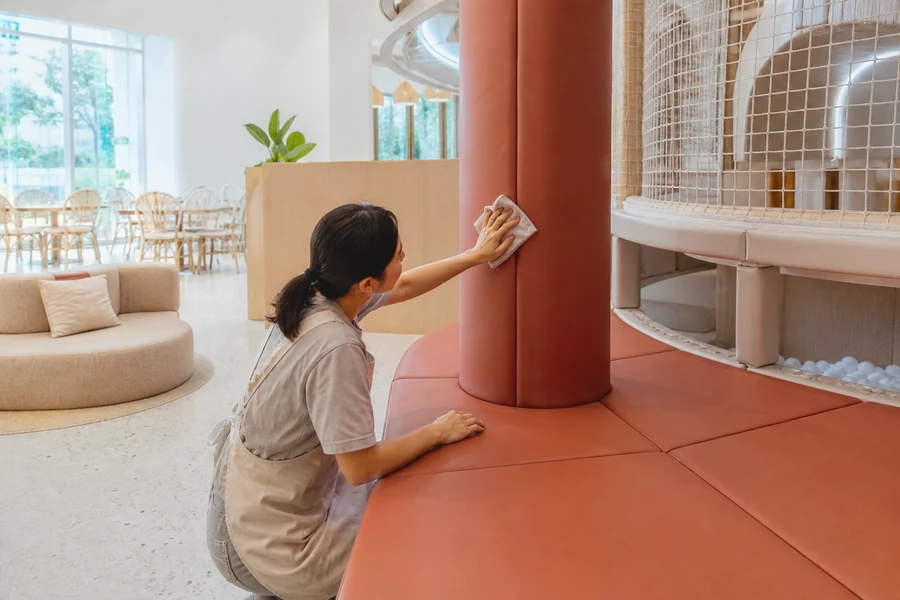
Commercial soft play equipment gets sanitized constantly, and the cover is the first line of defense for the foam underneath it. A wipe-clean, non-porous PVC surface means no liquid gets through to the padding — no mold risk, no trapped moisture, no smell building up over months of use.
It also has to survive fire code. PVC takes flame-retardant treatment consistently, which matters because most commercial venues require it. At KoalaPlay, that’s reflected directly in the build: decking uses a flame-retardant PVC tarpaulin rated for UV and abrasion resistance, sponge columns use a glossy, tear-resistant PVC outer layer, and trampoline safety pads use 0.55mm PVC over the EPE foam core underneath. The cover and the core are a system — a soft, high-density foam padding only performs as intended if the material wrapped around it can survive the traffic without tearing or letting moisture in.
Where PU leather still makes sense
PU leather isn’t a downgrade — it’s built for a different job. Its softer, warmer feel and closer resemblance to genuine leather make it a reasonable choice for low-traffic decorative touches: lounge seating in a play café waiting area, accent panels, or furniture that’s meant to look premium rather than survive climbing traffic.
Where it falls short is anywhere that takes repeated direct impact or heavy sanitizing cycles. If a quote lists PU leather as the cover on a structural climbing column or a high-traffic slide surface, that’s worth questioning — it’s a sign the supplier may be prioritizing look over the durability that component actually needs, similar to how soft play equipment overall differs from hard play equipment in what it’s built to withstand.
Fire safety and hygiene standards to ask about
Whatever cover material a supplier proposes, ask for documentation, not just a material name on a spec sheet:
- EN 1176 — the primary playground safety standard across Europe.
- GB 6675-2023 — China’s national toy and children’s product safety standard, relevant for equipment manufactured there.
- Fire-retardant fabric certification, since most commercial venues require self-extinguishing or flame-retardant covers by code.
- Phthalate-free and lead-free composition, especially important for younger children who may put surfaces in their mouths.
- Third-party test reports confirming the material actually passed the standards claimed, rather than a supplier’s word alone.
How to choose the right cover material for your project
Match the material to what the component actually does:
- Columns, slides, decking, and safety pads: specify PVC vinyl and ask for the thickness and fire-retardant certification used.
- Low-traffic decorative seating or lounge furniture: PU leather is a reasonable, more premium-feeling choice.
- Venues with heavy daily sanitizing needs: PVC’s wipe-clean surface saves real labor time over a multi-year lifespan.
- Budget planning: weigh total cost of ownership, not sticker price — a PVC cover that survives years of climbing traffic usually costs less over time than repeatedly replacing a softer material that wasn’t built for it.
Before finalizing a quote, ask which cover material is used on which component, what thickness it’s built to, and what test reports back the fire-retardant claim. Reviewing how equipment costs break down in KoalaPlay’s indoor playground pricing guide is a useful way to see where material choices show up in a real quote.
Frequently Asked Questions
Is PVC safe for children’s play equipment?
Yes, when manufactured to commercial standards. Reputable soft play covers use phthalate-free, lead-free PVC formulations and are tested against standards like EN 1176. Ask your supplier for the specific certification rather than assuming it’s included.
How long does a PVC soft play cover last?
It depends on traffic volume and cleaning routine, but PVC covers on commercial equipment are built to hold up under years of daily use because the material resists abrasion, moisture, and UV fading. Ask your supplier for their expected replacement interval rather than relying on a general industry figure.
Can PU leather covers be used on soft play equipment?
Yes, but mainly on low-traffic decorative surfaces like lounge seating rather than structural components like climbing columns or slides. PU leather’s softer feel comes with lower abrasion resistance and less reliable waterproofing over time, which makes it a weaker fit for high-impact contact surfaces.
What cover material does KoalaPlay use?
KoalaPlay builds structural components — decking, sponge columns, and trampoline safety pads — with PVC, including a flame-retardant PVC tarpaulin on decking and 0.55mm PVC on trampoline pads. Full specs are listed on the Material & Quality page.
Get a spec sheet, not just a swatch
A cover material listed without a thickness, a fire-retardant certification, or a test report is a gap worth asking about before you commit to a quote. The right cover keeps the padding underneath it safe, sanitary, and compliant for years — not just presentable on installation day.
Get the right cover specification before you sign off
Send your floor plan, component list, country, target age range, and cleaning routine. We’ll help you identify where commercial PVC is needed and which decorative surfaces can use a softer finish.
References
- Material & Quality — KoalaPlay — https://koalaplayground.com/material-quality/
- EPE vs EVA vs PU Foam: Which Padding Material Is Best for Soft Play Equipment? — KoalaPlay — https://koalaplayground.com/epe-vs-eva-vs-pu-foam-soft-play-padding/
- Soft Play vs Hard Play Equipment — KoalaPlay — https://koalaplayground.com/soft-play-vs-hard-play-equipment/
- Indoor Playground Equipment Cost: Complete Price Guide 2026 — KoalaPlay — https://koalaplayground.com/indoor-playground-equipment-cost-2026/
- Vinyl Soft Play vs Fabric: Which Material Is Best for Your Play Area? — SoftPlayToys4kids — https://softplaytoys4kids.co.uk/2026/07/06/vinyl-soft-play-vs-fabric-which-material-is-best-for-your-play-area/
- PVC Leather vs PU Leather: Choose the Right Type — ZD Leather — https://zdleatherco.com/pvc-vs-pu-leather-which-is-right/








 English
 Spanish
 German