
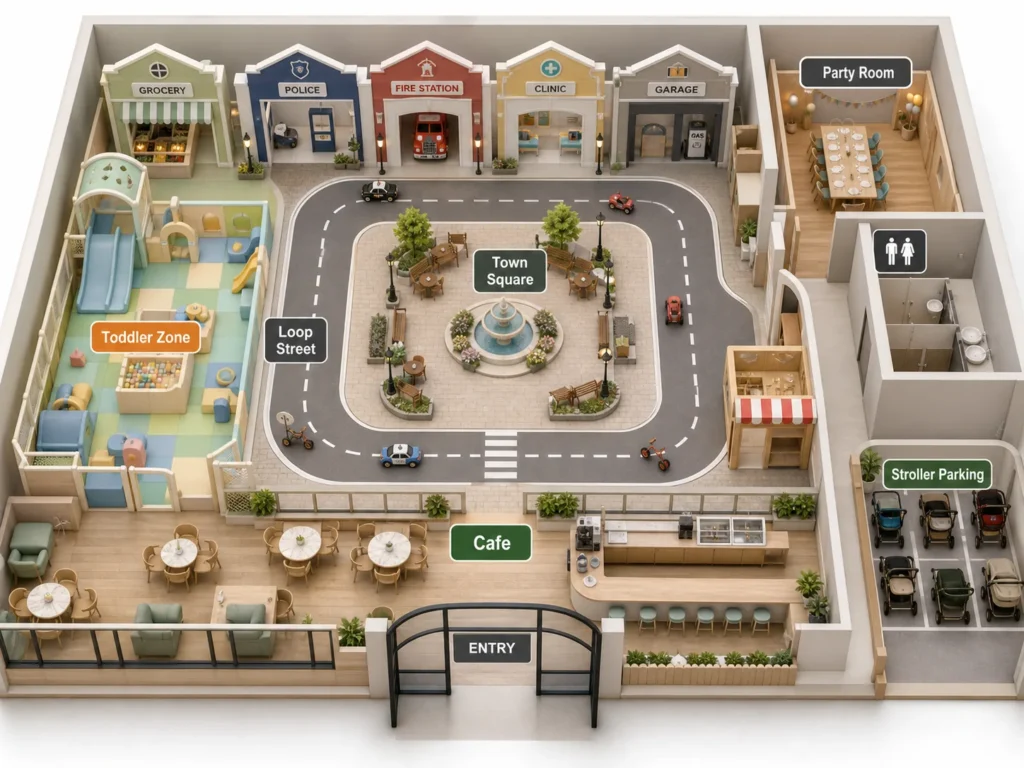
A play cafe or family entertainment center can look exciting on opening day and still struggle with repeat visits if children run out of things to do. Parents notice this quickly. If the play area feels like a generic soft play corner, families may come once, take a few photos, and then look for the next new venue.
That is why mini city indoor playground ideas are so useful for commercial projects. A mini city gives children a reason to return because the play changes every time: one visit they are a doctor, the next they run a supermarket, rescue a building, deliver mail, or act on a small stage.
This guide explains what a mini city indoor playground is, which storefronts work well, how much space you may need, and how to plan layout, safety, budget, branding, and supplier selection before you buy.
Why Read This Guide
Mini City Indoor Playground Ideas from a 10+ Year Playground Design Team
KoalaPlay has been working in the indoor playground industry for more than 10 years, helping play café owners, family entertainment centers, malls, and commercial kids’ spaces turn early ideas into real projects.
In this article, we share practical mini city indoor playground design ideas based on real project experience, including theme planning, layout thinking, role play zones, safety details, and how to make the space both fun for children and easier for operators to manage.
What Is a Mini City Indoor Playground?
A mini city indoor playground is a child-scale role-play environment designed like a small town. Instead of one large climbing structure only, it uses storefronts, streets, service counters, vehicles, signs, props, and soft play details to create a world children can enter.
Most mini city concepts are strongest for toddlers through about 8 years old. Younger children enjoy simple pretend actions such as shopping, cooking, caring for a plush pet, or driving a small bike along a road. Older preschool and early elementary children add rules, negotiation, jobs, teamwork, and storylines.
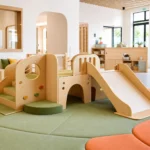
This is different from generic soft play. Soft play focuses mainly on movement: climbing, sliding, crawling, jumping, and balancing. A mini city adds social imagination and repeatable scenarios. The best venues combine both, so children can move their bodies and then slow down into role play.
Pretend play also supports learning. Early childhood educators often connect dramatic play with language, social interaction, problem solving, empathy, and self-regulation. In a commercial venue, that educational value becomes a business advantage because parents can understand why the play is more meaningful than simple entertainment.
Koalaplay often sees mini city zones work best when each storefront has one clear role, one strong interactive prop, and enough open space for children to play without blocking the route. The goal is not to fill every wall. The goal is to make the story easy to start.
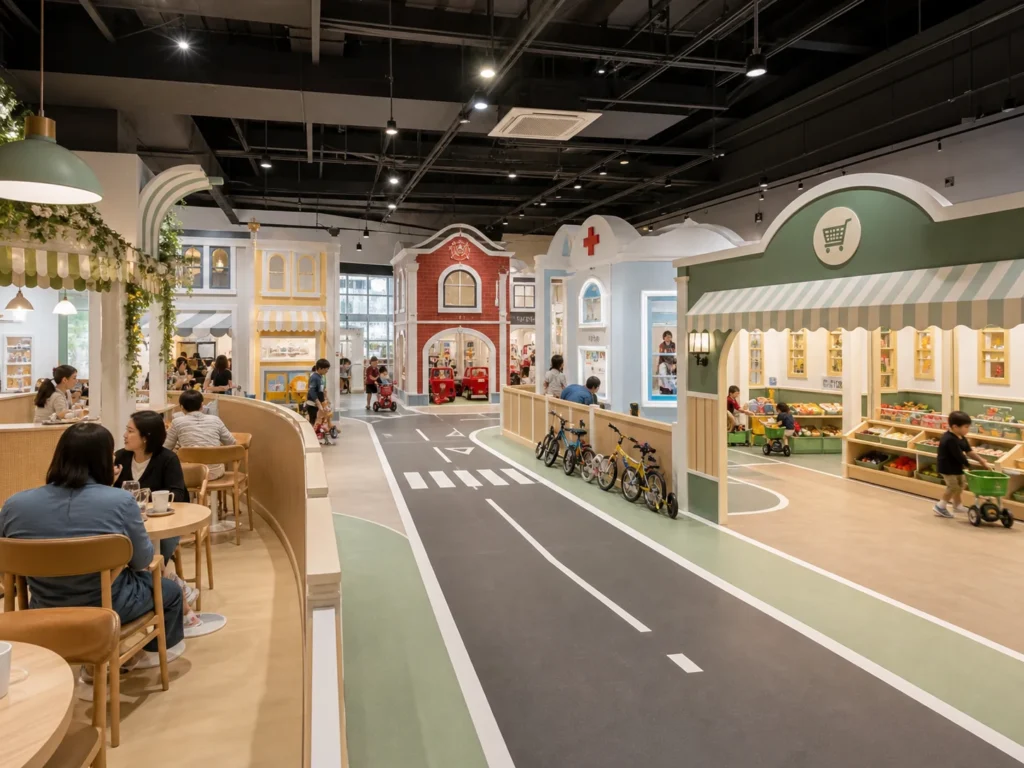
15+ Mini City Storefront and Theme Ideas
The best mini city indoor playground ideas balance familiar daily life with civic, adventure, learning, and creative themes. For a play cafe, choose fewer storefronts with richer props. For a large FEC, build a stronger street system with more destinations.
European Bakery Street
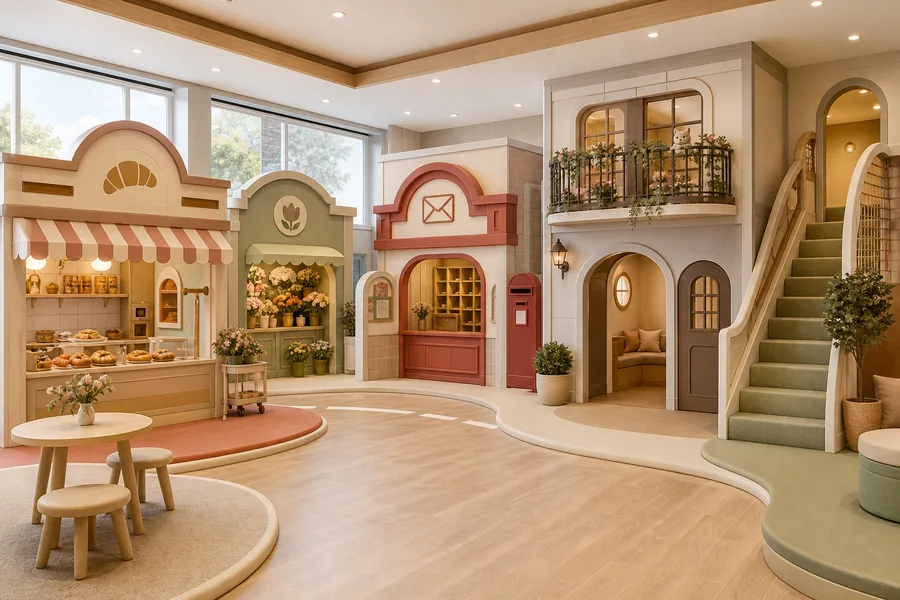
Design style: Warm European neighborhood street with bakery, florist, post office, apartment balcony, and arched stair corner.
Color set: Warm cream, muted sage, dusty rose, soft terracotta, honey oak.
Key play zones: Bakery counter, flower shop shelf, post office window, balcony role-play, small cafe table area.
Best for: Play cafes, boutique family clubs, compact commercial spaces needing a warm premium look.
Futuristic Skyport City
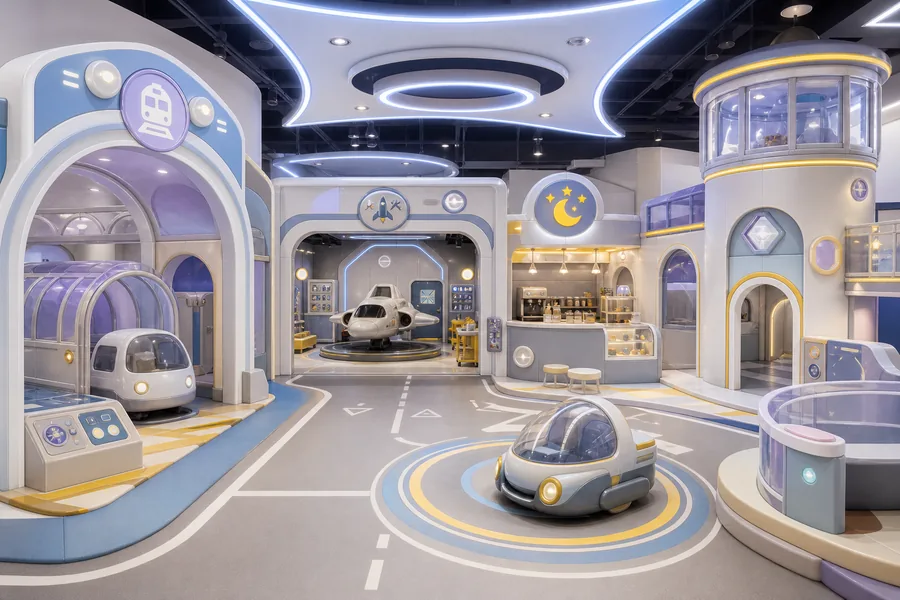
Design style: Soft sci-fi transit city with spaceport, capsule garage, observation tower, and moon-themed cafe.
Color set: Pearl white, mist blue, lavender gray, citrus yellow, brushed silver.
Key play zones: Transit station, pretend vehicle garage, control-panel wall, tower nook, open road loop.
Best for: Shopping mall play areas, STEM-themed family entertainment centers, brands wanting a modern signature scene.
Nordic Forest Village
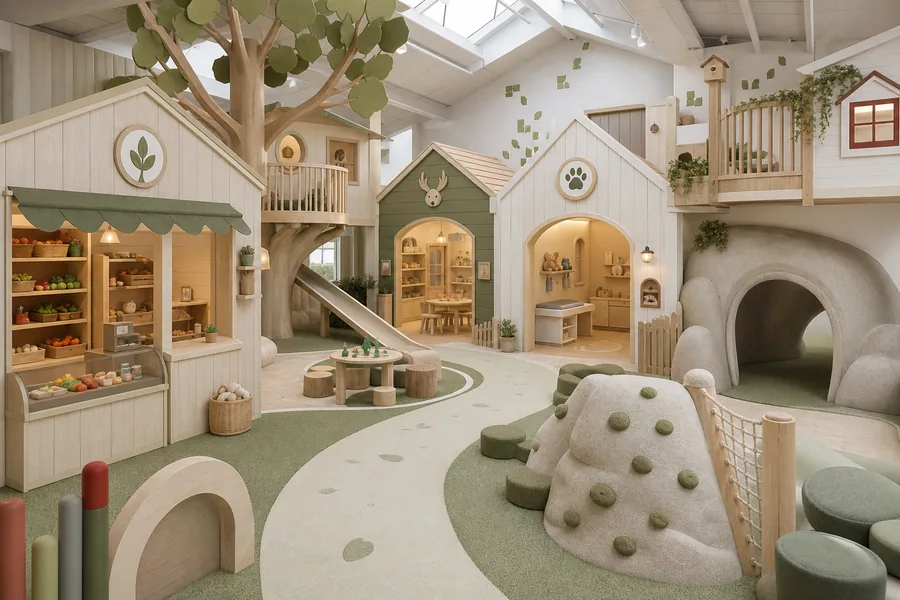
Design style: Scandinavian woodland village with treehouse, ranger station, grocery cabin, animal clinic, and soft cave tunnel.
Color set: Birch white, moss green, clay beige, mushroom gray, cranberry accent.
Key play zones: Ranger station, forest grocery, animal clinic, treehouse balcony, slide, padded cave.
Best for: Nature-themed play cafes, daycare spaces, early childhood centers, premium family lounges.
Mediterranean Coastal Town
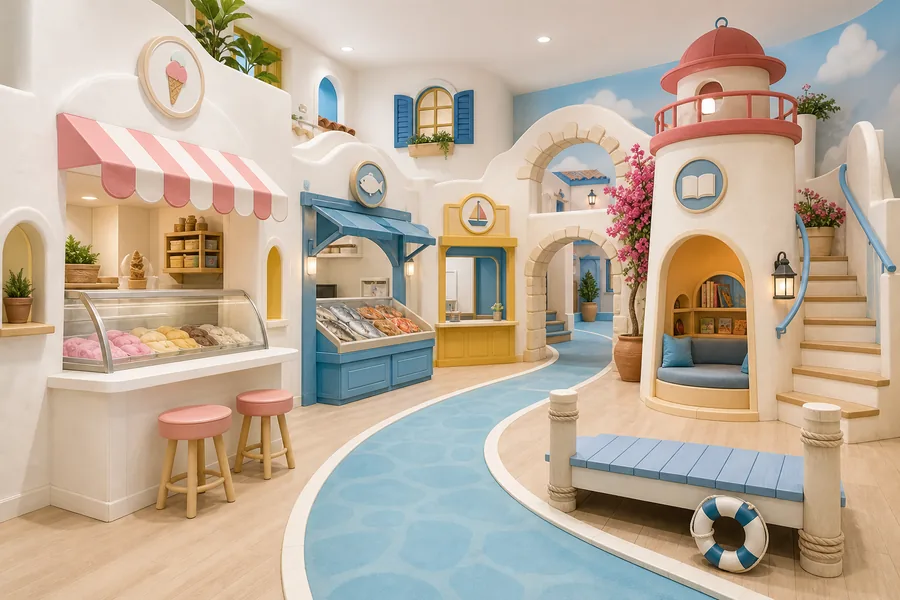
Sunny seaside mini town with lighthouse, gelato kiosk, fish-market counter, boat bench, and arched alley. With the color set: Chalk white, seafoam turquoise, lemon yellow, coral pink, sandy beige, cobalt accents.
Contact KoalaPlay for More Mini City Indoor Playground Design Ideas
You can also customize a one-of-a-kind mini city indoor playground based on your own style, theme, and business needs. KoalaPlay provides one-stop support from creative design to final installation.
Contact KoalaPlayEveryday Community Storefronts
Supermarket: Best for ages 2-8. Add baskets, food props, child-height shelves, barcode sounds, a small checkout, and restocking tasks. A kids supermarket role-play area is one of the easiest storefronts for children to understand.
Bakery: Best for ages 2-7. Use soft bread props, trays, a display counter, a pretend oven, and order cards. This works well near cafe seating because parents instantly understand the story.
Cafe or juice bar: Best for ages 3-8. Add menus, cups, a service window, pretend fruit, and simple order-taking. In a play cafe, this mirrors the real cafe and creates cute family photos.
Post office: Best for ages 3-8. Use mail slots, stamps, parcel shelves, and a delivery bag. Connect it to the whole mini city by giving children letters to deliver to other storefronts.
Bank: Best for ages 4-8. Keep it simple and positive: a counter, safe box, number cards, coins, and saving jars. Avoid complex money rules for younger children.
Care and Service Themes
Doctor or clinic: Best for ages 3-8. Add a check-in desk, soft exam bed, pretend stethoscope, height chart, x-ray graphics, and appointment cards. A hospital role-play playground is a strong anchor for a care-themed mini city.
Vet: Best for ages 3-8. Plush pets, grooming brushes, adoption cards, and a care checklist make this area gentle and emotionally engaging. A pet care center role-play area also photographs well.
Dentist: Best for ages 4-8. Use oversized toothbrushes, smiling tooth graphics, a chair, and a brushing game. Keep the visuals friendly so the theme reduces fear rather than creating it.
Salon or barber: Best for ages 3-8. Add mirrors made from safe acrylic, capes, pretend dryers, combs, and style cards. A salon storefront can also serve birthday parties because children enjoy dress-up moments.
Adventure and Civic Themes
Fire station: Best for ages 3-8. Use a small fire truck front, jackets, hoses, alarm buttons, and rescue mission cards. A fire station role-play area gives children a clear teamwork story.
Police station: Best for ages 4-8. Keep the tone civic and helpful: lost-and-found, traffic safety, community helpers, walkie-talkies, and simple road rules.
Construction site: Best for ages 3-8. Add soft bricks, foam tools, hard-hat props, crane graphics, and a build-and-rebuild wall. Construction pairs well with soft play because it can include crawling tunnels and low climbing details.
Looking for More Mini City Indoor Playground Designs?
KoalaPlay has hundreds of indoor playground design cases available for reference. Contact us to get more mini city theme ideas, layout examples, and project materials for your own play space.
Contact Us for More DesignsLearning and Creative Themes
School: Best for ages 3-8. Add a small chalkboard, teacher desk, alphabet cards, books, and classroom jobs. Keep it playful, not exam-like.
Theatre or stage: Best for ages 3-8. Use curtains, costumes, simple lighting, and a small audience bench. This is one of the most photo-shareable zones because families can record performances.
Science lab: Best for ages 5-8. Add color-mixing visuals, magnets, gears, measuring cups, safe oversized lab props, and discovery cards. This is a good fit for venues that want a STEAM education message.
Art studio: Best for ages 2-8. Use wipe-clean boards, color walls, rotating display frames, and pretend art tools if you do not want messy materials. If you allow real crafts, separate the area from soft play and plan cleaning carefully.
Connective Elements That Make It Feel Like a City
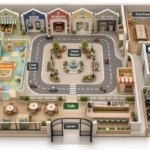
A mini city becomes more convincing when the spaces connect. Add a cycling road with parking, traffic signs, street lamps, a central town square, a small bus stop, and a simple map. These details give children a reason to move between storefronts.
Koalaplay’s mini city theme indoor playground page shows how storefronts can work as a complete commercial environment, not isolated playhouses.
How Much Space Do You Need?
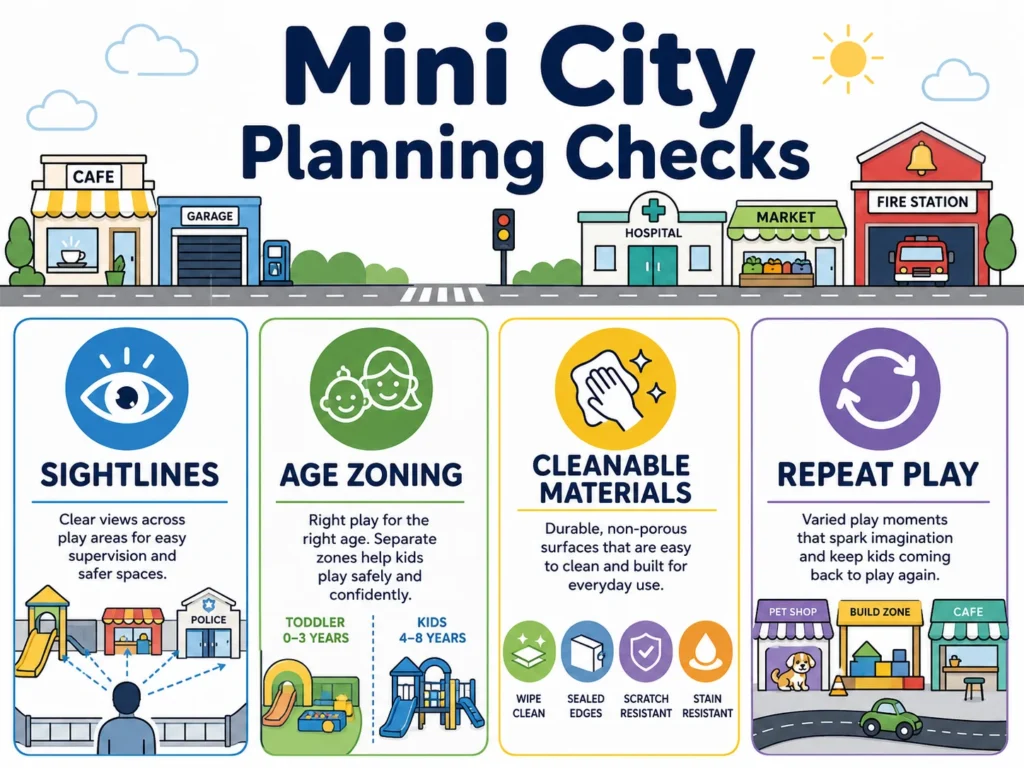
The most common buyer question is space. A practical mini city with 4-6 storefronts often works best in about 1,500-3,000 sq ft of play area, before adding cafe seating, back-of-house space, restrooms, reception, storage, and party rooms.
For a small play cafe, choose 3-4 compact storefronts and one movement feature, such as a small slide, ball pit, or toddler soft play island. Keep the road narrow but visible, and place seating where parents can watch.
For a larger FEC, use a loop street, central town square, 8-12 storefronts, birthday party connection, and one or two stronger active-play features. Avoid hidden corridors so parents and staff can supervise easily.
Plan area in layers: active play, role play, circulation, parent seating, stroller parking, lockers, entry control, restrooms, party rooms, storage, and cleaning access. Storefronts attract attention, but circulation and visibility decide whether the venue feels comfortable on a busy weekend.
Layout and Traffic Flow Best Practices
A mini city should feel like a town, not a row of disconnected boxes. A loop or street layout helps children move naturally and reduces crowding.
Use a central town square when space allows. It can support performances, birthday photos, traffic games, seasonal displays, and staff prop reset.
Age zoning matters. Toddlers need slower, lower, softer play near parents. Older children need role-play depth, movement, and missions. A low divider, color change, archway, or soft barrier is often enough.
Soft play integration adds physical value. A ball pit, low slide, crawl tunnel, mini climbing bridge, or small indoor play structure can sit beside the mini city. Koalaplay’s indoor playground equipment and role play zone categories can help you balance movement with pretend play.
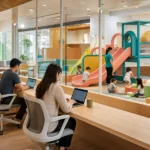
Keep the cafe within view. Parents choose play cafes partly because they can relax while watching. If sightlines are poor, cafe spend and dwell time can drop even when the playground looks beautiful.
Safety, Materials, and Compliance
Safety planning starts before production. Ask how the manufacturer handles rounded edges, padding, anti-slip flooring, pinch points, openings, entrapment risks, visibility, cleaning access, and fire-retardant materials.
Common materials include flame-retardant PVC or PU leather covers, EPE or high-density foam padding, galvanized steel or treated wood structures, safety netting, acrylic mirrors instead of glass, and washable surfaces. The specification should match use intensity, local code, budget, and destination market.
For international projects, buyers often reference ASTM F1918 for soft contained play equipment, ASTM F1487 for public playground equipment, and EN 1176 for playground equipment and surfacing. These standards do not replace local code review, but they help define the conversation with suppliers, landlords, inspectors, and insurers.
Cleanability is also safety. Mini city areas use many props, counters, handles, costumes, and seating surfaces. Choose wipeable materials, avoid deep crevices, and plan prop storage. For high-traffic venues, replaceable parts can be more valuable than hard-to-repair decoration.
Some venues also need sensory-friendly options. Softer lighting, lower sound effects, quiet corners, simple signage, and reduced visual clutter can make the playground more comfortable.
Koalaplay’s material quality page can support early procurement conversations around materials, testing, and manufacturing.
Theming and Branding That Drives Word-of-Mouth
Mini city design is not only decoration. It becomes a marketing engine when the theme is consistent, easy to photograph, and connected to the venue brand.
Use a clear design language: modern city, pastel village, forest town, coastal market, airport city, farm town, science city, or local neighborhood. Repeat colors, icons, uniforms, props, and signs across the zone.
Add Instagrammable moments, but make them useful. A town square clock, storefront sign, mini delivery van, birthday stage, mural wall, or “first day at work” photo spot can invite sharing without blocking play.
Parents often share what feels personal. A child pretending to be a baker, doctor, firefighter, or performer is more memorable than a wide equipment photo. This is why role-play zones can be strong for play cafes: the story belongs to the child.
Budget and ROI: What Affects Cost?
Mini city indoor playground costs vary widely. Price depends on site size, storefront count, materials, customization, soft play integration, lighting, flooring, shipping, installation support, local code requirements, and whether the project includes cafe fixtures or only play equipment.
Use ranges during early planning, not fake exact prices. A compact role-play corner sits in a different budget category from a large FEC mini city with custom facades, integrated slides, road systems, party rooms, and detailed props.
ROI comes from several revenue levers:
| Revenue lever | How a mini city helps |
|---|---|
| Entry fees | More perceived value than a simple open play corner |
| Birthday parties | Storefronts create themed activities and photo moments |
| Memberships | Children can repeat different roles on each visit |
| Cafe spend | Longer dwell time supports food and drink orders |
| Private events | Town square, stage, and themed rooms support packages |
| Merchandise or add-ons | Costumes, crafts, passports, and activity cards can become paid extras |
Role-play zones can increase dwell time because children build stories. They can also support repeat visits because the play is not finished after one slide or one climb. Still, the business case depends on staffing, prop reset, cleaning, party programming, and cafe quality.
Custom vs. Off-the-Shelf: How to Choose a Manufacturer
Off-the-shelf role-play units can work for small budgets, short timelines, or temporary concepts. They are easier to buy, but they may not fit your floor plan, brand, ceiling height, traffic flow, or target age range.
Custom mini city playgrounds are better when the venue is a serious commercial investment. Custom design can adapt dimensions, colors, themes, sightlines, entry control, age zones, and soft play integration to the actual building.
When choosing a manufacturer, ask:
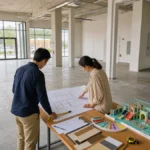
- Can you design from my floor plan, ceiling height, columns, doors, and fire exits?
- Can you show similar role-play or mini city projects?
- Which materials are used for padding, panels, flooring, nets, and props?
- Which standards or tests can you support for my destination market?
- What is included in design, production, shipping, installation guidance, and after-sales support?
- How are replacement parts handled after opening?
- What lead time should I expect from concept design to shipment?
For buyers still comparing play cafe formats, Koalaplay’s guide to types of play cafe can help clarify whether mini city role play should be the core attraction or one zone inside a broader concept. If you already have a floor plan, the Koalaplay service process explains how design, production, delivery, and support connect.
FAQ
How much space do I need for a mini city indoor playground?
A practical mini city with 4-6 storefronts often needs about 1,500-3,000 sq ft of play area. Smaller play cafes can use 3-4 compact storefronts, while larger FECs can add a loop street, town square, party room, and more active play.
What age range is best for a mini city playground?
Mini city playgrounds usually work best for toddlers through about 8 years old. Toddlers enjoy simple pretend actions, while older children add rules, teamwork, and longer storylines.
How much does a mini city indoor playground cost?
Cost depends on size, number of storefronts, materials, customization, soft play integration, shipping, and installation needs. Ask for a range during concept planning, then request a detailed quote after the floor plan and theme are confirmed.
Can I fit a mini city into a small play cafe?
Yes. Use fewer storefronts, combine functions, keep sightlines open, and choose one strong movement feature instead of many small attractions. A compact supermarket, clinic, cafe counter, and toddler soft play zone can already feel complete.
Which mini city storefronts are most popular?
Supermarket, clinic, fire station, bakery or cafe, pet care, salon, construction site, and theatre are popular because children understand the roles quickly and parents enjoy the photo moments.
How long does it take to build a custom mini city playground?
Timeline depends on design approval, production complexity, shipping route, site readiness, and installation method. Start by sharing your floor plan, target age range, budget range, country, and preferred opening date so the manufacturer can estimate a realistic schedule.
Plan Your Mini City Playground Project With Koalaplay
A good mini city is not just a set of cute storefronts. It is a commercial play system that needs the right theme, space plan, safety details, parent sightlines, cleaning logic, and repeat-play value.
Koalaplay designs and manufactures custom indoor playground and play cafe solutions for commercial family venues worldwide. If you are planning a mini city indoor playground, send your site size, floor plan, country, target age range, budget range, preferred theme, and installation needs. The Koalaplay team can help you evaluate the storefront mix, layout direction, material specification, and quote.



 English
 Spanish
 German