

When buyers source indoor playground equipment, they often hear phrases like “ASTM approved” or “ASTM certificate.” The problem is that these terms are frequently used too loosely. In commercial projects, that can create real risk because landlords, operators, schools, and investors do not only want a sales promise. They want evidence that the equipment was evaluated against a recognized safety standard.
In practice, ASTM certification for indoor playground equipment usually means a product has been tested or assessed against relevant ASTM safety standards, rather than receiving one universal certificate directly from ASTM itself. The smart buyer should verify which ASTM standard applies, whether the report matches the exact model, and whether additional third-party certification or local documentation is still needed.
What ASTM is and why it matters
ASTM International is a standards development organization. It publishes technical standards used by manufacturers, testing laboratories, engineers, and buyers to evaluate product safety and performance. In playground projects, ASTM standards help define issues such as openings, barriers, projections, use zones, and other injury-related risks.
| Term | What it usually means | What a buyer should request |
| ASTM standard | The technical rule set published by ASTM | The exact standard number, such as ASTM F1918-21 or ASTM F1487-25 |
| Test report | A lab document showing evaluation against listed clauses | Lab name, report number, model number, and result |
| Certification | A formal conformity program run by a third party | Scope, validity, and certificate owner |
| Supplier claim | A marketing statement | Evidence tied to the exact product being purchased |
The U.S. Consumer Product Safety Commission is especially useful here because it states there is no specific certification requirement for playground equipment, even though some products may still be subject to children’s product rules depending on classification. This is why many market conversations use “ASTM certificate” as shorthand for a wider compliance package rather than a single mandatory government document.
“There is no specific certification requirement for playground equipment.” — U.S. Consumer Product Safety Commission
Which ASTM standards matter for indoor playgrounds
A common mistake is assuming one ASTM standard covers every type of indoor play equipment. For commercial indoor playground projects, the two standards most often discussed are ASTM F1918 and ASTM F1487, but their scopes are different.
ASTM F1918-21 is the official specification for soft contained play equipment. It is highly relevant for many indoor playground structures that include padded elements, netted routes, enclosed climbing areas, tube slides, and other contained play features. ASTM says the standard is intended to reduce the potential for life-threatening and debilitating injuries.
ASTM F1487-25 covers playground equipment for public use and includes safety and performance standards plus dimensional requirements for clearance and use zones. However, ASTM F1487 specifically excludes soft contained play equipment, which is why indoor playground buyers should not rely on a one-standard answer.
| Standard | Official scope | Why it matters to buyers |
| ASTM F1918-21 | Soft contained play equipment | Relevant for many enclosed indoor play structures |
| ASTM F1487-25 | Playground equipment for public use | Important for broader public-use playground safety criteria |
| CPSC guidance | U.S. voluntary-standard and safety context | Helps buyers understand regulatory expectations in the U.S. market |
If you are still matching products to age groups and venue types, our guide to age-appropriate playground equipment is a practical starting point.
What an “ASTM certificate” usually includes
In real procurement, the phrase “ASTM certificate” usually refers to one of three things. It may mean a third-party lab test report, a supplier declaration that a model conforms to a named ASTM standard, or a more formal third-party certification program for certain public playground categories.
IPEMA explains that it offers a product certification program validating conformance to specified ASTM standards, and its listed program includes ASTM F1487-25. This shows why buyers should separate the standard itself from the evidence pathway used to support a claim.
Take Koalaplay for instance, the most credible marketing position is evidence-based and model-specific. According to the report pages supplied by the user, model KL-009 received a Pass result in a TÜV Rheinland / CCIC (Fujian) Co., Ltd., Xiamen Branch report, numbered CN26K866 001, against ASTM F1487-25 and ASTM F1918-21, with an issue date of 2026-04-03. The visible pages also show clause-level pass marks in areas such as openings, projections, barriers, slide sections, elevated structures, and soft-contained-play requirements. That is the right kind of proof to mention in marketing because it is specific, third-party, and tied to an identifiable product.
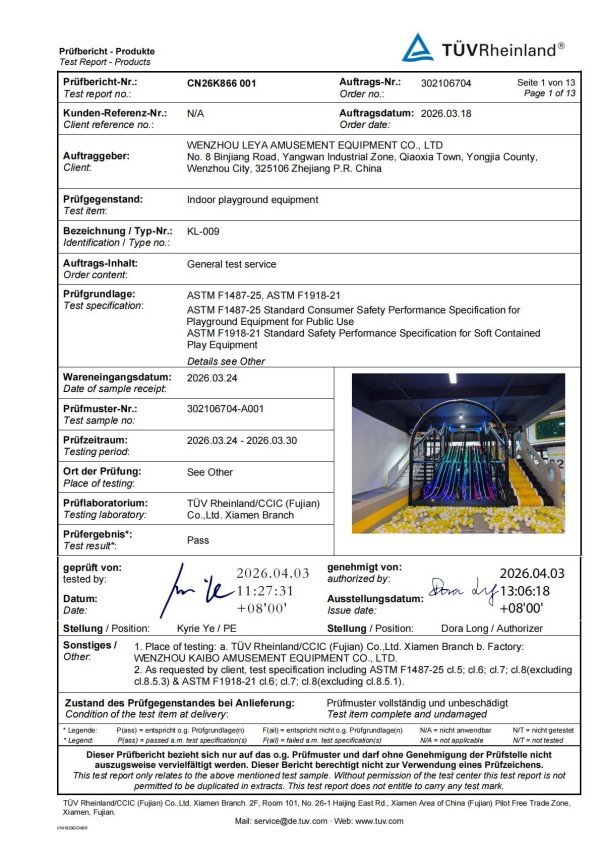
Verified Safety & Compliance Documentation
Access official third-party certification reports for Koalaplay equipment, including TÜV Rheinland testing and compliance with ASTM F1487, ASTM F1918, and EN standards.
These documents provide transparent, model-specific validation covering structural safety, soft containment systems, and material performance—ensuring your project meets international safety expectations.
Ask for the report to review detailed test results and compliance scope.
At the same time, good marketing must stay accurate. One report for one model should not be presented as a blanket promise for every custom layout or every product in a catalog. If a project changes size, components, age group, or structure, the buyer should ask whether the existing evidence still covers the delivered configuration.
If you are comparing concepts and package structures, Koalaplay’s indoor playground equipment solutions page gives a clearer overview of how commercial projects are usually grouped.
How much does ASTM certification cost?
There is no single universal ASTM certification fee for indoor playground equipment. ASTM mainly publishes the standards. What buyers actually pay for is a mix of document access, engineering interpretation, lab testing, possible retesting, and sometimes an optional certification pathway.
The public pricing that ASTM does show is only the cost of buying the standard text. At the time of research, the ASTM store lists ASTM F1487-25 at $131.00 and ASTM F1918-21 at $104.00. Those prices do not represent the total cost of compliance.
| Cost layer | What it covers | Practical meaning |
| Standard purchase | Buying the ASTM document | A small fixed cost compared with testing and project review |
| Design review | Mapping the product to the right clauses | Usually handled through engineering or supplier compliance work |
| Lab testing | Physical and dimensional evaluation | Quoted case by case based on product size and complexity |
| Retesting | Validation after modifications or failures | Often needed if the product changes materially |
| Optional certification | Program-based conformity route | Separate from basic test-report cost |
So the useful buyer question is not simply “What is the ASTM certificate price?” It is “What evidence package is required for my product, my market, and my venue approval process?” That question produces far better procurement decisions.
How valuable is ASTM-related compliance?
The value is high when the evidence is current, relevant, and correctly described. ASTM-related testing improves trust with landlords, partners, insurers, and serious buyers because it shows that safety claims were reviewed against recognized criteria rather than presented only as marketing language.
Its real value is not the phrase itself, but the traceability behind it. A buyer who receives the standard number, laboratory name, report number, model match, and issue date is in a much stronger position than a buyer who receives only a catalog statement saying “ASTM approved.”
If you are assessing commercial durability at the same time, Koalaplay’s material quality standards page is a useful companion resource.

What buyers should ask before accepting an ASTM claim
Before you rely on any supplier’s ASTM statement, verify the scope. Ask which ASTM standard applies, whether the report matches the exact model, whether the testing lab is clearly identified, and whether your local market requires any extra paperwork beyond ASTM-related evidence.
| Buyer question | Why it matters | Good evidence |
| Which ASTM standard applies? | Prevents scope confusion | A precise standard number |
| Does the report match this model? | Avoids overclaiming across a whole catalog | Same model number, size, and intended users |
| Who tested it? | Helps assess credibility | Named third-party lab and report number |
| Has the design changed? | Determines whether older evidence still fits | Updated review or retest if needed |
| Are local requirements different? | Prevents delays in approval | Market-specific documentation plan |
If your project is moving from sourcing into implementation, Koalaplay’s indoor playground installation checklist can help you connect compliance review with on-site execution.
Conclusion
For indoor playground equipment, ASTM should be understood as the technical basis for evaluation, not as a magic label. The right buying process is to identify the correct standard, verify the evidence against the exact product, and confirm whether your venue or market requires anything more than a third-party test report.
That is also the best way to use Koalaplay’s own supporting evidence. A model-specific TÜV Rheinland pass report is strong marketing support precisely because it is concrete and reviewable, not exaggerated.
If you are screening suppliers, planning a new play cafe, or preparing project documentation, Koalaplay can help you align equipment selection with a clearer compliance strategy. For project-specific support, you can contact the team through the Koalaplay contact page.
Frequently Asked Questions
Is ASTM certification mandatory for indoor playground equipment in the United States?
Not as one universal certificate. CPSC states there is no specific certification requirement for playground equipment, although some products may still involve other children’s product rules depending on classification.
What is the difference between ASTM F1487 and ASTM F1918?
ASTM F1487 covers playground equipment for public use, while ASTM F1918 covers soft contained play equipment. Indoor commercial projects often involve soft-contained structures, so buyers should confirm which scope actually applies.
Does ASTM itself issue the certificate?
Usually, buyers work with ASTM standards, third-party labs, and sometimes certification programs. ASTM publishes the standards, while conformity evidence often comes from testing reports or certification bodies.
How much does ASTM certification cost for an indoor playground?
There is no single fixed total price. The public ASTM prices cover document access only, while engineering review, testing, and optional certification are usually quoted separately.
Can one ASTM report cover every product from a supplier?
No responsible buyer should assume that. A report is strongest when it matches the exact model, configuration, age group, and scope being purchased.
What should I ask a supplier for?
Ask for the exact ASTM standard number, the lab name, the report number, the issue date, and confirmation that the delivered configuration matches the tested one.
References
[4] IPEMA. (n.d.). Certification Program. https://ipema.org/certifications/










 English
 Spanish
 German