
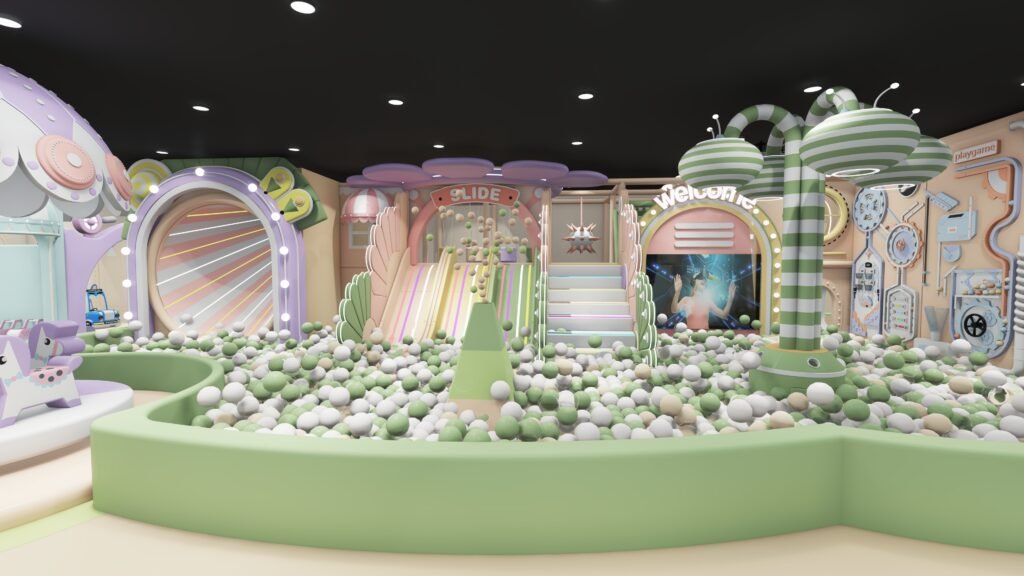
Planning to open an indoor playground, a play cafe, or a role play area? The first question almost every entrepreneur asks is the same: how much does indoor playground equipment actually cost?
The honest answer is — it depends. But vague answers don’t help you build a business plan. In this guide, the Koalaplay Team breaks down real equipment costs by type, venue size, and business model, and — critically — we cover the hidden costs that most suppliers won’t mention upfront. By the end, you’ll have a realistic budget framework you can actually use.
Indoor Playground Equipment Cost Range Table
Before we dive deep, here’s a snapshot of what to expect at different investment levels:
| Venue Type | Play Area Size | Equipment Cost (USD) |
|---|---|---|
| Small soft play / play cafe corner | 300–800 sq ft | $8,000–$30,000 |
| Mid-size play cafe | 800–1,500 sq ft | $30,000–$70,000 |
| Standalone indoor playground | 1,500–3,000 sq ft | $60,000–$150,000 |
| Large family entertainment center | 3,000+ sq ft | $150,000–$500,000+ |
| Role play area (pretend city) | 500–1,200 sq ft | $20,000–$80,000 |
These figures represent equipment only — not rent, fit-out, staffing, or permits. We’ll cover the full picture below.
What Drives Indoor Playground Equipment Pricing?
Understanding the cost levers helps you make smarter purchasing decisions rather than simply chasing the lowest quote.
1. Equipment Type and Complexity
Not all play equipment is priced the same. A basic soft play foam block set is fundamentally different — in both cost and engineering — from a multi-level themed climbing structure or a custom role play village. Here’s how the main equipment categories stack up:
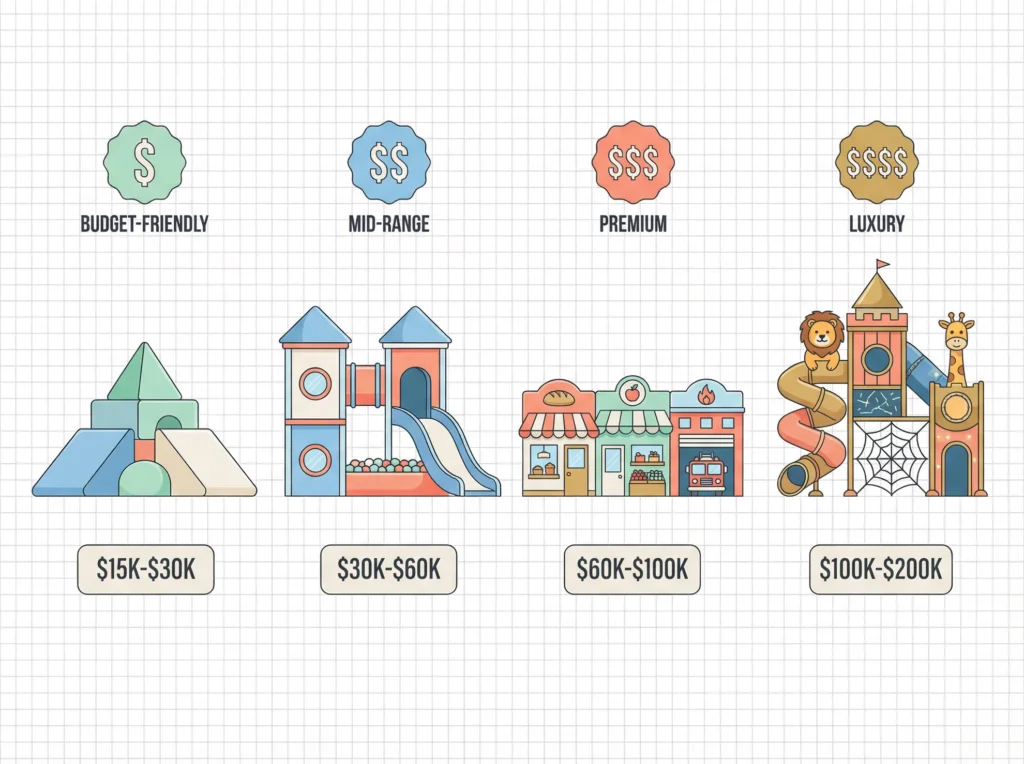
Soft Play Equipment (foam shapes, ball pits, toddler climbing sets) is the most accessible entry point. A well-specified soft play package for a 500 sq ft area typically runs $8,000–$25,000, depending on the density of pieces and whether custom colors or branding are involved. These pieces are modular, easy to ship, and straightforward to install — which keeps costs down.
Multi-Level Play Structures (tunnels, slides, climbing nets, ball cannons) represent the classic indoor playground format. A commercial-grade two-level structure for a 1,000–1,500 sq ft footprint generally costs $30,000–$80,000. The price scales with height, the number of play events (slides, bridges, interactive panels), and the structural steel specification required for your ceiling height.
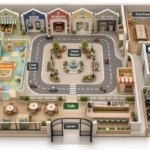
Role Play Areas — also called pretend cities, kids’ towns, or role play villages — are a growing premium category. These themed environments simulate real-world spaces (a bakery, a fire station, a hospital, a supermarket) and command higher prices because of the custom fabrication involved. A well-designed role play area of 600–1,000 sq ft typically costs $25,000–$80,000. If you’re exploring this format, Koalaplay’s role play area equipment page shows the range of what’s possible.
Fully Themed Playground Structures (jungle, ocean, space, candy themes with custom characters and 3D elements) sit at the top of the price range. These are destination-level investments, typically $100,000–$300,000+ for a complete themed environment. The value is in the visual impact that drives social media sharing and repeat visits.
2. Customization Level
Standard catalog equipment is cheaper than custom-designed pieces — that’s a universal truth. However, “custom” doesn’t always mean expensive. At Koalaplay, we offer customized design solutions that work within defined budget envelopes. The key is deciding early what needs to be custom (typically the hero pieces and entrance elements) versus what can be standard (secondary climbing nets, ball pit surrounds, soft play mats). A hybrid approach can deliver a premium look at a mid-range price.
3. Materials and Safety Certification
Commercial-grade equipment built to ASTM F1918 or EN1176 standards costs more than uncertified alternatives — and for good reason. The material specification matters enormously: galvanized steel frames with powder coating, LDPE plastic panels with UV stabilization, and PVC vinyl padding with fire-retardant treatment all add to the unit cost but dramatically extend the equipment’s service life and reduce your liability exposure.
When comparing quotes, always ask which certification standard the equipment meets. A $20,000 quote for uncertified equipment is not comparable to a $35,000 quote for CE-certified, EN1176-compliant structures. Learn more about what to look for in material quality before making a decision.
4. Supplier Origin and Geography
The global indoor playground equipment market has three main manufacturing hubs, each with a very different price point:
| Supplier Region | Relative Cost | Quality Notes |
|---|---|---|
| China (reputable manufacturer) | Baseline (1×) | High quality when sourced from certified factories; requires due diligence |
| USA domestic manufacturer | ~3–4× | Higher labor costs; shorter lead times; easier warranty claims |
| European manufacturer | ~4–5× | Premium materials; strict EN1176 compliance; highest price point |
Most of the world’s commercial indoor playground equipment — including equipment used in the US, UK, Australia, and the Middle East — is manufactured in China. The key differentiator is not origin, but factory certification, quality control processes, and the supplier’s track record. [^4]
Play Cafe Equipment Costs: A Specific Breakdown
The play cafe format — a hybrid of a children’s play area and a parent-friendly cafe — has become one of the fastest-growing venue types globally. Because it combines two distinct fit-out categories, the cost structure is unique.
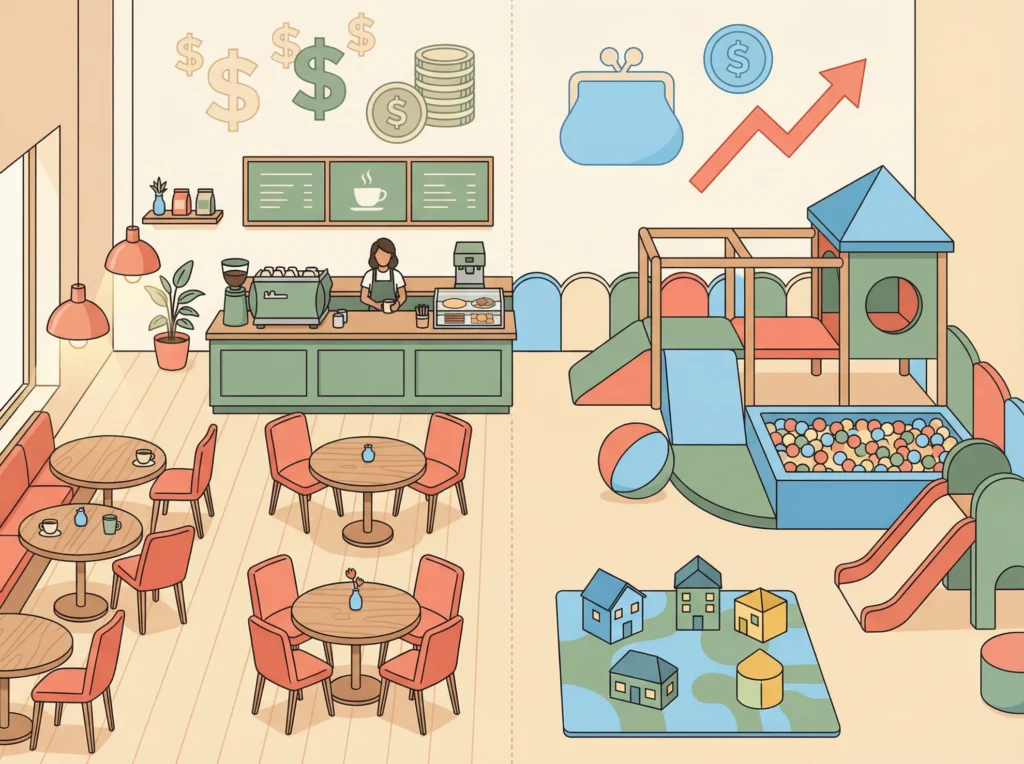
A typical play cafe has two cost centers:
Play Equipment Zone (the children’s area): For a 500–1,000 sq ft play zone inside a cafe, expect to budget $15,000–$50,000 for the play equipment itself. This typically includes a soft play structure, a toddler zone, a ball pit, and possibly a small role play corner. Koalaplay’s 1,000 sq ft play cafe equipment list is a useful reference for understanding what’s needed at different budget levels.
Cafe Fit-Out (the adult area): Commercial kitchen equipment, counter, seating, and decor typically add $10,000–$30,000 on top of the play equipment cost, depending on the level of finish and whether you’re doing full food service or just beverages and light snacks.
For a complete picture of play cafe startup investment, including a cost-to-start breakdown for 2025, see our dedicated guide: Cost to Start a Play Cafe 2026.
The Hidden Costs: What Your Quote Doesn’t Include
This is the section most supplier blogs skip. We’re including it because we believe informed buyers make better long-term partners.
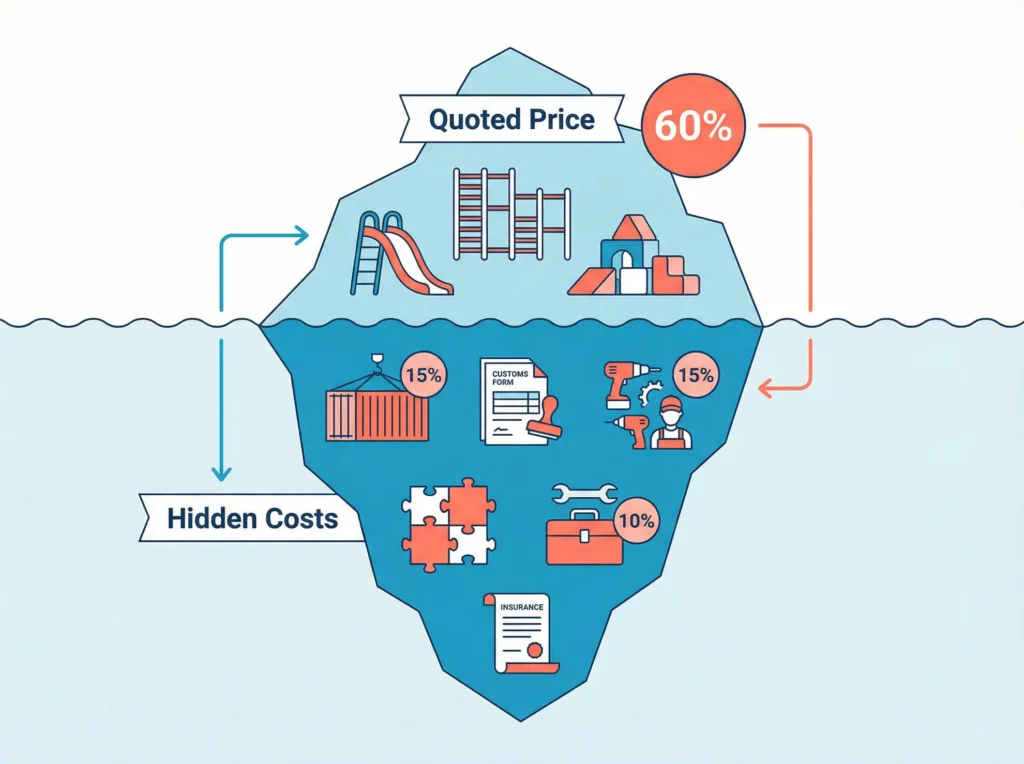
When you receive a quote from a manufacturer, the price typically reflects the equipment leaving the factory (EXW — Ex-Works) or loaded onto a ship (FOB — Free on Board). Neither of these is your true landed cost.
Shipping and Import Duties add approximately 15–20% to the equipment cost. This includes ocean freight, destination port handling charges, customs clearance, import duties (which vary by country and HS code), and inland trucking to your venue. In the US, import tariffs on Chinese-manufactured goods have fluctuated significantly; always confirm the current rate with a licensed customs broker before finalizing your budget.
Installation is frequently underestimated. The labor quote from your supplier covers the technicians’ daily rate — but you are typically responsible for flights, accommodation, meals, and any equipment rental (scaffolding, forklifts) required on-site. A realistic installation budget for a mid-size playground is $5,000–$15,000 beyond the quoted labor cost. Koalaplay’s indoor playground installation checklist walks through exactly what to prepare before the installation team arrives.
Site Preparation is a wildcard. If your floor isn’t perfectly level, if you need additional lighting above the structure, or if fire sprinkler heads need to be relocated, these are contractor costs that fall outside the equipment scope. Budget a contingency of $2,000–$8,000 for site prep depending on the condition of your space.
Annual Maintenance and Consumables are the ongoing cost that most first-time operators underestimate. High-traffic areas — slide exits, entry decks, ball pit surrounds — experience wear within 18–24 months. Ball pit balls need replacing at roughly 10% per year. Safety inspections are required annually in most jurisdictions. Budget approximately 8–12% of your equipment value per year for maintenance and consumables.
The practical rule: Take your equipment quote and add 30% to arrive at your realistic total project cost before rent, staffing, and marketing.
How to Get the Most Value for Your Budget
A higher budget doesn’t automatically mean a better outcome. Here are the strategies that consistently deliver the best return:
Prioritize the hero piece. The one structure that appears in every photo and every social media post should receive the largest share of your equipment budget. Everything else can be simpler. A striking entrance arch, a signature slide tower, or a beautifully detailed role play shopfront creates the visual identity of your venue.
Plan for modular expansion. Rather than trying to fill your entire space on day one, design your layout so that additional equipment can be added in Phase 2. This reduces your initial capital requirement and lets you invest in expansion once revenue is flowing. Koalaplay’s commercial playground equipment for sale includes modular components specifically designed for phased installation.
Invest in flooring. Playground flooring is the most-touched surface in your venue and one of the highest-impact safety investments. Rubber tiles, foam mats, and poured-in-place rubber each have different cost and performance profiles. Our playground flooring guide covers the options in detail.
Request a detailed BOM. A reputable supplier will provide a full Bill of Materials with material specifications, certifications, and dimensions. If a supplier is reluctant to share this, that’s a signal worth heeding.
Getting a Quote: What to Prepare
To receive an accurate quote from any manufacturer — including Koalaplay — you’ll need to provide:
- Floor plan or dimensions of your available space (length × width × ceiling height)
- Target age group (toddlers 0–3, children 3–10, or mixed)
- Venue type (play cafe, standalone FEC, mall kiosk, restaurant, hotel, daycare)
- Budget range (even a rough range helps the design team propose the right solution)
- Theme preferences (if any)
With this information, Koalaplay’s design team can prepare a preliminary layout and itemized quote, typically within 3–5 business days. Contact us here to start the conversation.
FAQ
How much does a small indoor playground cost to set up?
A small indoor playground in the 800–1,500 sq ft range typically requires $30,000–$70,000 for equipment, plus 30% for shipping, installation, and site prep, bringing the total to approximately $40,000–$90,000 before rent and staffing.
What is the cheapest type of indoor playground equipment?
Soft play foam equipment — blocks, shapes, and small climbing pieces — is the most affordable entry point, with packages starting around $5,000–$15,000 for a small toddler area. However, these pieces have a shorter commercial lifespan than steel-framed structures.
How much does a play cafe cost to open?
A play cafe combining a 500–1,000 sq ft play zone with a cafe fit-out typically requires $40,000–$100,000 in total setup costs (equipment + cafe fit-out + site prep), not including rent, permits, or working capital. See our full cost to start a play cafe guide for a detailed breakdown.
Is it cheaper to buy from China?
Equipment from reputable Chinese manufacturers is typically 3–4× less expensive than equivalent US-made equipment. The key is verifying certifications (CE, ASTM, EN1176), requesting factory audit reports, and working with a manufacturer that has a documented installation and after-sales process. Koalaplay ships to over 30 countries and provides full documentation for customs and certification purposes.
What ongoing costs should I budget for after opening?
Budget approximately 8–12% of your equipment value annually for maintenance, replacement parts, and consumables (ball pit balls, PVC vinyl repairs, safety padding). Additionally, factor in annual safety inspections, which are required in most markets.
How long does it take to recoup the investment?
Break-even timelines vary significantly by location, pricing model, and venue type. Play cafes with strong birthday party and membership revenue can reach break-even in 18–30 months. Larger standalone FECs typically take 3–5 years. Our guide on how to evaluate indoor playground profitability provides a framework for modeling your specific scenario.
Does Koalaplay provide installation support?
Yes. Koalaplay provides professional installation teams for international projects, as well as detailed installation manuals and video support for operators who prefer to use local contractors. Learn more on our service page.
Related Reading
- The Complete Guide to Play Cafes: Concept, Business Model, and Future Trends
- 8 Tips You Need to Know Before Starting a Play Cafe Business
- How to Start an Indoor Playground Business: A Practical In-Depth Guide
- Top 8 Popular Indoor Playground Themes in 2026
- Indoor Playground Business Launch Success 2025
References
ASTM International. ASTM F1918-22: Standard Safety Specification for Soft Contained Play Equipment. https://www.astm.org/f1918-22.html
European Committee for Standardization. EN 1176: Playground Equipment and Surfacing. https://www.en-standard.eu/csn-en-1176-1-playground-equipment-and-surfacing-part-1-general-safety-requirements-and-test-methods/
Grand View Research. Indoor Playground Market Size, Share & Trends Analysis Report, 2024–2030. https://www.grandviewresearch.com/industry-analysis/indoor-playground-market
IBISWorld. Indoor Playground Industry in the US — Market Research Report. https://www.ibisworld.com/united-states/market-research-reports/indoor-playground-industry/
 English
 Spanish
 German