
You’ve secured the lease, sketched the floor plan, and started talking to suppliers — and then it hits you: should you fill this space with soft play equipment, hard modular structures, or some combination of both? It’s not an aesthetic question. It’s a business decision that determines which customers walk through your door, how much you spend upfront, how long the equipment lasts, and whether kids ask to come back.
The wrong choice doesn’t just mean lower revenue. It can mean a space that’s too dangerous for your target age group, maintenance costs you didn’t plan for, or a venue that bores children after a single visit. Facility owners who get this right early avoid expensive retrofits 18 months in.
soft play equipment suits toddler-focused venues with tighter budgets and smaller spaces, while hard modular equipment fits high-traffic venues serving a wider age range and justifies a larger upfront investment. Most successful commercial venues today use a hybrid of both — and this guide will help you decide exactly what mix makes sense for your space, your audience, and your numbers.
What Is Soft Play Equipment?
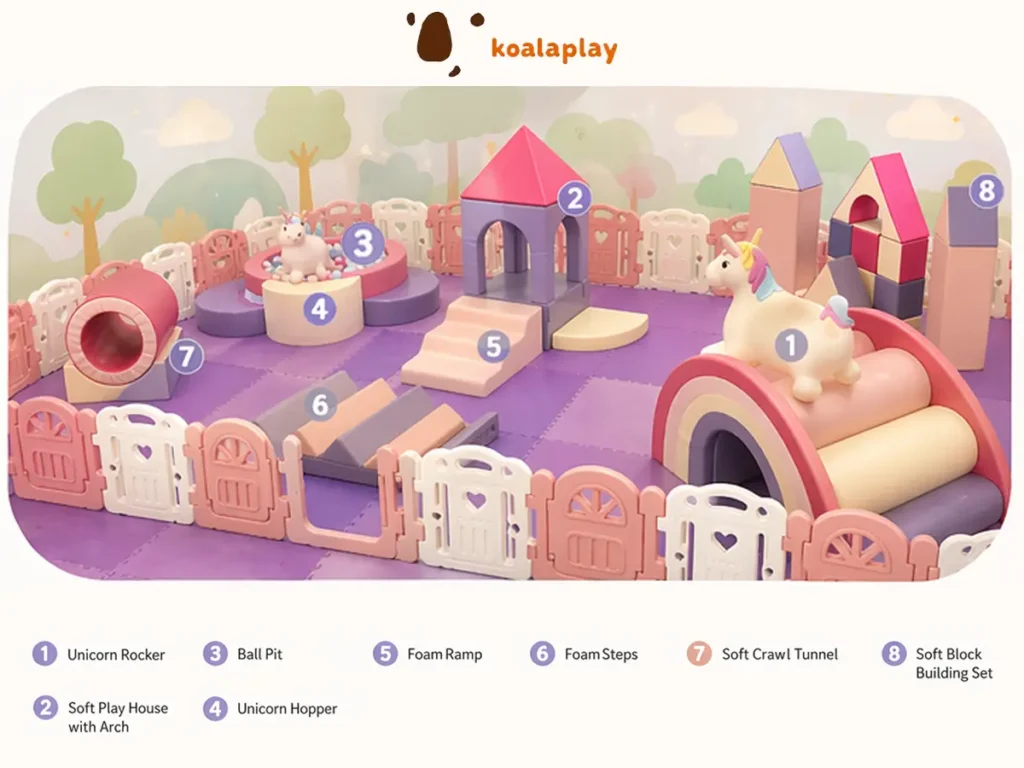
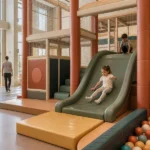
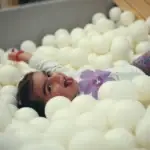
Soft play refers to play structures built from foam cores wrapped in PVC or similar padded materials. Think ball pits, foam climbing shapes, padded tunnels, soft rockers, and sensory play panels. The defining characteristic is that nearly every surface a child can fall on, bump into, or climb over is cushioned.
Soft play equipment is aimed primarily at children aged six months to around five years. The padded surfaces reduce the consequences of tumbles at a stage when children are still developing balance and coordination. For a café operator adding a play corner, or an operator opening a dedicated toddler play centre, soft play is the natural starting point.
Equipment in this category is also modular in a different way from hard play — pieces can often be rearranged, swapped out, or moved to a new location without specialist installation. That flexibility is valuable for venues that are still testing layouts or expect to evolve their offering.
What Is Hard Play Equipment?
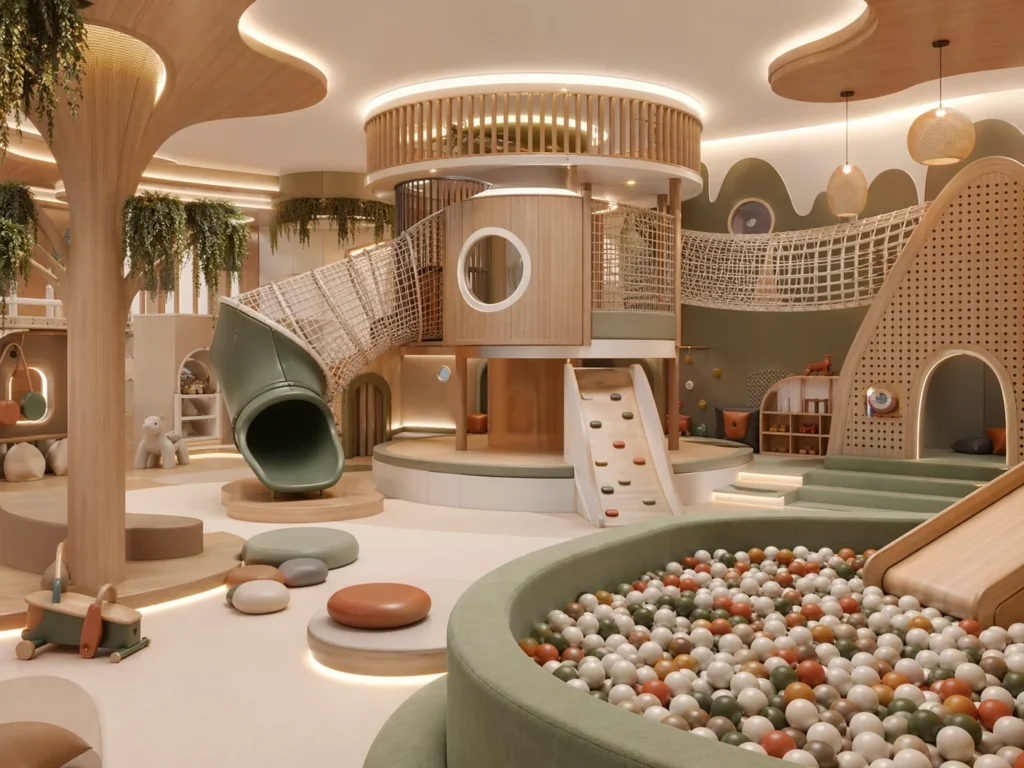
Hard play — sometimes called modular or structural play equipment — uses steel frames, HDPE plastic panels, fibreglass components, and engineered rope or net systems to create multi-level play structures. Think climbing frames, tube slides, rope bridges, elevated platforms, ball cannons, and adventure courses.
These structures are bolted to the floor, engineered for load-bearing, and designed for children roughly aged three to twelve. The harder materials mean they handle heavy-throughput use far better than foam — a commercial modular structure can accommodate thousands of visits per month without significant wear. That durability is the central argument for hard play in any high-traffic venue.
Hard play structures also create the kind of visual impact that drives social media shares and repeat visits from older children. They scale up naturally: you can start with a core structure and add climbing nets, slides, or themed elements over time as the business grows.
Age Range and Audience Fit
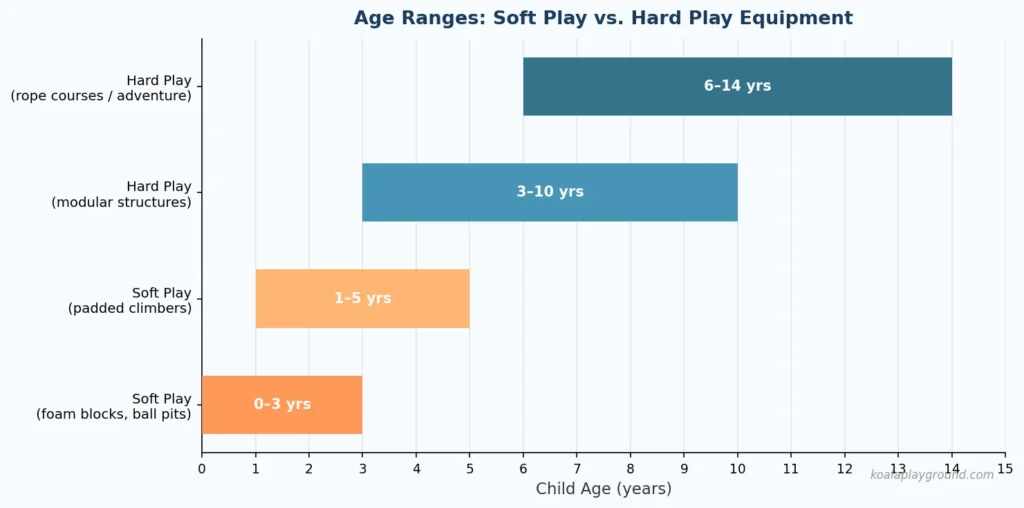
This is where most venue owners make their first mistake — buying equipment for the age range they wish to serve rather than the one their location and price point will actually attract.
Soft play equipment is designed for the six-months-to-five-years window. Below three, padded surfaces and low-height climbers are the only genuinely appropriate option. From three to five, children can use either type depending on the specific equipment — but soft play remains the lower-risk choice for this group.
Hard modular structures come into their own from about three years old for entry-level structures, scaling up to twelve and beyond for rope courses and adventure elements. Children in the five-to-ten range specifically gravitate toward structures with height, challenge, and speed — things soft play simply cannot deliver.
The practical implication: if your primary audience is parents with toddlers under three, a soft play setup covers your entire customer base. If you’re targeting the broader three-to-twelve range — the sweet spot for birthday party bookings, after-school sessions, and school holiday crowds — hard play or a hybrid is essential. Many operators investing in equipment for daycare centres or school programmes find that indoor playground equipment designed for younger children overlaps usefully with soft play, while hard structures handle the older cohort.
Costs Compared: What to Budget
Equipment costs for soft play vs. hard play equipment vary significantly by size, density of pieces, and level of customisation. Here are realistic ranges based on current market pricing for commercial-grade equipment:
Soft play equipment:
A small toddler zone (around 500 sq ft) with foam shapes, a ball pit, and padded climbers typically costs $8,000–$25,000 for the equipment. A mid-size soft play installation of 1,000–1,500 sq ft, with more varied pieces and some themed elements, runs $25,000–$60,000. Custom-branded or heavily themed soft play environments for larger spaces push toward $80,000–$120,000+.
Hard modular equipment:
Entry-level hard play structures for a 1,500 sq ft footprint run $50,000–$120,000. A full-scale modular playground with multi-level platforms, multiple slides, tunnels, and themed panels for a 3,000 sq ft venue is typically $120,000–$250,000. Premium themed builds with characters, integrated technology, or unique architectural elements exceed $300,000.
What these numbers don’t include: shipping, installation, safety surfacing under structures, and ongoing maintenance. Plan for those to add 25–35% to the equipment cost.
The full indoor playground equipment cost breakdown for 2026 is worth reading before you finalise a budget — it covers not just equipment but the full fit-out picture.
Safety Standards Both Types Must Meet
Safety standards are non-negotiable for commercial play venues, regardless of which type of equipment you install. The two dominant frameworks globally are:
EN 1176 — the European standard, widely adopted across Australia, the Middle East, Southeast Asia, and much of the world. It covers structural integrity, entrapment hazards, fall heights, and material safety. For soft play specifically, EN 1177 addresses impact-absorbing surfacing requirements.
ASTM F1918 and ASTM F1487 — the US and Canadian standards. ASTM F1918 specifically covers soft contained play equipment, while F1487 covers general playground structures. These are also widely referenced across North America and Latin America.
Both types of equipment — soft and hard — must meet whichever standard applies in your market. The difference is that soft play’s padded surfaces inherently reduce fall injury risk, while hard play compensates through engineered fall zones, compliant surfacing beneath structures, and load-rated anchoring.
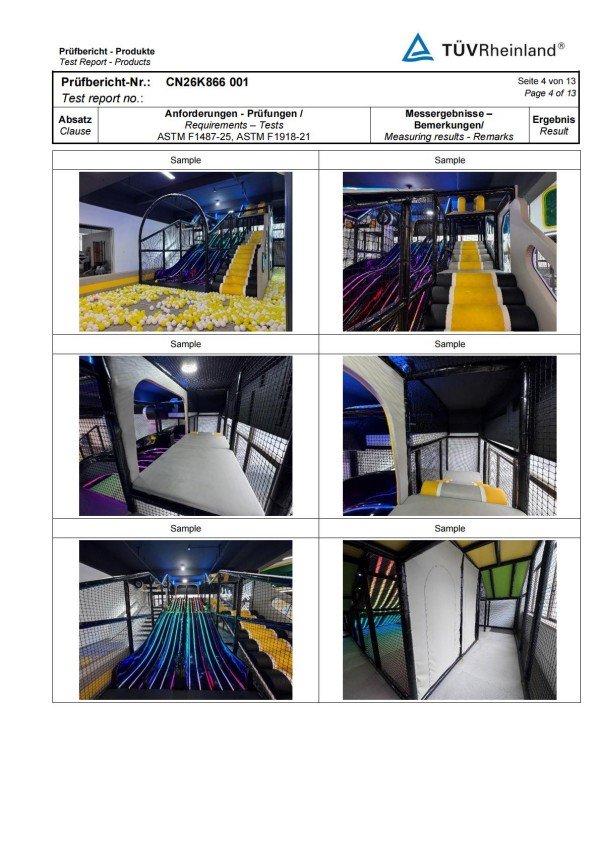
When sourcing equipment, ask every supplier for TUV, SGS, or equivalent third-party test reportsagainst the relevant standard for your region. Compliance protects your customers, satisfies insurance requirements, and is the baseline for any liability protection. At Koalaplay, all equipment is designed and tested against applicable international standards before it ships.
Maintenance and Durability
Maintenance is where the soft-play-versus-hard-play calculation often surprises operators.
Soft play equipment is straightforward to clean — foam surfaces wipe down quickly, and the absence of moving parts keeps mechanical failures low. The catch is that PVC covers and foam cores degrade over time, especially under commercial throughput. High-use soft play pieces may need cover replacement or foam refilling every three to five years. Budget for this in your operating costs.
Hard modular equipment has a higher initial outlay but lower ongoing maintenance in most respects. Steel frames and HDPE panels don’t compress or tear under normal use. Regular inspections, fastener checks, and occasional touch-up painting on steel components are the primary maintenance tasks. A well-specified hard structure from a reputable manufacturer can remain in service for ten to fifteen years.
The material quality behind commercial playground equipment — the difference between HDPE, steel grades, and foam densities — is worth understanding before you commit to a supplier. Cheaper materials across both categories increase long-term costs significantly.
Space Planning: Which Fits Your Venue?
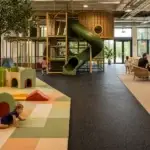
Soft play is more forgiving on space. A useful toddler soft play area can work in as little as 300–500 sq ft, making it practical for café play corners, childcare annexes, or smaller leisure venues. Heights are low — typically under two metres — so ceiling height is rarely a constraint.
Hard play structures need room: not just footprint, but height. A standard multi-level structure for ages three to ten requires a ceiling clearance of at least 3.5–4 metres, and the structure itself typically occupies 600–1,500 sq ft of floor space. You’ll also need a surrounding fall zone of at least 1.5 metres in every direction from any elevated component.
Space planning should also consider supervision. Hard play’s height and speed create more blind spots — venue layout needs to support sightlines for staff. Soft play’s lower profile makes supervision simpler, which can reduce staffing requirements in toddler-focused settings.
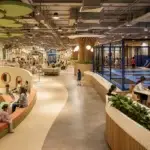
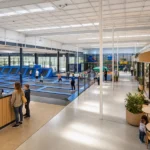
The way your equipment types connect spatially also affects traffic flow. Placing a soft play zone near the entrance creates a natural landing area for parents with young children while older kids move deeper into the venue. Explore the full range of indoor play features to see how different elements can be laid out across a floor plan.
The Hybrid Approach: The Smart Middle Ground
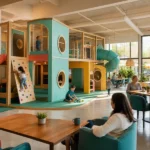
The venue model that consistently outperforms single-type setups is a well-designed hybrid — a soft play zone for under-fives alongside a modular hard play structure for the three-to-twelve age group. This isn’t just about covering more ages; it’s about extending dwell time, increasing average spend per visit, and building a venue that different family compositions can all use at once.
A parent with a two-year-old and an eight-year-old has a difficult time at a venue that only serves one of those children well. A venue that serves both children simultaneously becomes the default choice for that family every time.
Role play areas are a particularly strong addition to either soft or hard play environments. A role play zone — with themed areas like a supermarket, fire station, or kitchen — dramatically increases replay value by giving children something to do, not just somewhere to climb. Children revisit imaginative role play experiences in a way that pure climbing structures don’t sustain as well over multiple visits.
When planning a hybrid venue, also consider themed approaches that tie the soft and hard zones together visually. A cohesive theme across both equipment types creates a more immersive environment and stronger social media presence — which drives new customer acquisition.
Frequently Asked Questions
Can I start with soft play and add hard play equipment later?
Yes, and this is a common growth path. Many operators open with a soft play setup to manage initial costs, validate their audience, and build cash flow — then add a hard play structure one to two years in. The main consideration is planning your floor layout from the start to accommodate the eventual structure without needing to relocate existing soft play pieces.
Which type of equipment has higher revenue per square foot?
Hard play equipment typically generates higher revenue per square foot in high-traffic venues, because it accommodates more children simultaneously, attracts a wider age range (including the six-to-twelve bracket who are often the primary birthday party demographic), and justifies higher entry pricing. Soft play can match this in niche toddler-focused venues where the demographic is very specific and session-based pricing is used.
How do I know if my supplier’s soft play equipment is safety-compliant?
Ask for the test report, not just the certificate. Reputable suppliers can provide a third-party test report (TUV, SGS, or equivalent) that references the specific EN 1176, EN 1177, or ASTM standard your market requires. Check which edition of the standard the report covers — standards are updated periodically, and older certifications may not reflect current requirements.
What is the typical lifespan of commercial soft play vs. hard play equipment?
Commercial-grade soft play equipment lasts roughly five to eight years under heavy daily use before foam cores or PVC covers require significant replacement. Hard play modular structures, when properly maintained, typically last ten to fifteen years. In both cases, lifespan drops significantly with low-quality materials — this is where the cheapest quote often costs the most in the long run.
Do I need different safety surfacing under hard play structures?
Yes. Hard play structures with elevated components require impact-attenuating surfacing beneath them — rubber tiles, poured rubber, or equivalent materials certified to EN 1177 or ASTM F1292 for the relevant fall height. This is a separate cost from the structure itself and is often underestimated in initial budgets. Soft play foam surfaces are typically their own impact absorption — but check your supplier’s documentation for the specific rating.
Ready to Plan Your Venue?
Choosing between soft play and hard play equipment — or designing a hybrid — is a decision that shapes everything that follows: your fit-out costs, your target demographic, your staffing model, and the experience that keeps families coming back. Getting it right at the planning stage is far less expensive than retrofitting a layout that doesn’t work.
Koalaplay works with facility owners at the planning stage to match equipment type, floor layout, and theme to the specific space and audience you’re building for. Whether you’re opening a play café, a standalone indoor playground, or a multi-zone family entertainment centre, the right equipment mix starts with the right conversation.
Request a free venue consultation and quote at koalaplayground.com — share your floor plan and goals, and get a recommendation built around your actual numbers.
References
- What Is Soft Play Equipment? — Softplay.com
- Soft Play vs. Traditional Playgrounds: Pros and Cons — Pepper Play
- Soft Play vs. Modular Indoor Equipment: Which Suits You? — TopKidsPlay
- Do I Need Soft Play Or Indoor Playground Equipment? — House of Play
- Indoor Playground Safety Standards EN1176, ASTM F1487, TUV SGS — eLuckyPlay
- EN1176 vs ASTM: Understanding the Differences in Playground Safety Standards — Toy Maker in China Blog
- What Are EN1176 Regulations and Why Do They Matter for Soft Play Installations? — Softplay Solutions
- Indoor Playground Equipment Cost: Complete Price Guide 2026 — KoalaPlay
- How to Start a Commercial Indoor Playground — Dreamland Manufacturer
- Safety Standards for Indoor Playgrounds — KidsPlayPlus


 English
 Spanish
 German